

The young soldier died fighting for Britain, yet for over a century he did not appear on the country’s official list of war dead.
According to his family, Kesa Singh left his village in India — a British colony at the time — to fight in what is now Iraq during World War I. He never returned, and few details of his life and military service were known beyond the memories of his wife and two young sons.
That changed this summer, when Mr. Singh became one of nearly 10,000 Punjabi soldiers whom researchers identified as having died for Britain in that war without being recognized for it by the authorities — the result of bureaucratic failings that historians say reflected the views of colonial administrators toward non-British troops from its empire.
“These men served honestly, they died sadly, and they weren’t afforded the same treatment as the other men whom they served alongside,” said Amandeep Madra, a British historian and the chairman of the U.K. Punjab Heritage Association, who helped lead the research effort.
Half a million Punjabi soldiers took part in the grueling Mesopotamia campaign from 1914 to 1918, battling the Ottoman Turks to capture modern-day Iraq and its strategic oil fields for the British Empire. About 1.4 million soldiers from the Indian subcontinent served in the British Indian Army during the war.
For more than a century, the officials maintained careful casualty lists of British troops who were killed in the two world wars, more than a million in total. But the same efforts were not afforded to over 100,000 soldiers and other personnel who died for the crown but hailed from colonies, primarily in Asia and Africa.
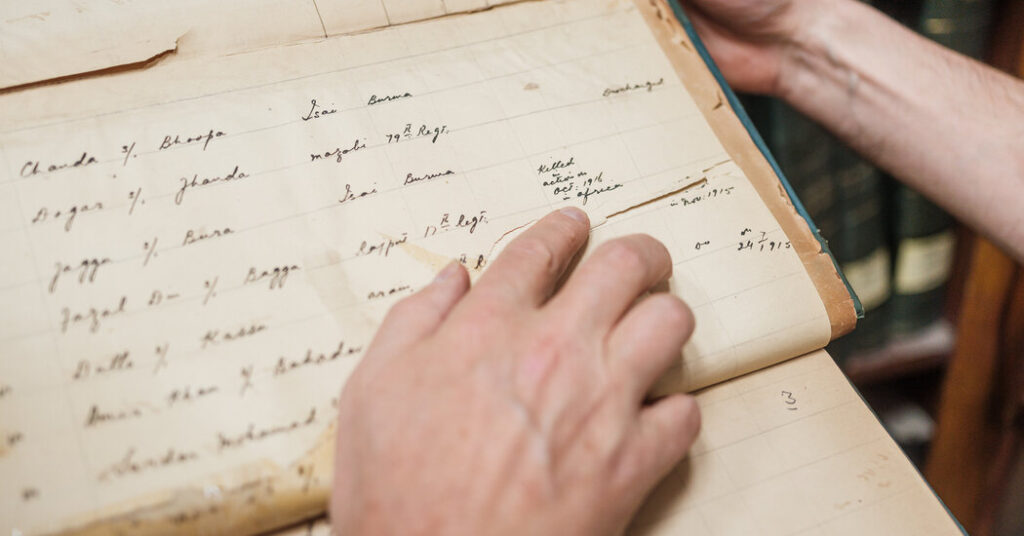
The handwritten names of the group of Punjabi soldiers were uncovered in archives at the Lahore Museum in Pakistan, which revealed their identities, hometowns and in some cases the circumstances of their deaths.
The discovery is the result of a yearslong effort by historians and the British authorities to address racial inequities in how the country has commemorated its war dead. The push comes amid a wider reckoning among British institutions with the legacies of the empire.
For the descendants of Kesa Singh, his recognition corrects an omission in the historical record.
“I feel a bit more complete,” said his great-grandson Dr. Inder Singh Palahey, a dentist from Leicester, England, who researched his ancestor’s fate for years without finding answers.
According to the newly unearthed records, Mr. Singh died from combat wounds sustained in Ottoman territory as he traveled home with his regiment. The records did not specify his age or date of death.
His omission stemmed from a combination of discriminatory attitudes and the practical challenges of record-keeping in a military conflict that spanned three continents, said George Hay, the official historian at the Commonwealth War Graves Commission, which was established in 1917 to list and commemorate the deaths of service members who fought for Britain in the two world wars.
Mr. Hay’s predecessors had tried to obtain the names of fallen Indian soldiers, he said, but they were rebuffed by colonial administrators who seemed incapable or unwilling to produce complete lists in the immediate aftermath of the war.
Another challenge was inconsistent rules for which deaths counted as war casualties. Unlike their British counterparts, Indian servicemen who died outside the conflict zone — including from injuries or disease sustained in combat — were not considered by the authorities to be worthy of commemoration, Mr. Hay said.
The lack of official recognition was partly because of prejudice and racism, an inquiry found in 2021.
The latest research effort began in 2014, when Mr. Madra learned of the archives in the Lahore Museum. With the help of archivists, historians at the University of Greenwich and volunteers at the Punjab heritage association, researchers were able to digitize the collection and cross-reference the list with the Commonwealth War Graves Commission’s records.
After screening for duplications, the researchers identified 9,909 soldiers from the historical Punjab state who died in World War I but did not appear on the official list.
After verifying the names, the commission added them to its register last month, the largest single update to its casualty record in 80 years. Mr. Hay said the commission would seek to place the names on some form of physical memorial.
The list also paved the way for descendants to conduct independent research. Dr. Singh Palahey learned that his great-grandfather had served in the 23rd Sikh Pioneers, a regiment that fought in the Mesopotamia campaign.
That detail could enable him to track down when the regiment was returning to India, offering an approximate date for his great-grandfather’s death. “That’s what I would like to find out,” he said. “It just adds more closure to the whole story for us, for our family history.”
The decision by the commission does not appear to entitle any descendants to claims of war pensions, which were distributed to families of deceased soldiers by the long defunct British Indian Government.
Uncovering further details about the fallen soldiers broadens the memory of the conflict in the popular imagination, Mr. Madra said.
“The world war was a world war, and there were people from all around the world fighting in it,” he said, “including people that looked like me.”