

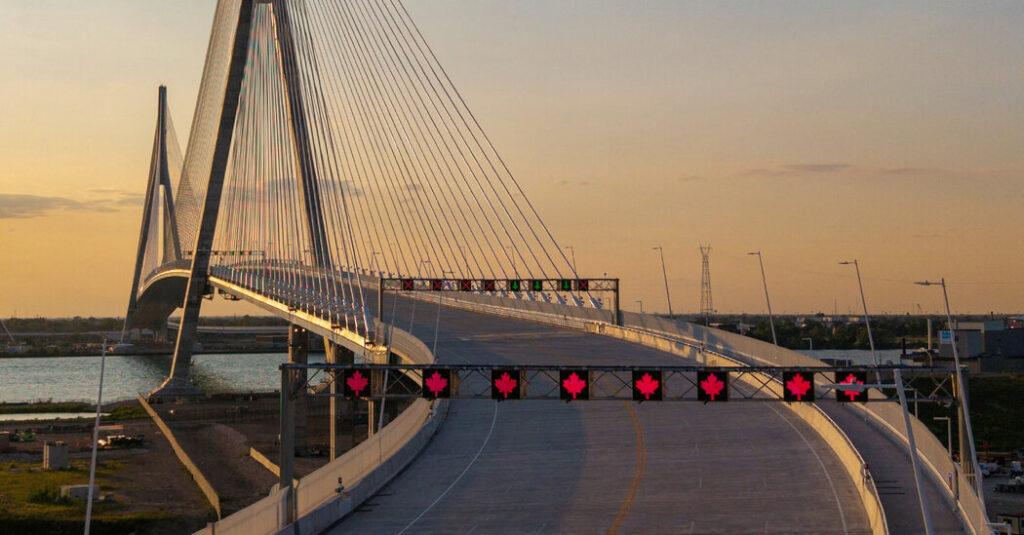
Some geographic trivia: Where are the only major border crossings in the 48 contiguous states where you head south to get to Canada? Answer: Detroit, where there are now three roadways to cross under or over the Detroit River. The latest connection, the Gordie Howe International Bridge, opened in late July after a weekslong delay caused by a Donald Trump temper tantrum.
The Gordie, named after the Canadian hockey legend who skated for the N.H.L.’s Detroit Red Wings for more than two decades, should represent the centuries-long ties between two traditionally friendly neighbors and two cities whose economies are closely linked. Instead, the president has made it part of his personal grudge match against Canada, one that includes new tariffs that will once again raise prices for American consumers and companies.
The Gordie is an impressive work: Its 2,799-foot main span is the longest of its kind in North America and designed to allow passage below it by large vessels. Its twin 722-foot towers are more than just concrete and steel. They’re designed to resemble the arc of a hockey stick swung for a slap shot, according to its architect, Erik Behrens.
Few towns are as hockey-mad as those the bridge connects, the Motor City and Windsor, Ontario. And while fans might debate the performance of the current Detroit Red Wings, there’s one thing uniting both sides: the legacy of Gordie Howe, a man who spanned the border long before the bridge named after him.
“Mr. Hockey” was born in 1928 in Floral, Saskatchewan, and spent 26 seasons in the National Hockey League, 25 with the Wings. An ambidextrous player, he racked up 801 goals and 1,850 points (records standing until another Canadian, Wayne Gretzky, came along). Surviving that long in a game famous for its raw physicality isn’t easy, but consider that the “Gordie Howe Hat Trick” was named for him: a goal, an assist and a fight in a single game. Howe regularly praised Detroit and the affection his fans showed him.
Ultimately, dementia claimed Mr. Hockey. But his memory remains bright among fans in Detroit and throughout Canada and, two years after his 2016 death, work began on what would become the Gordie. The project took longer than expected — don’t they all? — with overruns driving the cost to $4.5 billion. But major construction had been completed by last February, and its opening appeared to be on the horizon.
The Detroit-Windsor border is the busiest commercial land crossing between the two nations — Canada being one of America’s biggest trade partners, and the United States the largest for our northern neighbor. The older links, a tunnel and a bridge, were increasingly hard-pressed to handle the traffic. The auto industry, in particular, desperately sought a new bridge with additional customs booths and a more direct connection to Canada’s highway network. (The aging Ambassador Bridge requires trucks to traverse slow-moving streets.)
Where little could stop Gordie Howe on the ice, the bridge named for him was unexpectedly slammed into the boards by Mr. Trump. He declared the Gordie wouldn’t open until Canada “treats the United States with the Fairness and Respect that we deserve.”
Why target the Gordie Howe bridge? Mr. Trump doesn’t seem to be much of a hockey fan — though it would surprise no one if he proclaimed his abilities on the ice. What we know is he’s demanded Canada surrender sovereignty to become the 51st state. Failing that, he’s hammered our longstanding ally with tariffs on autos, auto parts, steel and other goods.
Reality doesn’t always matter for Mr. Trump. A closer look reveals that Canada gave the United States a sweetheart deal on the Gordie by funding the entire project. It would take about 50 years for Canada to be repaid through toll revenues.
Another bridge may have been on the president’s mind. Last winter, Commerce Secretary Howard Lutnick met with Matthew Moroun, whose family owns the Ambassador Bridge. The old span had, for nearly a century, a near monopoly on truck traffic. But it’s widely expected the Morouns will lose revenues to the new span, where drivers will pay less in tolls than they do on the Ambassador. Surely there could be no connection between the delay and the fact that Mr. Moroun donated $1 million to the MAGA Inc. super PAC in January.
Under intense pressure from Democrats, as well as the auto industry, Mr. Trump pulled another TACO. To save face he announced his usual deal, insisting, “We changed the terms” and “America now gets 50 percent of the Profit.” In reality, Gregor Robertson, Canada’s housing and infrastructure minister, told reporters, “We don’t anticipate that being very much given all of the costs at the front end with this bridge in the initial years of operating.”
Trump’s comments about the new deal came just days after he said on social media he would impose tariffs to punish Canada for the audacity of allowing wildfire smoke to cross the border.
Canadians are slow to get worked up about anything but hockey. This time, they disinvited America from a party to mark the bridge opening. The best we could do was send Gov. Gretchen Whitmer of Michigan across the span in a Mustang convertible. Nobody would be surprised if Canadians make it their preferred route in and out of the United States.
That is, if they continue to visit the United States. Many Canadians have stopped drinking U.S. booze, switched to foreign alternatives for other products, such as meat and dairy, and resisted travel to their neighbor. In a recent study, the Canadian government found its citizens made 7.1 million fewer visits to the United States last year than they did in 2024, a roughly 25 percent decline. Related spending dropped more than $2 billion, to around $13 billion, a 15 percent decline.
The Gordie Howe International Bridge should be a shiny, binational buckle along the world’s longest international border, and a monument to a great Canadian who loved Detroit. Sadly, Mr. Trump’s attacks against Gordie Howe’s homeland have now given Canadians less of a reason to take the bridge that honors him.
Paul A. Eisenstein publishes the website Headlight.News and The Car Collective on Substack.
The Times is committed to publishing a diversity of letters to the editor. We’d like to hear what you think about this or any of our articles. Here are some tips. And here’s our email: [email protected].
Follow the New York Times Opinion section on Facebook, Instagram, TikTok, Bluesky, WhatsApp and Threads.