

How far we get in our careers, we tend to believe, depends on us: our intelligence, our temperament, our hustle. But where we work and the support we get there matter immensely too. Does your company promote from within, or does it hire senior people from elsewhere? Does it spend real money on training and mentoring? Is it somewhere you’d want to stay for the long haul?
The age-old problem for job seekers is that, from the outside, it’s hard to know. Even if you land at a business with a great reputation, it might turn out that jobs in your particular department are dead ends.
So two nonprofits, the Burning Glass Institute and the Schultz Family Foundation, set out to uncover where the best jobs are. It analyzed the career histories of 12 million workers across 1,750 of the largest employers in the country from 2019 to 2024, pulling data from websites like LinkedIn and Glassdoor. It scored each occupation at each business on three factors: promotions (the likelihood of rising to a higher position internally within five years of starting the job), retention (the share of workers who stay at least three years), and salary.
The result is the most useful database I’ve seen for anyone considering a job in corporate America — a role-by-role guide to the amazing, the average, and the abysmal places to build a career. Most businesses have a huge range depending on the position. At the average company, there’s an 81-percentile point gap between its best- and worst-performing roles on promotions and retention. At Chanel, for example, fashion designers rank in the 97th percentile for retention among other fashion designing jobs across the country, while project management specialists rank in the 16th percentile.
It’s a gigantic repository, so I asked Burning Glass to narrow it down to six prominent tech occupations that a typical computer science major might pursue: software engineers, data scientists, software quality assurance analysts and testers, computer systems and security engineers, IT project managers, and IT systems analysts. The groupings are broad and based on the government’s occupational categories; the grouping for IT project managers includes product managers.
In the search bar below, start typing one of those six occupational groupings to see how people in that role fare at a bunch of marquee businesses. If you’re reading this on your phone, scroll to the right to see the percentiles for all three factors — promotion, retention, salary — or turn your phone sideways. Click or tap any column header to sort the results.
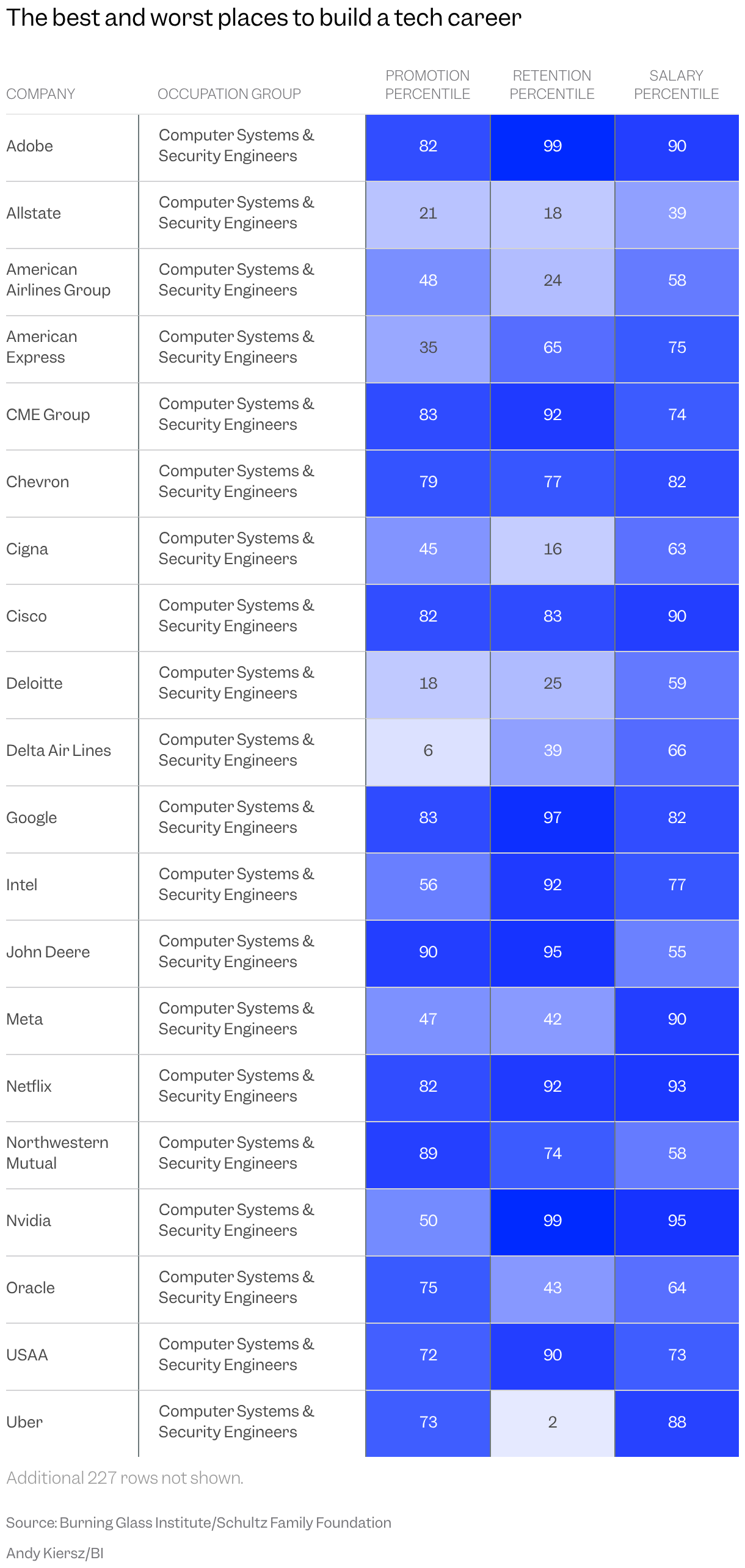
Across these roles, a few familiar tech companies emerge as the clear winners. Software is at the heart and soul of these companies, so it makes sense that they would treat the people building it exceptionally well. Two companies in particular stand out: Amazon and Salesforce. Tech workers at both get the whole package: top-of-market pay, fantastic opportunities for advancement, and jobs they tend to stick with. Take Salesforce’s software engineers: They rank in the 97th percentile for promotions, 98th for retention, and 96th for salary. It’s a win-win-win — one of the best jobs in America. Adobe, Google, and Microsoft also aren’t far behind.
Other tech giants also pay incredibly well, but the picture beyond pay is more mixed. Apple doesn’t offer that many promotions, but people tend to stay anyway. Uber is the opposite: Its workers move up at a decent clip, but the company struggles to hang on to them. Meta has a mediocre record on promotions, while retention varies wildly depending on the role.
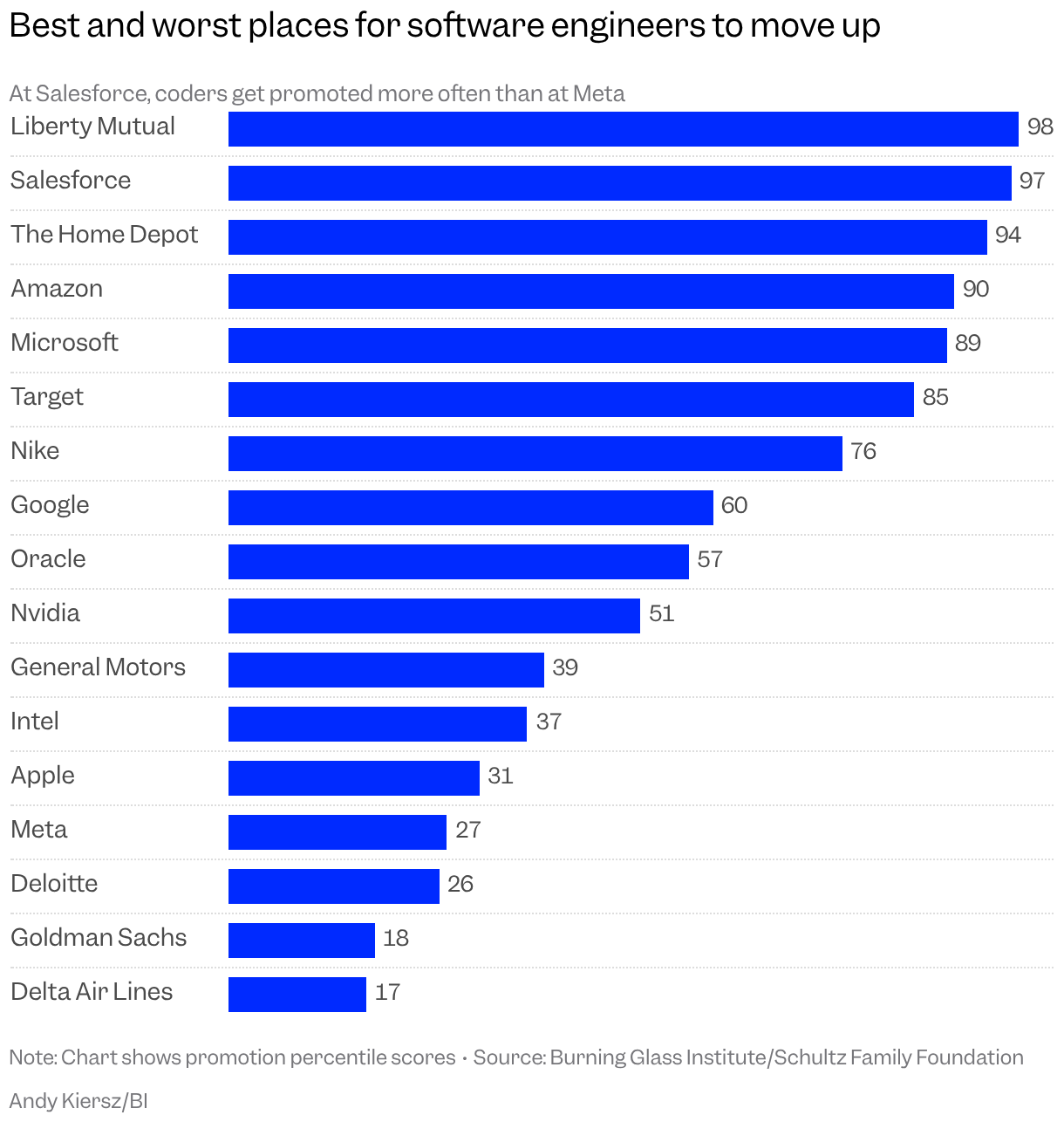
Outside of Silicon Valley, one of the best companies for tech roles is Liberty Mutual, which outperforms much of Big Tech on career advancement and longevity, even if its salaries don’t quite reach Valley levels. For example, software engineers there get promoted 3.7 times as often as those at Meta. USAA also stands out for how well their tech workers fare.
Once you look beyond the highest-paying employers, there are even more hidden gems across the economy. John Deere and Northwestern Mutual offer unusually strong advancement prospects and career longevity with middle-of-the-road salaries. In healthcare, people stay so long at the Mayo Clinic that both its IT project managers and systems analysts rank in the 99th percentile for retention, even though both jobs pay less than two-thirds of comparable roles elsewhere.
There are also far less appealing options for tech workers. At Goldman Sachs, software engineers are paid very well, but they see few opportunities to move up and tend to leave pretty quickly. Its data scientists fare poorly on advancement and retention too, without receiving the same premium in salary. At Deloitte, many technical roles appear to be a similarly bad deal: People don’t move up much and they don’t stick around for long.
These nuances matter a lot to tech workers today, even though they might not have worried about them as much in the past. Just a few years ago, everyone from coders to data scientists was in such high demand that, if their careers stalled at one employer, they could easily jump ship for a bigger title and more pay. That’s why tech workers were notorious for job-hopping every few years. When it was easy to leave, a weak internal career path wasn’t such a big deal.
We’re in a very different economy now. With hiring at a standstill and rolling layoffs becoming the norm, tech workers are longing for something that I rarely heard them talk about in the 2010s: stability. What so many want today is a steady home — a good employer that will keep them engaged and help them grow for many years. A lot of the young people I speak to say they’d take that over a higher salary or a flashy brand-name employer.
That might sound like a naive desire for a world that no longer exists: an era of corporate loyalty when employers took care of their employees. But Burning Glass’ analysis shows that the steady homes people want aren’t entirely a relic of the past. There are still great employers — or at the very least, great employers for particular jobs — if you know where to look.
Aki Ito is a chief correspondent at Business Insider.
Read the original article on Business Insider