

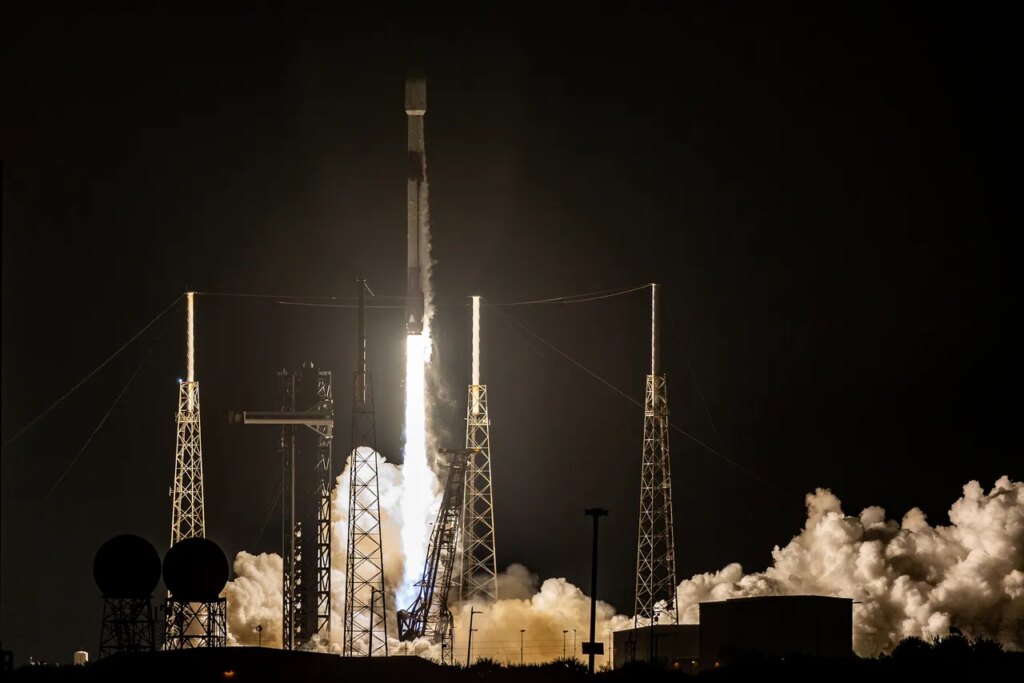
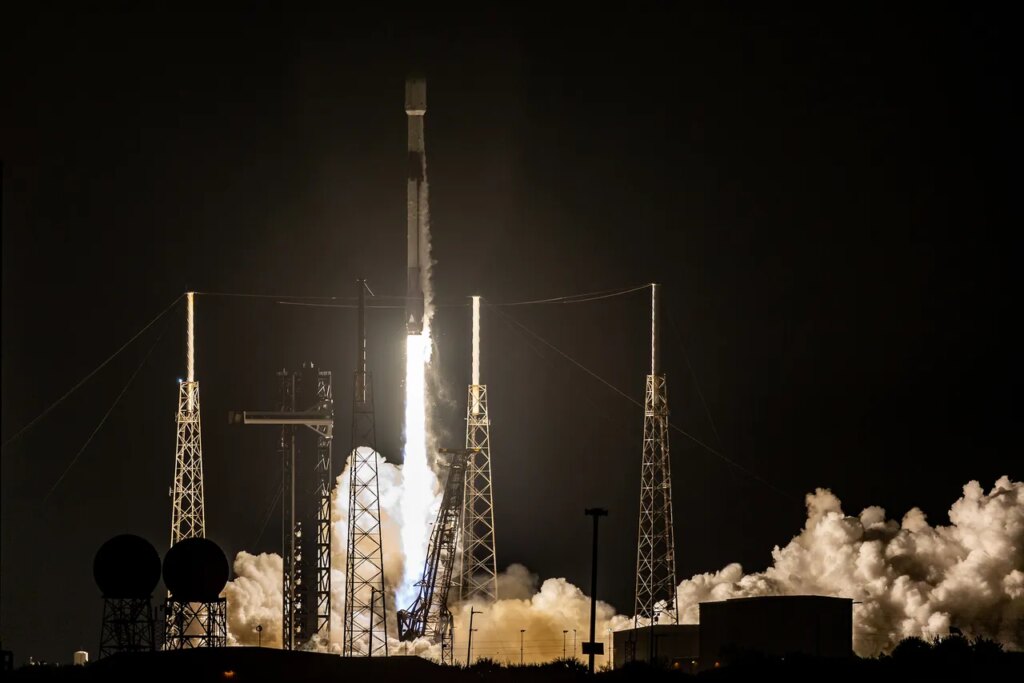
If you own a strong enough telescope, you might be able to witness history on Wednesday: A dead rocket is going to crash into the Moon.
On August 5, at around 6:34 am UTC, a spent SpaceX Falcon 9 upper stage is expected to hit the Moon’s sunlit western limb near Einstein crater at more than 5,400 mph. If it unfolds as predicted, the crash could throw up a plume of debris bright enough to briefly see from Earth with the right equipment.
That would be a first. No impact flash has ever been recorded on the sunlit face of the Moon, and that’s exactly where the Falcon 9 crash is forecast to happen, kicking up plumes of dust that could stand out against the blackness of space. The findings are based in part on two new preprint studies.
That includes one posted July 27 to arXiv and led by William Jo, a doctoral candidate at the University of Texas at Austin’s Cockrell School of Engineering, that forecasts just how big the impact could be. To predict the plume, Jo ran the crash through a high-resolution physics simulation that allowed him to model what would happen when 3,900 kilograms of hollow metal hit the lunar surface. That’s different from solid meteorites making impact.
“It’s like an empty eggshell, because it had all the fuel in it, and there is a rocket engine at one end that’s denser,” David Goldstein, an aerospace-engineering professor at UT Austin who supervised the work, says of the Falcon 9.
Rather than burrowing in like a cannonball, the shell will collapse from its edges inward, throwing up a broad, low curtain of soil spreading as far as 183 kilometers wide as well as a thin, faster spike nearly straight up. All told, the crash is forecast to displace about 12,700 kilograms of debris.
Jo describes the simulation as a “best-case” model. The code is two-dimensional and axisymmetric, so it can only simulate the stage coming straight down, engine-first, basically like dropping a pin on its head. But the real object—the spent stage of a Falcon 9 that carried two landers to the Moon in January 2025—is far more likely to arrive at an angle. A glancing strike would throw up a smaller, dimmer plume, possibly without the big spike.
“I would view our study as the most optimistic in terms of generating sprays,” Goldstein said.
It’s a detailed guess at the shape of the splash, but whether a plume will actually be visible from Earth is another matter.
Laurence Trafton, an astronomer at UT Austin, says it’s possible, but hard to know until the moment of impact. Size isn’t the problem: A plume reaching 50 kilometers past the limb would span about 28 arcseconds, astronomer-speak for an angle that’s roughly one‑sixtieth the apparent width of the Moon in the sky. At that size, “it can be easily resolved by a small telescope,” Trafton writes in an email.
The new paper provides an estimate of where exactly to train a telescope. But contrast in the night sky could be a confounding factor. The plume will be something like 30 to 300 times fainter than the blazing Moon beside it, and scattered moonlight will only make viewing harder. Catching it will require “a very steady mount,” Trafton says.
Timing will be on the observer’s side. The plume should peak about 90 seconds after impact, “long enough for an observer to witness,” Trafton says. Geography is not, at least depending on where you live.
The flash has to be caught at night. For anyone north of a line from Massachusetts to Texas, the Moon will hang so low that they’ll be peering through more than three times the usual thickness of atmosphere. That means viewers in those locations will be looking through a murky, turbulent slice of sky that could wash out any signs of the plume generated from the crash.
The best odds of seeing any lunar fireworks—or, more accurately, debrisworks—are in the US Southeast, according to Trafton.
Several scientists, including Bill Gray of Project Pluto who first flagged the impact, have laid out an observation plan urging professional and amateur astronomers to try to catch it.
While part of the appeal to amateur skygazers is simply to witness history, scientists have additional motives. Researchers have previously tried to glean information about the Moon by slamming objects into it. In 1999, NASA drove its Lunar Prospector probe into a crater hoping to kick up a sign of water. (The results were negative.) A 2009 NASA mission slammed a spent rocket into a similar south polar region, and that time, scientists did detect water ice in the plume.
More recently, a 2022 upper stage rocket barreled into Earth’s big satellite. It was widely billed as a Falcon 9 on a lunar collision course, but that turned out to be a likely case of mistaken identity: Gray and others said it was almost certainly a discarded Chinese booster instead.
That impact was unplanned as was this one. But the goal of monitoring next week’s collision is the same as the planned impacts of the past: Read the Moon by the mess it throws up.
That mess will help provide a preview of what could come in a more active era of lunar exploration. NASA wants astronauts back on the Moon within a few years and, eventually, it plans to build bases. China is also racing to put humans on the lunar surface. Every lander leaves spent hardware in orbit that has the potential to come down hard. The Falcon 9 crash is a chance to gauge just how hard and how wide the effects will spread.
“We’re going to be colonizing the moon apparently pretty soon,” Jo says. “Those particles that come out will be coming out at maybe 300, 400 meters per second… and moon rock is also very abrasive,” he adds, noting it could put astronauts in harm’s way.
Goldstein puts it in Apollo terms. “If you look at the old pictures of Neil and Buzz reentering the lunar module, you can see they were dirty—covered in dirt,” he says. “Dust control during lunar operations is going to be one of the biggest problems that’s faced.”
So set an alarm for the wee hours of Wednesday, aim a good telescope at the Moon’s bright edge, and hope the air holds still—and the clouds stay at bay.