
‘Smiling Friends’ Creators on Their Surprise Emmy Nom: ‘I’ve Never Won Anything. Like, Even at School’


“‘Smiling Friends’ is over!”
This line, uttered in the latest season of Zach Hadel and Michael Cusack’s mixed-media animated Adult Swim comedy “Smiling Friends,” became an unintentional premonition. The duo took to YouTube in February, months after Season 3 concluded, to announce that the show would not be coming back. Though it had previously been renewed for fourth and fifth seasons, the creators, citing burnout after years of hard work, shared that they’d release only two more already-completed bonus episodes in April.
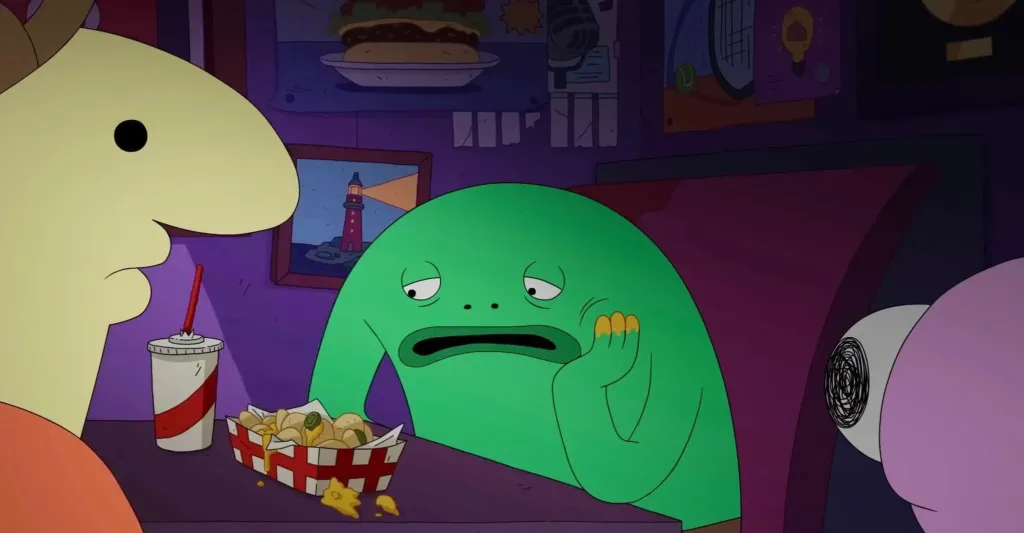
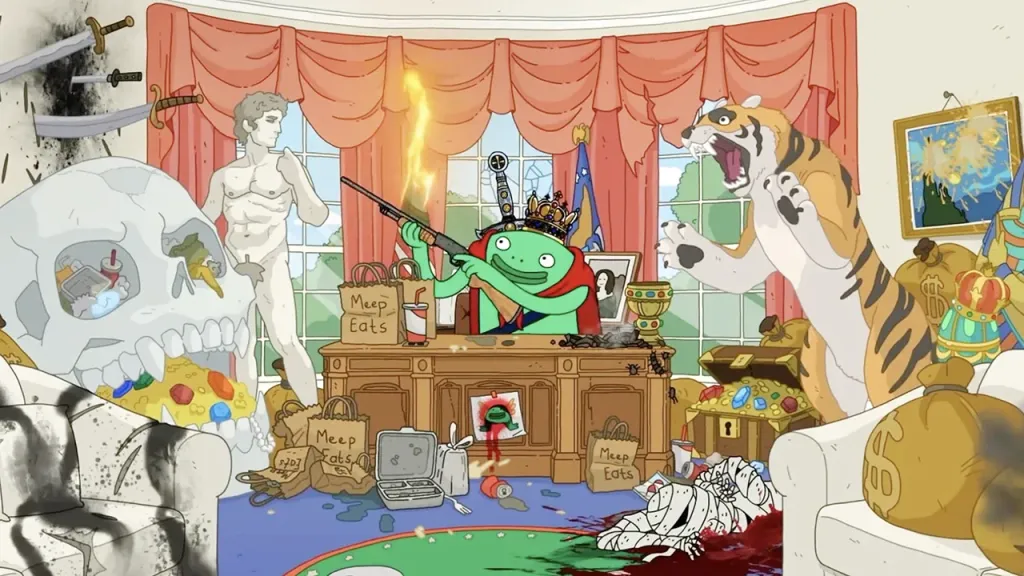
But the show, which had a meteoric rise in popularity after humble beginnings, scored its first Emmy nomination this year, finding itself among animated giants like “The Simpsons” and “South Park.” In the nominated episode, “Le Voyage Incroyable de Monsieur Grenouille,” “Smiling Friends’” agent of chaos, Mr. Frog, goes on a journey of enlightenment that reunites him with his father, played completely straight by a live-action Creed Bratton (“The Office”), shirtless and painted green, composited into an animated environment.
“Seeing our names up there with all those gigantic monoliths is kind of weird,” Hadel admitted. “We’re this little rinky-dinky tiny little thing, so that’s very cool.”
“It was completely unexpected, genuinely,” Cusack added. “I can’t speak for Zach, but I’ve never won anything. Like, even at school. Even to be nominated for something like this is very strange.”
You’ve done one Mr. Frog episode in each season, but this season’s is much more emotionally direct than most.
MICHAEL CUSACK: The motivation going into the episode was to play on the prestigious-television kind of tone. The joke behind it was that it was cinematic when Mr. Frog meets his father, and it’s emotional and, contrary to most of Smiling Friends, which is really quick and fast-paced, it gets really slow. That’s the joke, to us. I guess you could say it’s accidental Emmy bait.
ZACH HADEL: The very early stages of the show, we had it basically mapped out. It would be cool to see Mr. Frog go from a celebrity to gaining power, then becoming the president. So originally the third [Mr. Frog] episode was going to be him accruing power. But we’re like, what do you really do? We started talking about his family. That went through a few iterations. Once we hit on that dad scene with Creed, it was like, OK, this is interesting. We can sink our teeth into this. The way we storyboarded that scene was a whole different language. It was just fun to do a “Better Call Saul,” “Succession” prestige-TV thing.
This is an episode about Mr. Frog facing burnout, being on top of the mountain and saying, “I need to step away” — obviously in a much different way than how you did it. But was there a part of you that recognized this as a real feeling?
CUSACK: Definitely not consciously. If we were feeling burnout, it was probably just subconsciously going into the character, but I could also see that happening for Mr. Frog even if we were continuing. That wasn’t planned, but I could see subconscious elements maybe leaking through.
HADEL: I would say the most is we were thinking about it in terms of a trilogy. We had a Mr. Frog episode in Season 1, we had one in Season 2 and this felt like, OK, this is a nice wrap-up arc to the character. Even if we thought we were going to go on, there’s something about trilogies. For whatever reason, things work in threes.
Was there a moment when you guys really felt the show catching on? Was it when “The Simpsons” made a “Smiling Friends” joke?
HADEL: To be perfectly honest, of all the other adult shows that could have referenced us or taken a fun shot, I was surprised it was “The Simpsons.” I thought it was fake when I first saw it.
CUSACK: We were hoping for “Family Guy” at first because they seemed more likely. They always attack shows. And we were so ready to nuke them back.
HADEL: We were ready for “Family Guy.” We had a whole … in good fun, in good fun.
CUSACK: Oh no, I mean real nukes.
HADEL: [We’d] drop a real nuke on Seth MacFarlane’s house, the actual coordinates, the GPS.” [Laughs] But yeah, it was all of that. It’s just weird because it doesn’t happen all at once. I mean, even this Emmy thing is another element of that, where we’re still kind of like, oh my God. It still feels like this little intimate project that nobody should know about, as weird as that is to say.
Has it been rewarding to use this show to give other creators a platform for their voices on television?
CUSACK: We grew up watching that stuff, like YouTube. Obviously, we watched TV, too, but all these talented people didn’t have shows or anything. It worked perfectly to our benefit to be able to slot different people in for their different styles. I’m so proud of it looking back on it that we could have all those people involved.
Now that the show has ended, are you still looking to work with or help establish some of those creators?
HADEL: We’ll always be collaborative to some degree, but one of the reasons “Smiling Friends” is so intense is it’s doing a lot of things at once. It’s trying to be a mixed-media thing, it’s trying to be a fully frame-by-frame animated thing, it’s trying to work with multiple different creators, multiple different art styles. If we ever came back to that, I think it would just be “Smiling Friends.”
A version of this story first ran in the Down to the Wire Comedy issue of TheWrap’s awards magazine.