

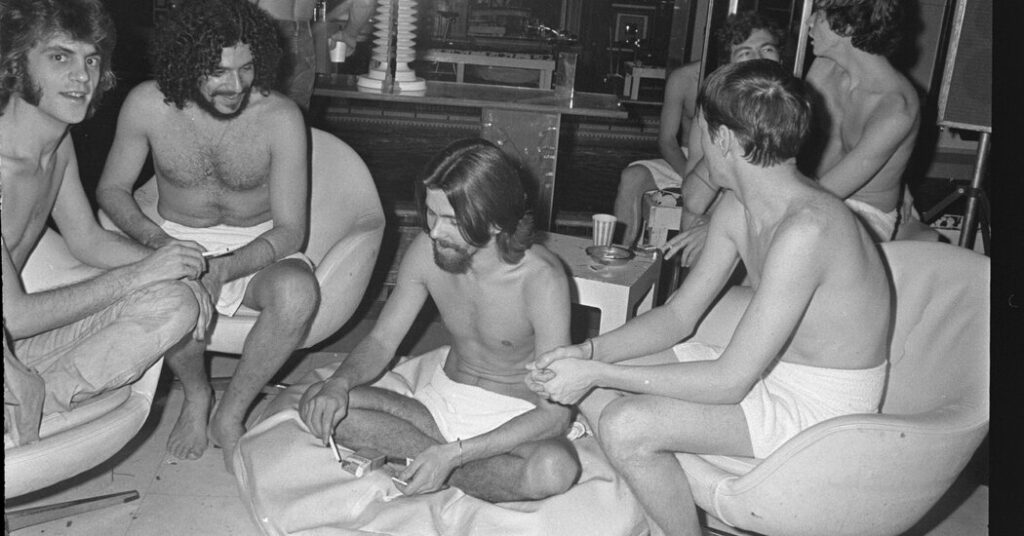
Before gay kickball leagues, “RuPaul’s Drag Race,” Grindr or even Stonewall, there was the steamy world of bathhouses.
Operating 24 hours a day, bathhouses were havens for gay men, where they could be entertained by the likes of Bette Midler and Barry Manilow, go for a swim and engage in sexual activity.
But at the height of the AIDS crisis some 40 years ago, public health officials in New York shuttered adult saunas and bathhouses to try to stop the spread of disease.
Now a group of gay state lawmakers are spearheading a push to bring back what they describe as vital cultural spaces.
“It’s 2026, not 1986,” said Tony Simone, a State Assembly sponsor of the bill whose district in Manhattan includes Chelsea and Hell’s Kitchen. “We have modern medicine and education. It’s ridiculous that this is legal in Florida, in Texas, but not in New York City.”
Public baths and spas are legal in New York, but the state’s health code prohibits those facilities from setting aside areas, like the private rooms available in bathhouses, “for the purpose of sexual activities where anal intercourse, vaginal intercourse or fellatio take place. Such facilities shall constitute a threat to the public health.”
Supporters of the bill contend that repealing that code follows the principles of harm reduction, which prioritizes providing safe environments and offering resources over banning a particular action.
“It is hard to make a case on the public health grounds from 40 years ago to say that this prohibition should still remain in place,” said Dr. Jessica Justman, an epidemiologist at the Columbia University Mailman School of Public Health who specializes in infections diseases and H.I.V. prevention. Not only has testing and treatment come a long way since then, Dr. Justman said, but the mainstream public health system’s approach has evolved to embrace harm reduction.
The effect of prohibitions must be weighed against the practicality of carrying them out, she said.
“Better to meet people where they are and work with them and help them take as many steps as they can to protect themselves,” she said.
Opponents questioned the necessity of repealing the health code, arguing that it did not serve health or moral interests.
“For the same reasons we oppose legalization of prostitution, we would oppose this,” said Dennis Poust, the executive director of the New York State Catholic Conference. “It contributes to just a cheapening of the gift of sexuality. It exploits people, and it is a serious public health threat in both cases,” he added, noting that H.I.V. is far from the only infection that can be sexually transmitted.
“I think society has done just fine without public bathhouses in New York City,” he said.
Earlier this year, Minneapolis became the latest city to repeal its prohibition on adult saunas, spurring the current proposal in New York.
State Senator Erik Bottcher, who is sponsoring the bill in the Senate, said the proposed legislation would require the State Department of Health to communicate rules and regulations to establish a public health framework to govern the use and operation of these spaces, “which is not something that exists now” at underground venues.
The earliest that the Legislature could act on the bill would be next year; lawmakers concluded their yearly session in June. It is not clear if Democratic legislative leaders support the proposal; representatives for the Assembly and Senate majorities did not respond to a request for comment on the legislation, nor did the governor’s office.
Representatives for Republican minority leadership in the State Legislature declined to comment.
Bruce Blakeman, the Republican nominee for governor of New York, offered some conditional support for the measure. “Provided the facilities are healthy and clean, I have no problem with consenting adults taking a bath together,” Mr. Blakeman, the Nassau County executive, said.
H.I.V. diagnoses in New York City have fallen significantly since the AIDS crisis, but there has been a slight uptick in recent years, centered in low-income neighborhoods and among Black and Latino men and women. The city reported 1,791 new cases in 2024, up 5.4 percent from 2023, and up 12.7 percent from 2022, when there were 1,589 reported cases.
State Health Department officials did not respond to a request for comment.
Bathhouses have existed since Roman times for both hygiene and as places of social gathering. Before the widespread availability of indoor plumbing, public and private bathhouses existed across New York City, and were used by all.
As indoor plumbing spread, however, the bathhouses began to serve another purpose.
“Before gay people had legal protection or safe gathering spaces, bathhouses provided greater privacy and physical security than the alternatives, which were streets, parks, restrooms and bars,” explained Ken Lustbader, the co-founder of the NYC LGBT Historic Sites Project.
By the 1920s, bathhouses like the Everard on 28th Street had gained a reputation as a gay oasis, and by the 1960s, gay bathhouse culture was so sufficiently established that proprietors began to see commercial opportunity. In 1968, the lavish Continental Baths opened in the basement of the Ansonia Hotel on West 73rd Street, touting a swimming pool, sauna rooms, a disco and a cabaret lounge complete with a baby grand piano, as well as many private rooms.
“I was at the baths all the time,” said Allen Roskoff, 76, a longtime leader of the gay liberation movement.
The baths, he said, were one of the first places that men of his generation and before found themselves and a sense of community.
“We were afraid, we lived in the closet,” he said. “Our parents disowned us, and all of a sudden, we had this exciting venue to start a new life. Everything was great until the AIDS crisis.”
The devastation of H.I.V., which has claimed the lives of over 100,000 people in New York City alone, endures to this day.
Even so, the decision to close the baths was a divisive one. The mayor at the time, Edward I. Koch, pushed to close the baths to stop the spread of the disease.
Others argued that closing the bathhouses sacrificed an opportunity to use the spaces to provide resources and information around safe sex. The city’s health commissioner at the time, Dr. David J. Sencer, said the ban would do “little if anything to the control of AIDS.”
Mr. Roskoff acknowledged the way that his community had grown and changed since 1985. The Marriage Equality Act was passed in New York in 2011, allowing same-sex marriage; L.G.B.T.Q. families have blossomed; gay life has become part of the cultural mainstream. Still, he rejected any notion that the spaces provided by bathhouses were no longer necessary.
“A good portion of our community is monogamous and they’re married and have children,” Mr. Roskoff said. “But there’s also the other part of the community that still goes out, and still likes the camaraderie.”
Michael Falco, who runs the Queer Nightlife Community Center, said the possibility of legalizing adult bathhouses had come up repeatedly during a recent town hall for nightlife workers and venue owners.
“I think part of the problem we have right now is so much of connection — whether around sex or meeting people — is done through apps,” he said. The opportunity for people to find community and in a “more organic, analog way” was exciting, he added.
There is also political motivation behind the bill. In other parts of the country, the L.G.B.T.Q. community has seen its support erode along with anti-discrimination measures. Given this backdrop, proponents like the Manhattan borough president, Brad Hoylman-Sigal, said the proposal was especially urgent.
“It sends a positive message to the L.G.B.T.Q. community at a time when Washington is saying exactly the opposite,” he said.
Michael Gold contributed reporting.