

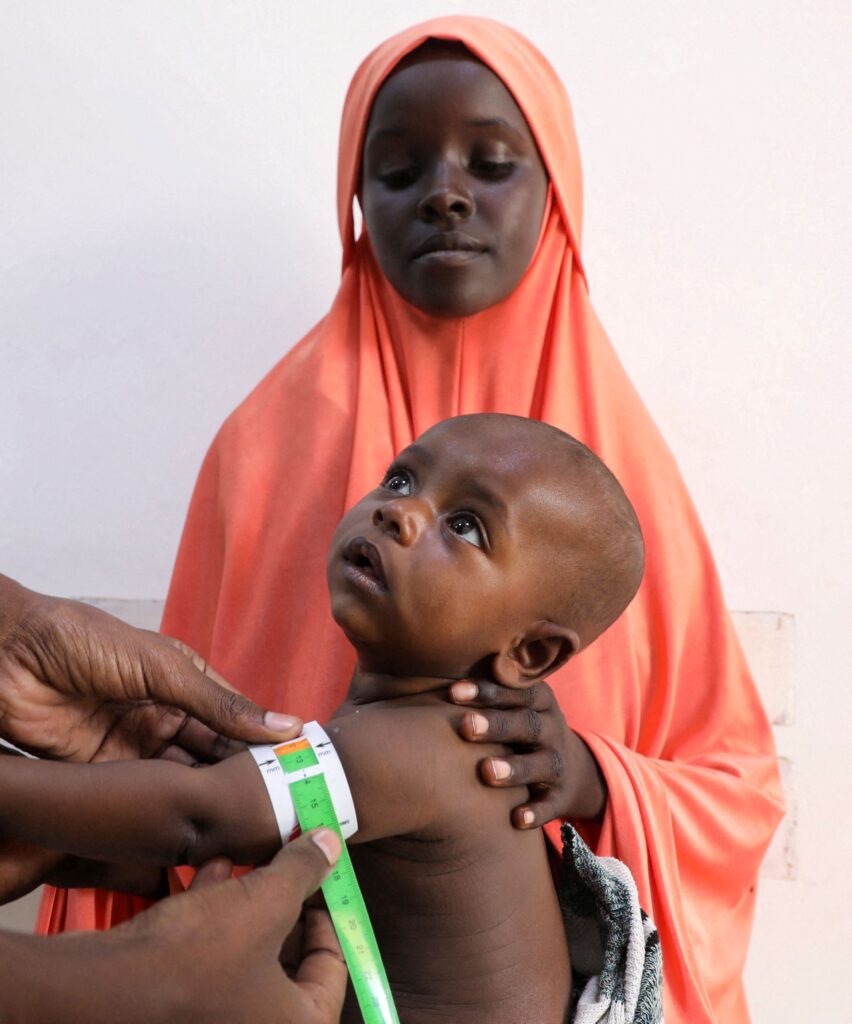
Hospital admissions for severe malnutrition in Somalian displacement camps have surged 83 percent compared with last year, Doctors Without Borders reported Tuesday, as the African country weathers drought and aid cuts from the United States and other donors.
Forty-seven percent of children in the camps in Baidoa in southwestern Somalia were malnourished, the aid group — also known as MSF, its initials in French — found in a survey last month, and more than 100 children died at the group’s hospital there in the first half of the year, MSF health adviser Mitchell Sangma said.
“In spite of all our medical treatment, in spite our efforts to increase our team, to increase care, unfortunately, we have also seen the increasing number of deaths,” Sangma told The Washington Post. “We suspect that there are more deaths in the community which we cannot confirm.”
The Trump administration has cut virtually all aid to Somalia, ranked the fourth-poorest country by the World Population Review. In 2023, Somalia received $1.18 billion in U.S. aid.
The State Department suspended all assistance to the Somalian government in January after accusing it of seizing more than 83 tons of food aid and destroying a U.S.-funded World Food Program warehouse.
“The Trump Administration has a zero-tolerance policy for waste, theft, and diversion of life-saving assistance,” the department said at the time. “Any resumption of assistance will be dependent upon the Somali Federal Government, taking accountability for its unacceptable actions and taking appropriate remedial steps.”
Somalia officials denied the allegations.
The country’s health system is largely dependent on foreign assistance. The U.S. has historically been among the most important donors, but European Union and other humanitarian funding is also down. Through May, the $852 million U.N. Humanitarian Needs and Response Plan for the country, already cut by 40 percent from 2025, was just 20 percent funded, the Office for the Coordination of Humanitarian Affairs reported.
Six million people were facing “high levels of acute food insecurity,” including 1.9 million in emergency conditions, the OCHA reported, and nearly 1.88 million children were expected to need treatment for acute malnutrition.
“What we are seeing is shocking and far beyond the threshold of an extremely critical emergency,” MSF project coordinator Allara Ali said. “What is equally shocking is the lack of urgency from donors, who continue to downscale and withdraw support from Somalia.”
Twenty-two thousand children were enrolled in MSF nutrition programs in the first six months of the year, Sangma said, and nearly 3,000 severely malnourished children with medical complications were admitted to the group’s Bay Regional Hospital in Baidoa.
“We started this year with 15-bed capacity to manage malnutrition cases, malnourished children, but then over the months we kept on increasing from 50 to 70, 70 to 100, 100 to 120,” he said. “At the peak, we had to convert part of the office to attend to patient wards.”
The economically fragile country, scarred by years of instability and displacement, is suffering a drought that has caused crop failures and livestock deaths.
“The consequences of the cuts are becoming more visible now and will get worse in the coming years,” Sangma said. “But the gaps, we already see.”