

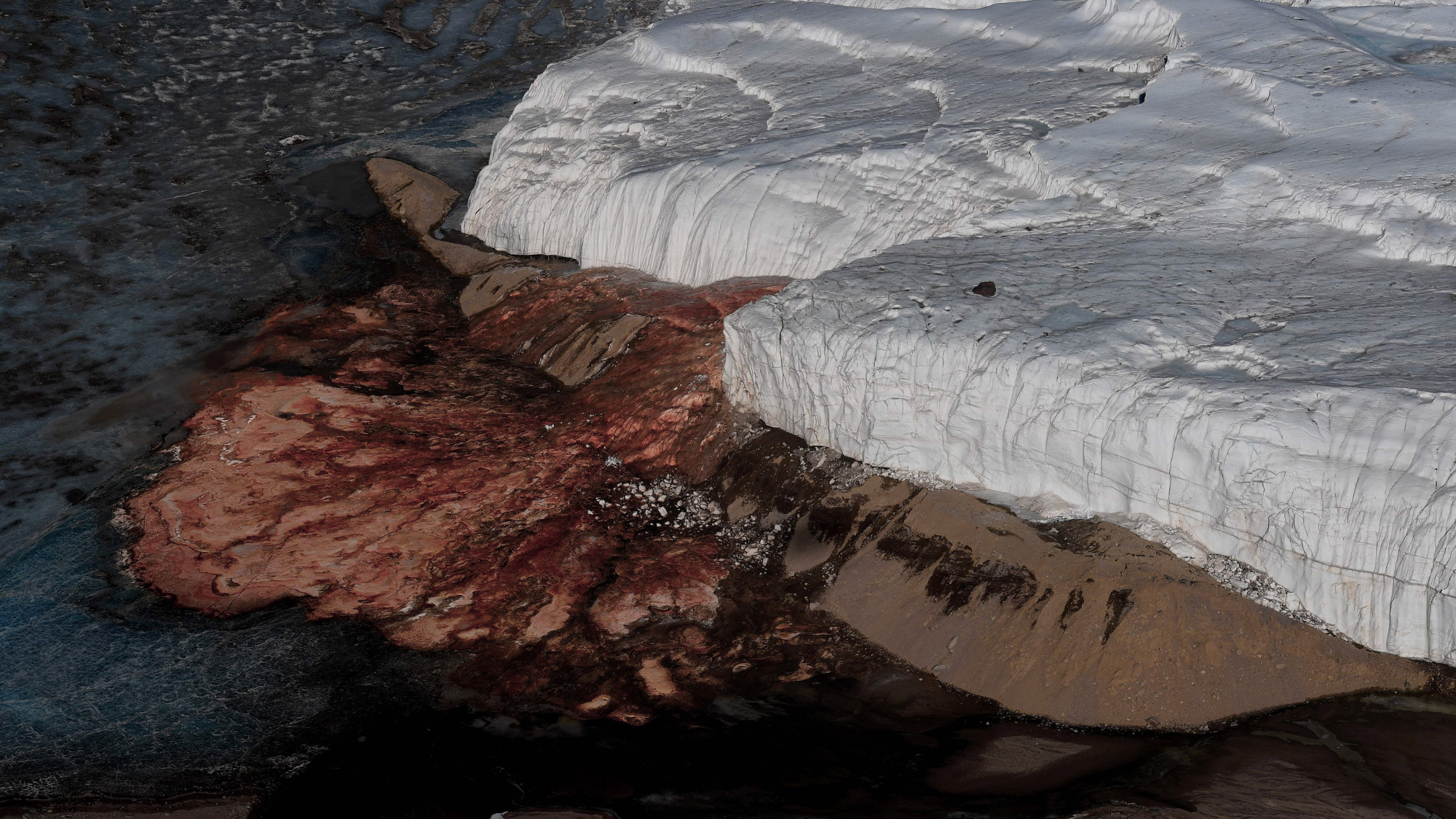
In East Antarctica, there’s a waterfall that looks like a harbinger of the end times. A rusty-red stream called Blood Falls pours out of the Taylor Glacier that looks like the Earth scraped its knee while skateboarding. Why it was blood red wasn’t a mystery. For years, scientists have known its unsettling color comes from iron-rich, mineral-filled brine. It was where all that blood-colored water was coming from that we didn’t know.
In a new study published in Nature Geoscience, researchers think they’ve found the answer: microscopic organisms living in the crimson leakage.
The team analyzed hundreds of samples of water, sediment, and the air surrounding Blood Falls, finding that many of the area’s microscopic eukaryotes (a cellular organism) are more closely related to marine life than, say, the freshwater microbes found elsewhere nearby. It’s a weird discovery considering that the nearest ocean is more than 20 miles away.
Scientists Found a New Clue Beneath Antarctica’s Blood-Red Waterfall
The best explanation the researchers can come up with is that the waterfall is being fed by an ancient pocket of seawater that got trapped beneath the glacier over a million years ago, back when sea levels were higher and the advancing ice sealed off the briny reservoir. Whatever the explanation, the microbes have apparently been hanging out in that pool of isolated underground water ever since.
That’s not the only possible explanation. The researchers suspect it could also be explained by strong Antarctic winds that are blowing marine microbes inland, though there isn’t much genetic evidence to support that idea. Collected air samples didn’t have many ocean-dwelling microorganisms.
Either way, the discovery offered scientists the exceedingly rare opportunity to study how life marches on even in the world’s harshest environments and helps us better understand the Earth’s history and can potentially help us figure out how life survives and maybe even thrives elsewhere in the solar system.