
Saudi Arabia, Pakistan and Turkey sign NATO-like defence pact: Why it matters for India and China

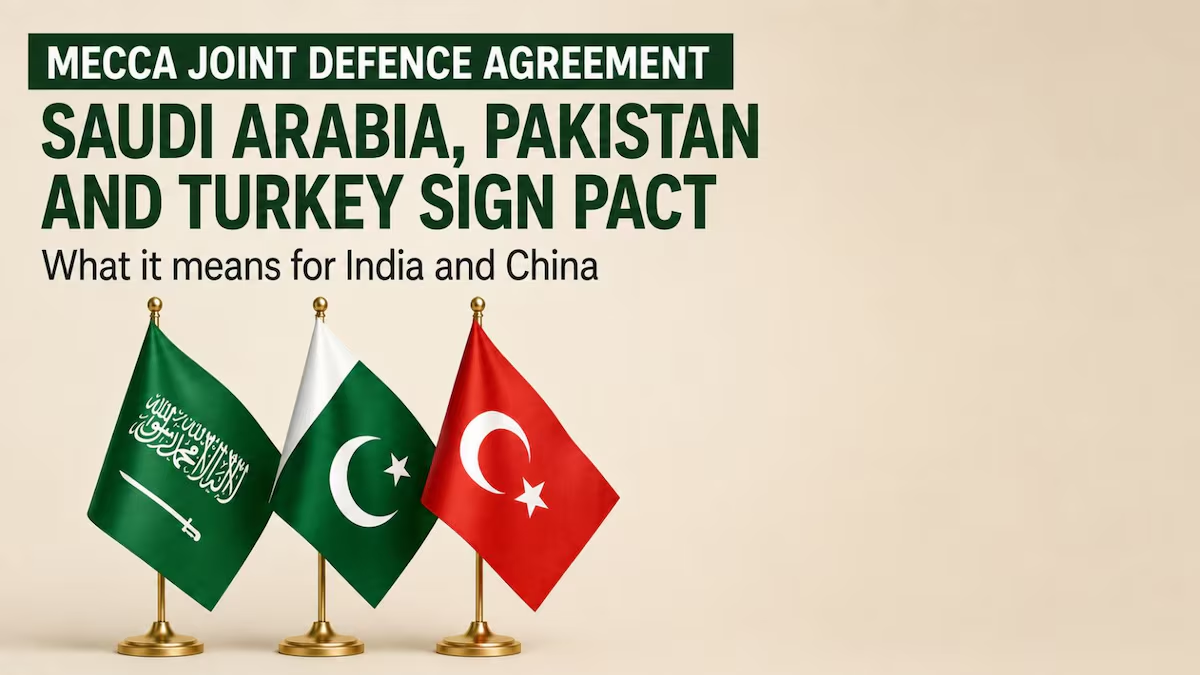
The “Mecca Joint Defence Agreement”, signed in Mecca on Friday, stipulates that an armed attack against any one of the three countries “shall be regarded as an attack on them all”. Turkish Foreign Minister Hakan Fidan said the arrangement was technically similar to NATO’s Article 5 mutual-defence commitment, while stressing that it was not directed against Iran or any other country.
The timing gives the pact wider significance. The agreement comes as the Iran war moves closer to Saudi Arabia and Iranian missile fire has reached Gulf oil exporters.
For Saudi Arabia, the pact adds Pakistan’s military strength and Turkey’s defence capabilities to a new collective framework. For Pakistan, it formalises security ties with two powerful regional partners. For Turkey, it provides a platform that Ankara says could eventually expand to include other countries.
According to CNN, the pact gives Saudi Arabia a powerful new layer of protection beyond its longstanding security partnership with the United States, amid growing doubts over whether Washington can still be relied upon to protect its oil-rich Gulf allies. CNN also noted that Turkey has the second-largest military in NATO after the US, while Pakistan is the only nuclear-armed Muslim nation.
Three countries, one pact
The official rationale for the agreement is to “strengthen collective deterrence against any act of aggression” and provide “for the enhancement of all aspects of defence cooperation among the three states”, according to a joint statement issued by the three countries.
Fidan said the pact was not aimed at Iran but was instead a general commitment to support the security of the three allies. In the event of an attack, he said, the countries would decide through consultations the degree, form and format of support required.
Fidan said negotiations on the agreement had continued for two years and eight months. A committee of ministers similar to the structure within NATO will be formed, along with a general secretariat based in Saudi Arabia, while operational details will be decided at the first committee meeting.
Turkey has also indicated that the pact could expand. Fidan said President Recep Tayyip Erdogan wanted the framework to grow beyond its three founding members, with Egypt potentially joining once technical issues are resolved.
Why India is concerned
For India, the biggest concern is the formalisation of Pakistan’s security relationship with Turkey and Saudi Arabia.
The pact may embolden Islamabad to take a more belligerent attitude towards India. Even if Saudi Arabia refuses to provide direct military support to Pakistan in an India-Pakistan conflict, Islamabad could potentially benefit from intelligence cooperation, weapons flows, diplomatic support or financial assistance.
The concern comes against the backdrop of growing Pakistan-Turkey defence cooperation, which was particularly visible during Operation Sindoor.
The new framework could deepen that relationship further, giving Pakistan greater access to Turkey’s expanding defence industry, including combat drones, naval combat systems and electronic warfare capabilities. Enhanced intelligence cooperation and military interoperability could also strengthen Pakistan’s strategic depth and operational resilience.
For New Delhi, this could complicate crisis-management calculations during a future India-Pakistan confrontation, particularly if South Asian tensions coincide with wider instability in West Asia.
Pakistan-Turkey ties in focus
The defence relationship between Pakistan and Turkey adds another dimension to the new pact.
Turkey’s expanding defence industry could provide Pakistan with greater access to military technologies, while institutionalised cooperation among the three countries could deepen intelligence sharing and military coordination.
That could give Islamabad additional strategic options during a future crisis with India, even without direct Saudi military intervention.
The development is therefore significant for New Delhi not only because of Saudi Arabia’s participation, but because it formalises a security framework that brings Pakistan and Turkey even closer.
Saudi Arabia’s India dilemma
Saudi Arabia’s participation also presents a diplomatic challenge for New Delhi because India has spent the past decade strengthening its economic, energy and strategic ties with Gulf countries.
Saudi Arabia’s primary motivation for the pact remains securing reliable military support against non-state and regional threats to its critical infrastructure.
However, Pakistan could seek to use the new arrangement to multilateralise its bilateral disputes with India under a broader pan-Islamic defence umbrella. Pakistani leadership has also sought to group India alongside Israel in its public rhetoric on regional security.
New Delhi, meanwhile, maintains a strategic and defence technology partnership with Israel while continuing to sustain important diplomatic and trade links with key Arab capitals. Islamabad’s attempt to leverage wider regional sentiment could therefore test India’s balancing act in West Asia.
Why China could worry
The pact could have a different, and potentially unintended, consequence for China.
Michael Kugelman of the Atlantic Council, in X post, described the agreement as a logical outgrowth of the deepening security ties among the three countries. He said its focus on collective regional deterrence, with an eye on Iran, could be welcomed in Washington because the US wants greater burden-sharing from its top allies.
A more self-reliant Saudi Arabia, Turkey and Pakistan could reduce the need for continuous US military attention in West Asia. That could give Washington greater capacity to focus on China, which the US regards as its principal long-term strategic competitor.
Any reduction in the American military burden in West Asia could allow Washington to devote additional resources to the Indo-Pacific, critical minerals, advanced technology, supply-chain resilience and alliances surrounding China.
That creates a strategic paradox for Beijing: a pact that strengthens regional allies could potentially give the US more room to focus on China elsewhere.
What China stands to gain
The agreement is not entirely negative for Beijing.
China could benefit commercially from closer ties with all three members. Pakistan’s familiarity with Chinese military equipment could create opportunities for more Chinese systems to enter Saudi Arabia, while Beijing remains an important diplomatic and economic partner for each country.
But greater Chinese involvement in the region could carry its own risks.
“China would be careful not to become a major arms supplier to the region to undermine US interests there. US can step up arms supplies to Taiwan in retaliation,” former Indian Foreign Secretary Kanwal Sibal wrote on X.
For Beijing, that creates a trade-off between deeper economic and defence engagement with the three countries and the risk of provoking a stronger US response elsewhere.
Also Read: Australia, Vietnam agree to deepen defence and security cooperation in Canberra