

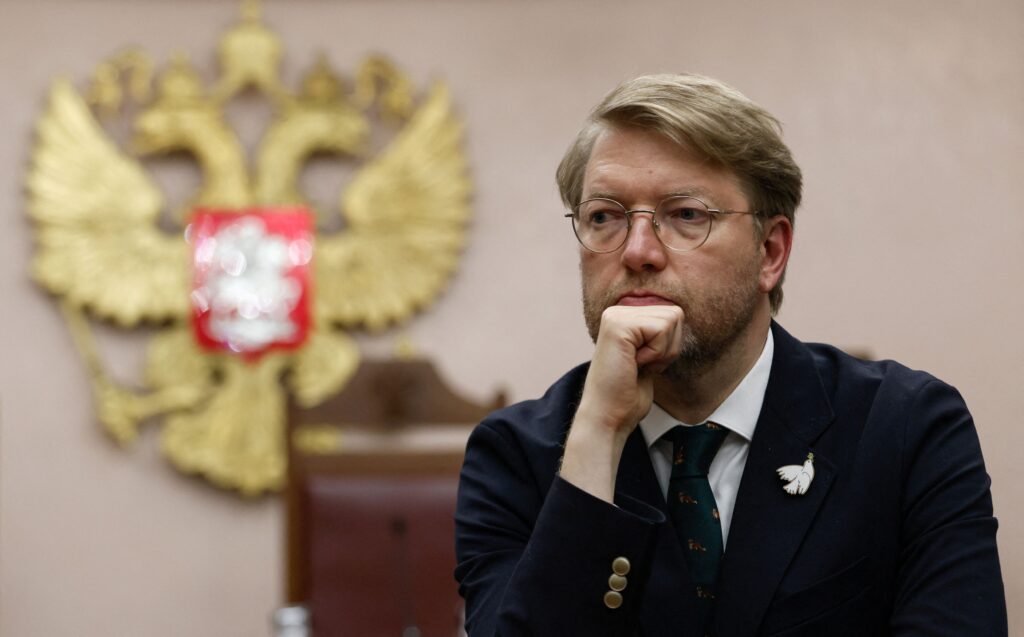
The Russian Supreme Court has barred the country’s last remaining anti-war party from running in parliamentary elections next month amid an intensifying crackdown on dissent over Russia’s increasingly unpopular war against Ukraine.
The decision Monday to keep the liberal-leaning Yabloko off the ballot sparked outcry among Russia’s opposition, much of which has already been forced into exile.
“The Kremlin got frightened,” Yulia Navalnaya, the widow of opposition leader Alexei Navalny, wrote on X. “They saw what they didn’t want to see: People are beginning to unite.”
Yabloko campaigned under the slogan “For Peace and Freedom,” a clear counter to Russian President Vladimir Putin’s push for conquest in Ukraine. The party had garnered rare support from Russia’s normally fractious opposition as the last option for voters who wanted to register discontent with the war in the September vote.
“It was not even a matter of support for Yabloko,” Navalnaya wrote. “But the fact that millions of Russians would have the opportunity to say what they really think about Putin and the war.”
Boris Nadezhdin, the country’s most visible anti-war politician, was barred last month after authorities declared him a foreign agent and charged him with displaying “extremist symbols.” He had posted a video with an image of Navalny, who died in 2024 after being poisoned in a Russian prison.
Nadezhdin fled Russia; He emerged in Paris last week.
Yabloko, which hasn’t managed to clear the 5 percent threshold to win seats in the Duma since 2003, was seen until recently as a fringe party. But as Russians become increasingly dismayed by the expanding reach of Ukraine’s drones and the growing impact of the war on the economy, the party appeared to be gaining support. Recent polls suggested it could win 9 percent of the vote next month, the Moscow newspaper Nezavisimaya Gazeta reported.
The party’s apparent success attracted a backlash from Kremlin-aligned parties such as Rodina. The nationalist party, whose name means “Motherland,” sued Yabloko, accusing it of receiving foreign funding, violating copyright law and promoting “extremism.”
Yabloko denied the charges. Hundreds of supporters gathered outside the Supreme Court on Monday and chanted “Russia Without Putin!” After the ruling, security forces attempted to disperse them.
More than a dozen prominent members of Yabloko had already been barred from running in the federal elections after being charged with allegedly displaying “extremist symbols” — mostly, posts about Navalny. Authorities in several regions had barred the party from running for regional parliaments.
Still, the Central Election Commission agreed at the end of July to register its participation in the September vote.
Opposition leaders said the show of unity and support for Yabloko spooked authorities. “The Kremlin only tolerates opposition parties when it can control the outcome,” said former oligarch-turned-Putin critic Mikhail Khodorkovsky, once Russia’s richest man, now a leading opposition figure in exile in London.
“Hundreds of people showing up at the courthouse today made sure Yabloko was not one of those cases,” he said. “Too risky. That is why Putin’s rubber-stamp court just removed them from the ballot.”
“When they allowed Yabloko onto the ballot, they apparently saw it as a kind of punching bag — a liberal party that everyone could criticize and that would, as always, pull in a maximum of 2 percent,” Oleg Orlov, co-chair of the Memorial Human Rights Defense Center, told the Echo Moskvy radio station. “Then, suddenly — unexpectedly, for them — Yabloko has turned into a genuinely serious contender.”
Yabloko chairman Nikolai Rybakov told the court Monday that the party had neither received foreign funding nor broken any laws. Its social media campaign, he said, was created by volunteers.
“The young people who make videos in support of us, who came to the Supreme Court today — we don’t pay them anything,” Rybakov said. “They support us simply because they want to live in Russia, and they don’t want to be killed.
“I don’t know how to explain that to the plaintiffs,” he said. “For us, it is essential to stay and keep working in the country and maintain ties with the people who live here. … We will do everything for Russia to become a prosperous democratic state.”
Rybakov said the party would appeal the ruling.