

Featured, Power
By Anthony Isibor
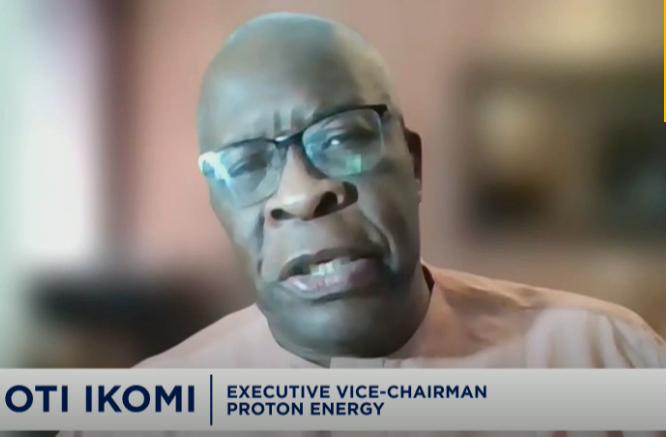
The N728 billion power sector bond programme will help address the liquidity crisis in Nigeria’s electricity market and provide the funding needed to settle outstanding liabilities to generating companies, according to Oti Ikomi, Executive Vice-Chairman of Proton Energy.
Ikomi, speaking in an interview with CNBC Africa on August 7, said the bond programme was part of efforts by the Federal Government to convert the accumulated liabilities in the electricity market into a structured financing arrangement that could inject much-needed liquidity into the sector.
He said the power sector had accumulated more than N4 trillion in liabilities since the reforms began almost a decade ago, making it necessary to develop a mechanism for addressing the debts while improving the financial position of operators across the electricity value chain.
“The power sector bond is designed to help the administration meet and settle the debts in the sector, particularly to generating companies,” Ikomi said.
He explained that electricity generation, transmission and distribution were interconnected parts of the power market, requiring each stage to function efficiently for the sector to become financially sustainable.
According to him, the introduction of cost-reflective tariffs through Band A tariffs was an important step, but government subsidies remained for Bands B, C, D and, in particular, the Lifeline Support Band E.
He said the continued subsidy meant that the government still had obligations to the sector, creating the need for a mechanism to settle accumulated liabilities and restore liquidity.
Ikomi described the bond as an innovative public-private sector initiative involving a number of Nigerian advisers, including Olaniwajayi, Access, Coronation, Wema Bank and CardinalStone.
He said the bond was being issued by Enbed Plc, a special purpose vehicle of Ednet, with the offer scheduled to close on August 14.
The programme comprises two series and is targeting N728 billion, with a minimum subscription of N5 million.
One of the attractions, he said, was the coupon structure attached to the bond, with investors receiving semi-annual coupon payments.
Ikomi said the first coupon for Series One, which he put at N63.5 billion, had been paid on July 14.
“That is confidence,” he said, arguing that investors would take comfort from seeing that the bond had been issued and that coupon obligations were being met.
He said the yields were expected to be above 17 per cent per annum, approximately 200 basis points above inflation, making the instrument attractive to investors while providing funding for the electricity sector.
Tariffs, subsidies and sector efficiency
On whether the bond could improve the bankability of future private-sector investments in electricity, Ikomi said the government’s position on tariffs and the planned reduction of subsidies could coexist if the reforms were properly implemented.
He commended President Bola Tinubu, the new Minister of Power, Joseph Olasunkanmi Tegbe, and the Special Adviser on Power, Rilwan Lanre Babalola, as well as the Special Adviser on Oil and Gas, Olu Arowolo Verheijen, for their roles in the ongoing reforms.
Ikomi said the fundamental requirement was for the electricity produced, transmitted and distributed to be paid for.
“What we generate, what we transmit, and what we distribute, we must pay for,” he said.
He pointed to metering as one of the major weaknesses in the electricity market.
According to him, Nigeria has about 12 million electricity consumers, but only about six million are currently metered.
He said another five million consumers were in the process of being metered, adding that the problem went beyond the number of meters because some consumers were either not paying, not paying appropriately or were being subjected to estimated billing.
He said improved liquidity from the bond programme should enable distribution companies to invest in their networks, while investment would also be required in transmission infrastructure.
Reducing technical and transmission losses, he said, would be critical to improving the financial position and efficiency of the sector.
Grid stability and the trust deficit
Ikomi identified the “trust deficit” between consumers and the power sector as one of the biggest challenges confronting the industry.
He said repeated grid failures and other problems had weakened confidence in the electricity market, making it important for the current administration to demonstrate that its reforms could translate into measurable improvements.
“The current team leading the power sector are taking a much more pragmatic view of the power market,” he said.
He also pointed to the Nigeria Electricity Act 2023, which was updated in 2024, as an important development because it allows states to manage certain elements of electricity supply at the subnational level.
However, he warned against the assumption that every state could develop its own independent transmission grid.
According to Ikomi, such an arrangement would be inefficient because of the scale and technical requirements involved.
Instead, he said, the government was focusing on strengthening key transmission corridors.
He cited the Lagos-to-East corridor and a northern corridor as examples of areas where work was being undertaken.
He said the government was also working with the Transmission Company of Nigeria, the Independent System Operator and other agencies to improve the interface within the transmission system.
The objective, he said, was to strengthen the network rather than create fragmented transmission systems.
Transmission losses remain major obstacle
Ikomi said Nigeria’s electricity challenge was not only about increasing generation or expanding access, but also about reducing the amount of electricity lost before it reaches consumers.
He put average technical and transmission losses at about 35 per cent and said the target should be to reduce them to well below 20 per cent.
“When you have that, you begin to get benefits derivable to the citizens,” he said.
He acknowledged that Nigeria’s national grid expansion strategy had fallen short over the years, describing the situation as a clear failure.
However, he stressed that electricity infrastructure was highly capital-intensive and could not be transformed overnight.
He said complementary initiatives in renewable energy, including solar power, could help close the access gap.
Ikomi said the Rural Electrification Agency was doing “a good work” in the renewable and solar space and was targeting up to 30 per cent hospital power supply from the source by the following year.
He also pointed to Lagos as an example of an area where existing infrastructure could be leveraged.
According to him, significant cabling had already been done in Lagos and the distribution system was in place, meaning that the focus should be on working through distribution companies to improve efficiency rather than duplicating infrastructure.
Mission 300 and electricity access
On initiatives such as Mission 300 and other programmes aimed at expanding electricity access, Ikomi said progress would depend largely on implementation.
He acknowledged the scale of Nigeria’s electricity deficit, including estimates that about 85 million Nigerians still lack access to electricity.
He said some of the improvements being contemplated by the government could become visible relatively quickly, but others would require two to three years.
Ikomi said the Minister of Power had indicated that some of the enhancements being pursued could be delivered over shorter periods, while more substantial interventions would require a longer timeframe.
“These things take time. There’s no magic wand,” he said.
He nevertheless expressed confidence in the direction of the current power sector team, saying the administration was “on the right path”.
But he identified execution as the critical test.
“The key is execution. Execution,” he said.
Investor concerns shift to bankability and risk allocation
Despite the challenges, Ikomi said the broader Nigerian investment environment had improved at the macroeconomic level.
He pointed to foreign exchange stability and greater stability around gasoline prices as positive developments that could support investor confidence.
The next objective, he said, should be to achieve similar stability and efficiency within the power sector.
For investors in gas-fired power generation, such as Proton Energy and Elite, he identified the marketability and bankability of contracts as a major concern.
According to him, investors need reliable off-takers and agreements that can support financing.
“You need to have a very reliable off taker with agreements that are bankable,” he said.
He added that the government would also need to provide some level of support to make projects sufficiently attractive to investors.
Ikomi stressed that investors were not necessarily asking for sovereign guarantees, but rather support structures, credit enhancements and mechanisms capable of reducing risks.
“Nobody is asking for sovereign guarantees and all that like that,” he said.
“What they need is the support structures.”
He said credit enhancement would be particularly important because it would provide investors with additional confidence while helping determine how risks were allocated among participants in the electricity market.
“Credit enhancement: how you manage risk allocation,” he said, adding that risk allocation across the electricity value chain remained a key issue for investors.
Outlook improves
Ikomi said there had been increasing investor appetite for Nigeria in recent months, describing the trend as encouraging.
He said the combination of macroeconomic stability, power sector reforms, improved financing structures and efforts to address liquidity constraints could gradually improve the outlook for the electricity market.
The power sector bond, he said, was therefore not simply a financing exercise but part of a wider effort to restore confidence, improve liquidity, support investment by distribution companies, strengthen transmission infrastructure and reduce losses.
He acknowledged that significant challenges remained, particularly around execution, payment discipline, metering, transmission losses, contract bankability and risk allocation.
But he said the direction of reform was positive.
“The future is getting brighter,” Ikomi said.
A.I
Aug. 10, 2026
Tags: Anthony Isibor Oti Ikomi