

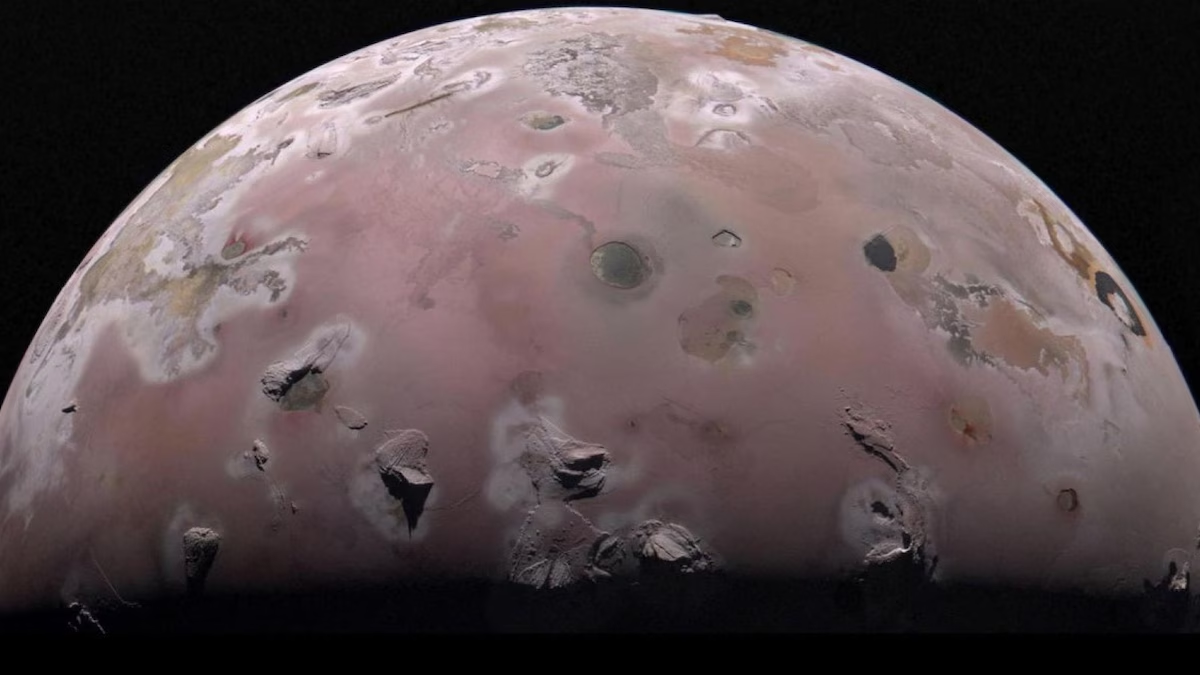
The breakthrough findings, published in the Journal of Geophysical Research: Planets, draw on data collected during two ultra-close flybys in late 2023 and early 2024. The results give planetary scientists an unprecedented look into how tidal forces generate heat within extraterrestrial bodies.
Io’s extreme volcanic activity is driven by continuous tidal flexing. As the moon travels along its elliptical orbit, Jupiter’s colossal gravitational pull stretches and squeezes its interior, generating immense internal heat.
Until now, scientists could only measure Io’s heat output at the very surface using infrared instruments. During flybys on December 30, 2023 and February 3, 2024, when NASA’s Juno skimmed just 1,500 kilometres (930 miles) above the surface, the spacecraft used its Microwave Radiometer (MWR) to probe beneath the crust.
The instrument detected a steep thermal gradient.
Temperatures jumped by more than 40°F just a few feet beneath the topsoil layer, a rise far too steep to be explained by solar radiation alone. The background heat flow across the moon was calculated at 1 to 3 watts per square metre. While modest locally, across Io’s entire surface this energy release is up to 30 times greater than Earth’s average background heat flow.
Researchers note the data could also indicate cooling subterranean lava flows capped by a crust 9 to 11 metres (30 to 35 feet) thick, covering roughly 10% of the moon’s surface at any given time.
“The Juno Microwave Radiometer directly observed Io’s heat output by looking below the surface,” noted Dr Scott Bolton, Juno’s principal investigator at the Southwest Research Institute.
ALSO READ | NASA’s Curiosity rover discovers ‘sea of polygons’ on Mars, reveals clues to its past
“The surprising discovery that we could see below a rocky moon’s surface has important implications for studying Earth’s volcanoes.”
In addition to measuring heat, the MWR instrument offered unexpected insights into Io’s landscape and geology.
While the moon is famous for its towering volcanic peaks, radar reflection data revealed that large swathes of Io consist of remarkably flat, expansive plains stretching over 100 kilometres. The surface material in these low-altitude regions appears extremely porous and light.
According to Dr Shannon Brown, lead author of the study at NASA’s Jet Propulsion Laboratory, the outer layer resembles pumice or fluffy volcanic ash rather than solid rock.