
Musa-Ododo: Tinubu’s Advice To Governors Is Apt; Governors Should Prioritise Roads Over Flyovers

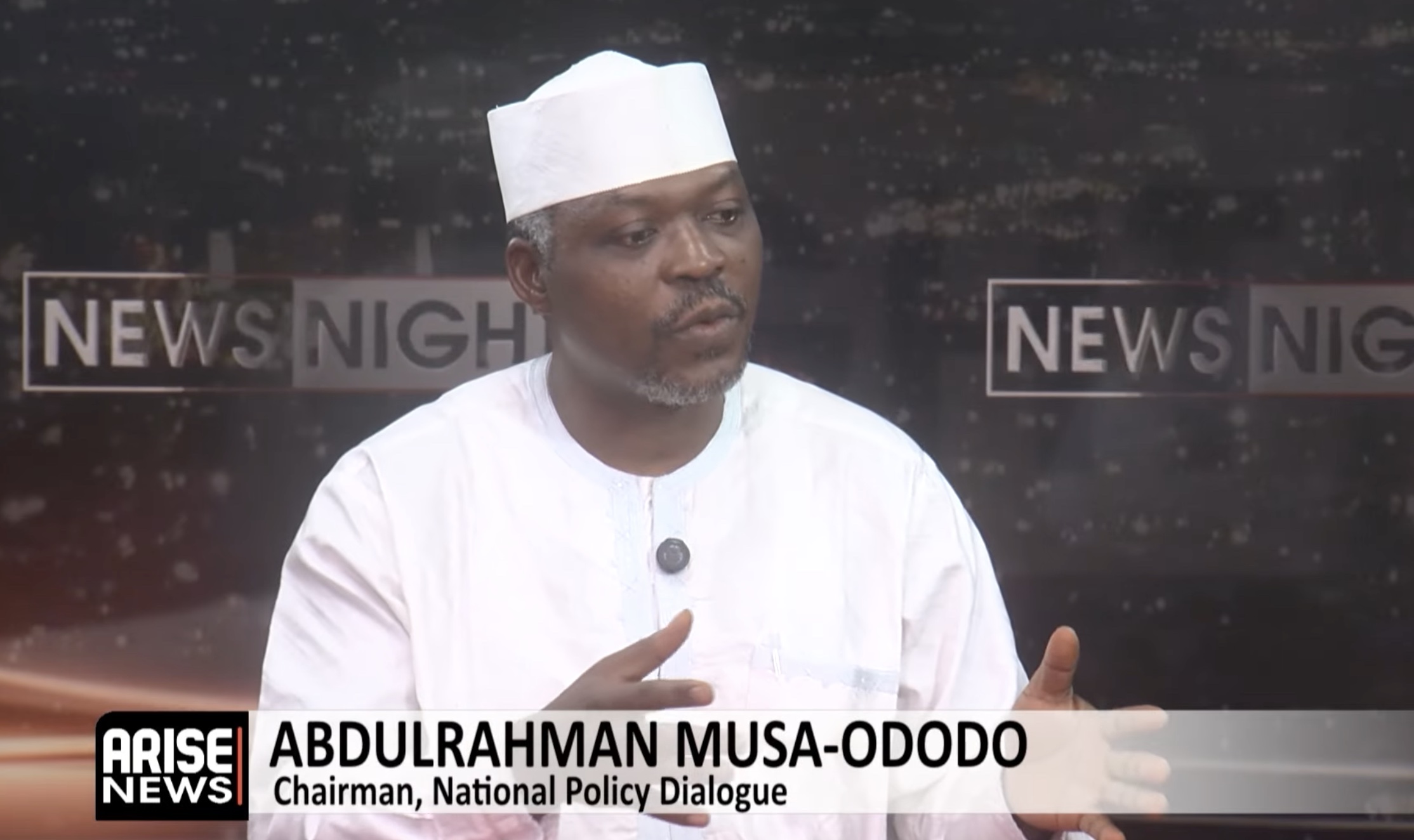
The Chairman, National Policy Dialogue, Abdulrahman Musa-Ododo, has backed President Bola Tinubu’s advice to state governors to prioritise roads over flyovers, describing the President’s position as apt, and stressing that road infrastructure delivers greater economic and security benefits.
Musa-Ododo made the remarks during an interview on ARISE NEWS on Friday while reacting to President Tinubu’s recent call on governors to invest in impactful, people-oriented projects rather than costly flyovers. Tinubu gave the advice at the opening of the 150th meeting of the National Economic Council (NEC) at the Presidential Villa, Abuja, where he urged state governments to channel resources into projects that directly improve citizens’ lives rather than white elephant projects.
“The President’s advice is very apt. Considering—of course, he said he has spoken to them four to five times—what he said speaks to strategic structural planning. What that means is prioritizing infrastructure that benefits the greater good of the people. That is exactly what Mr. President means, and that speaks to prudence in governance.
“Why build flyovers when roads suffice? Roads are the arteries of the economy and the lifeline of national security. Speaking to the context of that meeting, coming from Owerri, the security agencies need road networks to deploy rapid emergency response to counter insurgency. So, roads are very apt,” he stressed.
Describing President Bola Tinubu as a “subtle reformer,” Musa-Ododo said the President is confronting longstanding structural challenges through measured but deliberate reforms.
“President Bola Ahmed Tinubu is what I refer to as a subtle reformer. When people talk about restructuring, previous governments talked about it, but no one did it. Why I use the word ‘subtle’ is that he is confronting structural problems in a subtle way.”
According to him, while the Federal Government cannot take over state responsibilities, governors have a duty to prioritise projects that directly benefit citizens, particularly road infrastructure, which he described as critical to economic development and national security.
“In a democratic setting, this is a federation. Everyone has their own role. The President cannot—if you are doing some roads in some states, they’ll say, ‘This is a state road, this is a federal road.’ Meaning the federal government, no matter the President’s goodwill, cannot come down to start fixing state roads. Everyone must take responsibility. The governors are taking responsibility down to the lowest level, and that is why he’s telling them they cannot be all in all. They have a clear roadmap, and he is doing his bit in his own reform, bold as it may be,” he insisted.
On concerns that the increased allocations to states have been eroded by the naira’s depreciation since 2023, Musa-Ododo acknowledged that the currency’s value has changed significantly and cannot be compared with what it was when President Tinubu assumed office. However, he maintained that the key issue is not the size of the allocations but how governors prioritise spending, arguing that roads deliver greater public and economic benefits than flyovers, which he described as white elephant projects.
“When you think of the value of the Naira, you cannot really compare the worth then to the worth now. But what matters within the context of what he is speaking is: how—that’s why I say it speaks to strategic preference on what you take as a people. If roads deliver a greater good than building flyovers, then build roads, not these white elephant projects,” he maintained.
Musa-Ododo also called for a rethink of governance priorities, urging governors to reconnect with the needs of the people. He questioned the value of building new airports where nearby ones already exist, saying states should instead invest in projects that boost the economy and strengthen food security.
“That’s why we need to have a rethink. With all due respect—not all of them, some are doing extremely well—within the context of what we’re talking about, prioritizing needs to happen. There must be a rethink about what governance is. Absolutely. Because you must reconnect with the people.
“Sometimes I wonder what economic benefit an airport brings when there’s an airport close by that people can use. Now you’re building the next airport? No, that is not it. You must build something that is going to stimulate the economy for the people, especially since most Nigerians are agrarian. You should look at how—especially now that we need food security—we must have clarity about what we need to do. There must be a rethink around that,” he urged.
He said the Nigeria Governors’ Forum and the Progressive Governors Forum should encourage the sharing of best practices among states. While noting that some governors are performing well, he urged those lagging behind to align their priorities with the needs and realities of the people.
“The Nigeria Governors’ Forum and the Progressive Governors Forum should come together and say, ‘Look, this is what is working well.’ But away from that, if you really want to work, you know where your society is, you know what it is. But some of them like to chase these ghosts because of kickbacks.
“Some governors are trying and doing well, while some are not. Those who are not doing well must just find a way to align with the reality of the people,” he advised.
Favour Odima
Follow us on: