


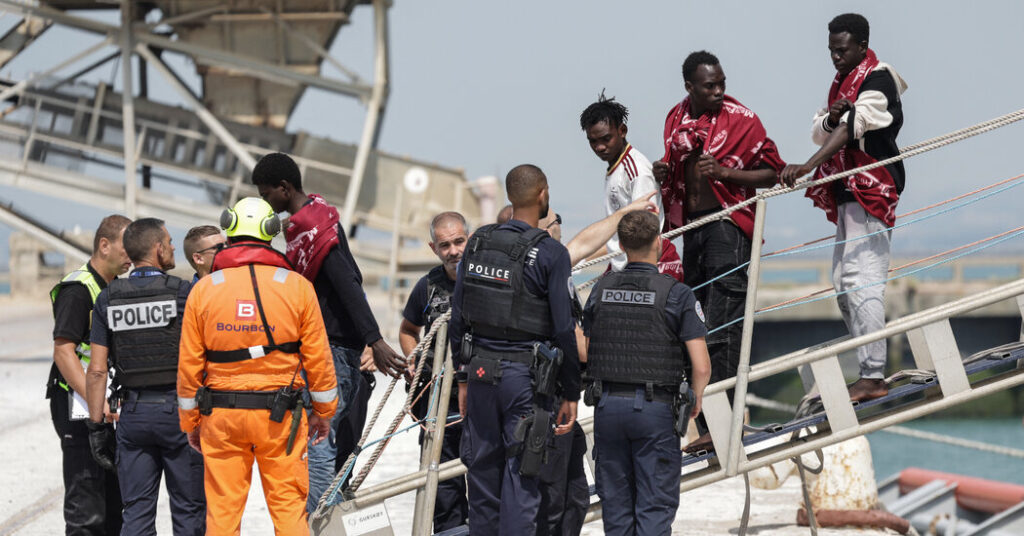
More than 150 people were rescued on Tuesday after a fire broke out on the small boat they were using to attempt a dangerous crossing from France to Britain, which has become a popular route for migrants from elsewhere and a contentious political issue.
The French authorities said all those on the vessel, which had left France on Monday, had been rescued in the English Channel by French and British emergency responders after its motor caught fire. There were no reports of deaths or injuries, and officials said all the migrants had been returned to France.
The rescue came at a moment of heightened debate in Britain over migrants’ use of small, often unseaworthy boats to try to reach the country. In Britain and elsewhere, the broader issue of irregular migration has come under new scrutiny since tens of thousands of people entered the Spanish territory of Ceuta from Morocco last week. Dozens died attempting that crossing, and most of those who reached Ceuta stayed only a short time before returning.
On Sunday, Britain’s new prime minister, Andy Burnham, visited Dover on the English coast, where he promised to be “relentless” in curbing the number of people coming to Britain in small boats. But he also said his government would help migrants in need, saying he wanted to “deal with the issue rather than play politics with the issue.”
“The public don’t like the idea that the border looks like it’s not controlled,” Mr. Burnham said. “We need to bring back that control. But also we need to offer support for people who genuinely need it.”
Under Mr. Burnham’s predecessor, Keir Starmer, Britain increased its cooperation with France in efforts to tackle small-boat crossings. That included a pilot program under which a small number of migrants who had crossed the channel would be returned to France, in exchange for the British admitting a similar number of people with strong claims to asylum.
According to Britain’s Home Office, crossings so far this year are down by about 43 percent compared with the same period in 2025. But many are still attempting the journey, particularly during favorable summer weather. More than 2,000 people have done so in the two weeks since Mr. Burnham became prime minister, the government said.
The use of a small boat is the most common form of irregular entry into Britain. Most migrants who arrive that way claim asylum, which allows them to stay while their application is considered.
The number of people crowding onto such boats — “mega dinghies,” as they are often called — appears to have risen, and the Tuesday rescue underscored the peril attached to those journeys.
A day earlier, Reform U.K., the populist right-wing party led by Nigel Farage, had said that if voted into power, it would deploy Britain’s navy to pick up such migrants and return them to France. Other parties were dismissive of the proposal, and France has made clear that it would not accept migrants returned in that way.
But Mr. Farage pushed the idea again after the rescue on Tuesday, saying that Reform’s plan would save lives. “We must put a stop to this,” he said on social media.
In a statement on Tuesday, French officials said that French patrol boats had monitored the migrant vessel, apparently in peril because of crowding, earlier in its journey, and had offered then to rescue the people aboard. Five accepted that offer, the officials said, the remainder only agreeing to rescue after the fire broke out.
In all, 103 migrants were rescued by French crews and 54 by British, according to the statement. All were taken to the French port of Boulogne-sur-Mer.