

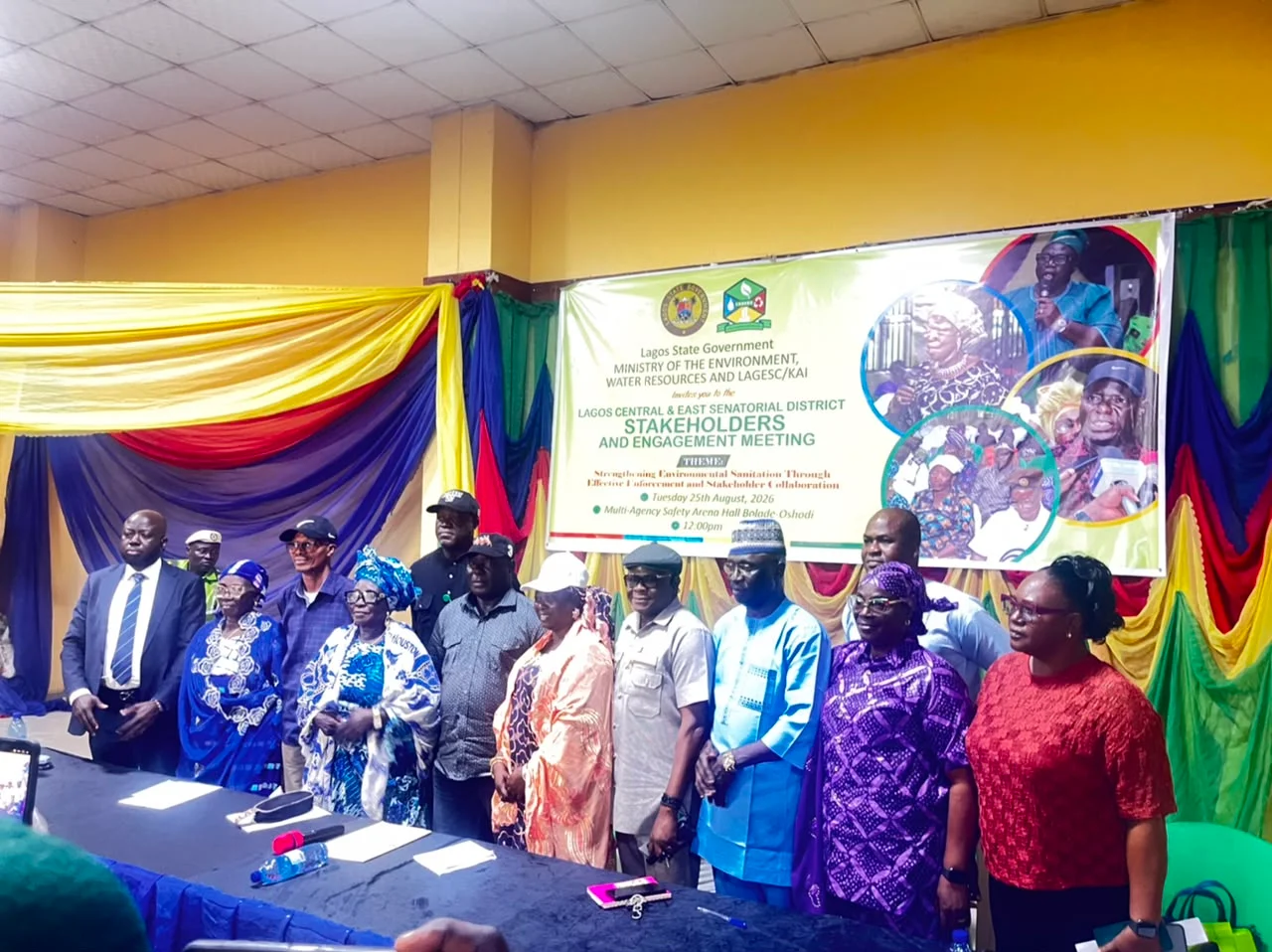
The Lagos State Government, through its Environmental Sanitation Corps (LAGESC), has intensified engagement with traders, transport operators, market associations and community leaders, urging them to embrace voluntary compliance with environmental sanitation laws.
The Government said greater stakeholder participation was necessary to reduce environmental infractions and sustain cleaner, safer and healthier communities across Lagos.
LAGESC Corps Marshal, Major Olaniyi Olatunbosun (Rtd), stated this on Tuesday at a stakeholder engagement meeting themed “Strengthening Environmental Sanitation Through Effective Enforcement and Stakeholder Collaboration.”
The meeting, held at the Multipurpose Hall of the Multi-Agency Safety Arena Complex, Bolade-Oshodi, brought together representatives of market associations, Community Development Committees (CDCs), environmental health officials and other stakeholders to discuss ways of improving collaboration between the government and communities.
Olatunbosun said environmental sanitation could not be achieved through enforcement alone, stressing the need for residents and community stakeholders to take ownership of efforts to maintain environmental order.
He urged market leaders to ensure compliance within their markets, while calling on transport unions to encourage their members to obey environmental regulations. He also urged traditional institutions to use their influence to promote responsible environmental practices.
“Residents must report environmental infractions, and more importantly, must refrain from creating those infractions themselves.
“The media also has an important role to play in educating the public, correcting misinformation and highlighting both the responsibility of citizens and the interventions of government,” he said.
The LAGESC boss said the government could not single-handedly maintain environmental order across every street, market, bus stop, drainage channel and community in Lagos.
He explained that the stakeholder engagement was designed to create room for dialogue and consultation, while allowing communities to contribute ideas on practical ways to improve environmental sanitation.
According to him, regular engagement with stakeholders would strengthen community ownership of sanitation initiatives and improve cooperation between LAGESC and residents.
Olatunbosun said the approach was also in line with the state government’s broader objective of making Lagos more resilient, sustainable and attractive to residents, investors and businesses.
He said LAGESC had intensified enforcement in 2026 against activities that undermine environmental order, including indiscriminate waste disposal, illegal dumpsites, street trading, obstruction of pedestrian walkways and roads, and unlawful occupation of public spaces.
He, however, stressed that enforcement remained only one part of the agency’s strategy, with education, engagement and voluntary compliance also necessary to reduce violations.
“Even in the military, stakeholder engagement remains a vital tool for achieving effective civil-military synergy.
“The same principle applies to environmental sanitation. Sustaining environmental order cannot be achieved by enforcement alone,” he said.
The Corps Marshal said LAGESC would continue to combine enforcement with education and community engagement to reduce environmental violations and strengthen its relationship with residents.
Olatunbosun also disclosed that the Lagos State Government had approved additional recruitment slots for LAGESC to strengthen its manpower and expand its presence at the grassroots.
He said the additional personnel would enable the corps to deploy more officers to communities and improve its capacity to monitor and respond to environmental violations.
“The governor of Lagos State, Babajide Sanwo-Olu, has approved and given us some slots to recruit.
“So very soon, the recruitment will be done, and we’ll be able to cover as much as we can,” he said.