

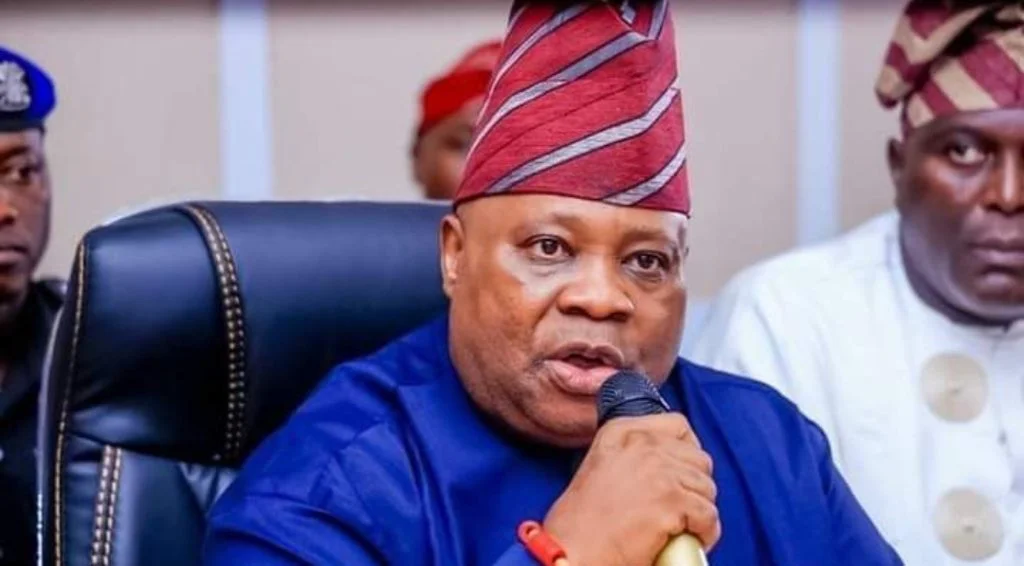
The Osun State Government has denied allegations of an alleged ₦11 billion loot, accusing the Economic and Financial Crimes Commission (EFCC) of conducting a politically motivated witch-hunt against the Governor Ademola Adeleke led administration.
The government insisted that the anti-graft agency’s claim that it froze the state’s accounts over misappropriated funds was false, describing the allegation as an attempt to justify it unlawful action.
It maintained that the account restriction was orchestrated to frustrate the payment of palliatives approved for civil servants amid prevailing economic hardship from the policies of President Bola Tinubu administration.
The position of the Osun State government was contained in a statement issued on Thursday by the Commissioner for Information and Public Enlightenment, Oluomo Alimi.
According to the state government, workers have already received the promised cost-of-living support despite the alleged attempt to halt the disbursement.
Adding further, the Osun government said the palliative package followed negotiations with labour representatives and formed part of its broader welfare measures for public employees.
Rejecting the accusation of financial misconduct, the government argued that available state resources were being channelled into infrastructure, workers’ welfare and other developmental projects rather than being diverted.
“We have not looted public funds. Every available resource is being deployed for projects and programmes that directly benefit the people of Osun State,” the government said.
Furthermore, the state government alleged that the EFCC had embarked on a sustained campaign of harassment against senior government officials since March 2026, claiming that repeated investigations had failed to produce any evidence linking the administration to financial wrongdoing.
Also, the government accused the commission of acting in the interest of the opposition, insisting that the freezing of the state’s accounts was politically motivated rather than driven by credible evidence of corruption.
“It is unfortunate that an agency entrusted with enforcing the law would resort to allegations it cannot substantiate in order to defend an action that is already attracting widespread criticism,” the statement added.
Defending its record, the administration said Osun had earned recognition for transparency in budgeting and public financial management, arguing that any genuine allegation of corruption should be handled through established legal procedures rather than the freezing of government accounts.
The government maintained that even if the EFCC believed it had evidence against any official, due process required that suspects be investigated and prosecuted in accordance with the law instead of imposing sanctions on the state’s finances.
Concluding its statement, the Osun government described the commission’s allegation as an afterthought designed to damage the image of Governor Ademola Adeleke’s administration.