

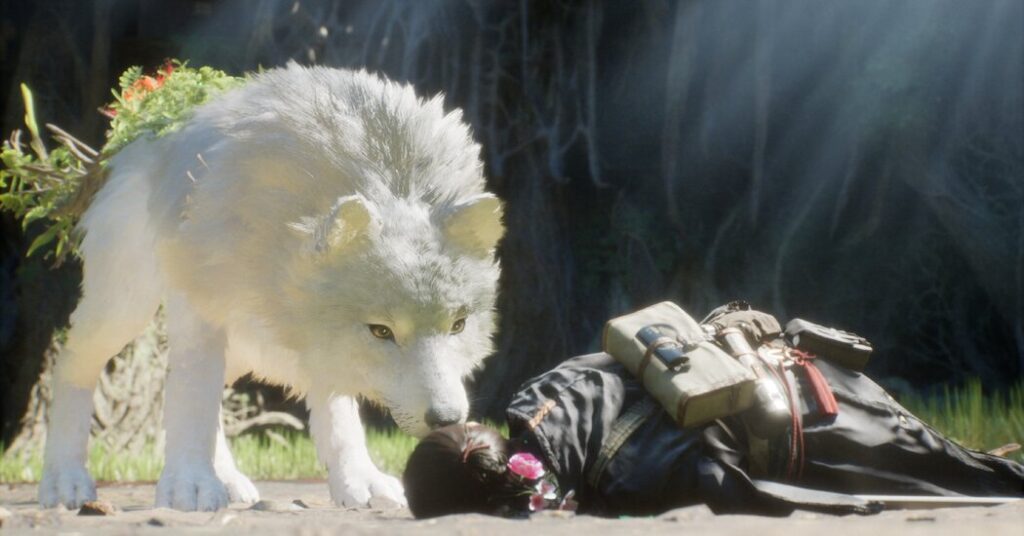
While Kota Furushima took a break from working on the Pokémon game series, his company’s bread and butter since 1996, he began thinking about a “very postapocalyptic, very harsh” futuristic Japan in which an 18-year-old warrior, who lost her memory, would embark upon a violent road trip with a friend to cleanse the world from blight.
Would that friend, Furushima pondered in 2019, be human or animal?
After making that decision, he had another important question: cat or dog?
Furushima, 40, had two cats when he was growing up, so he knew they “tend to not like accepting commands,” he said through an interpreter on a video call from his Tokyo home. Instead, he landed on an variation of a spirited and independent but trainable Shiba Inu, a dog breed that a close relative owned.
After considerable research, he submitted his idea during a companywide call for new games. This week, his company, Game Freak, released Beast of Reincarnation for the PC, PlayStation 5 and Xbox Series X|S.
The Shiba Inu-inspired companion became the silvery gray Koo, which is also part wolf and part plant. Furushima’s first concept sketch included small leaves sprouting from its fur. Now fully animated, the majestic Koo has a tail that sometimes looks “like the roots and trunk of a strangler fig.” At other times, the tail is verdantly green, glowing when Koo and the teenage warrior, Emma, feel connected.
The loyal Koo, who fights blighted beasts and a variety of golem, joins a lineage of dog companions in video games. The robotic red canine Rush has carried Mega Man to new heights since the franchise’s third game was released in 1990; Dogmeat, a blue heeler in Fallout 3 (2008) and a German shepherd in Fallout 4 (2015), can fetch useful items and pin down radioactive ghouls.
With satisfying rat-tat-tat sounds, Koo’s tail shoots at enemies, using plant-based ammo like seeds from higanbanas (red spider lilies) that become fiery. Other flowers — including kiku (chrysanthemum), asagao (morning glory) and sakura (cherry blossom) — add variety to Koo’s abilities. With them, he can heal Emma if she has been wounded badly by, say, a giant stag with mammoth antlers. Or the flowers can produce binding roots that hold a monster so Emma can more easily vanquish it.
Merging flora and fauna is familiar to Furushima, who has been involved in creating five Pokémon games in which grass-type fantasy creatures, like the amphibious Bulbasaur, bear plantlike qualities. That is where the similarity ends. The themes in Beast of Reincarnation include loneliness versus being alone, the burdens of having no memories and the looming end of the world. These motifs are far more mature than what has been portrayed in the popular “catch ’em all” games.
A loyal dog was needed to reinforce the idea of solidarity even when Emma and Koo are apart, said Furushima, who directed the game. That happens at one point when a colossal raven with gross roots near its talons captures Koo and thrums away.
When on the ground, Koo’s tail seeds sprout red spider lilies, which are central in Japanese lore. These highly toxic “flowers of hell” are named for the Buddhist observance of Higan and can symbolize death and the afterlife, as well as a pure, completely unfettered reincarnation.
The game’s narrative does not overtly detail the processes of reincarnation, or the environmental story that seems to be quietly building. Eventually, Emma begins to remember the events surrounding her past.
Furushima, adjusting his glasses and stroking his chin, was cautious about spoilers. It was up to players, he said, to do their own research about the lore and to consider the story’s meaning. “We get to see these different perspectives and angles on what reincarnation means,” he said.
Furushima reflected on the time when he, like Emma, was 18, hoping to invent something without the influence of the outside world. He chose classical music, singing in and conducting a choir before transitioning into pop music.
When Emma and Koo see a bucolic field in Beast of Reincarnation, the music that plays is “a representation of the emotions and the moments that Emma and Koo spend together.” It is then, in this calm before the storm, that Koo appears peaceful and satisfied.