
Iran-backed Houthi rebels attack crucial Red Sea port and Saudi Aramco refinery as fighting escalates

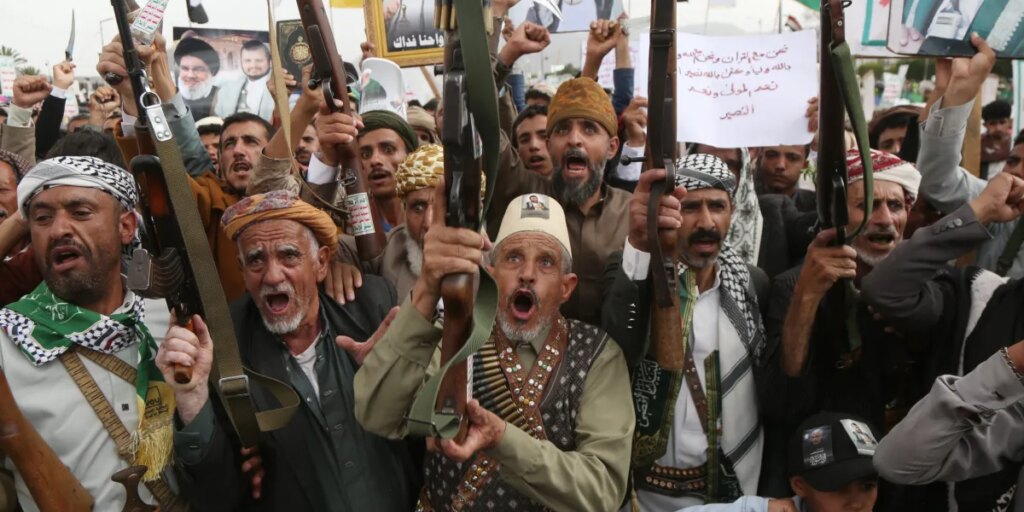
Yemen’s Houthis attacked a crucial port on the Red Sea, killing people and further escalating the conflict over strategic waterways in the Middle East. They also said they attacked an oil facility on Sunday in southwestern Saudi Arabia, the latest attack by the Iranian-backed rebels on the kingdom.
Meanwhile, Iran has made new demands about the restart of negotiations and the reopening of the Strait of Hormuz, the Pentagon is pressing the U.S. defense industry to accelerate production of weapons and Israel is insisting it won’t withdraw from Gaza until Hamas disarms.
Here’s a look at developments across the Middle East on Sunday. Full coverage can be found here.
Houthis target Aramco refinery, Red Sea port
The National Resistance Forces, a Yemeni government-allied force, said at least seven people — four troops and three civilians — were killed and 15 civilians were injured in the Houthis’ attacks Sunday on Mokha, a crucial port on the Red Sea.
Fayed al-Noman, assistant undersecretary of the information ministry, said the Houthis fired missiles and drones on the port, severely damaging its buildings and pier as well as commercial goods and food supplies at the facility.
Mokha is one of the main ports under Yemen’s internationally recognized government, renovated in recent years to handle shipping that avoids the Houthi-held ports in Hodeida.
The Houthis later claimed the attack, saying they fired “a large number of ballistic missiles and drones” that targeted military enforcement and warehouses in the area.
Yahya Saree, a military spokesperson for the Houthis, said they also targeted an Aramco refinery in the city of Jazan with a drone. The attack was in response to Saudi drones’ breaching Yemen’s airspace over the provinces of Hajjah and Saada, he said.
Early on Sunday, the Saudi Energy Ministry reported a fire at a facility belonging to the Aramco refinery without casualties. The ministry said the fire was extinguished but it didn’t describe its cause.
Sunday’s Houthi attack is the latest in a series of missile and drone attacks that have targeted Saudi Arabia and its shipping in the Red Sea.
The escalation threatens to reignite Yemen’s civil war more than four years after a 2022 truce stopped major fighting in the impoverished Arab country.
— by Samy Magdy in Cairo.
Details emerge about potential Iran-Oman deal
The Strait of Hormuz, crucial to global supplies of oil and natural gas, was considered an international waterway before the war.
But Iran and Oman are working to finalize a temporary deal that would reopen the strait with ships entering the strait through a route close to Iran and exiting through a route close to Oman, according to two people familiar with the talks who spoke on condition of anonymity because they were not authorized to speak publicly.
Ships would cross the strait without paying fees or tolls during the interim period.
The agreement is designed to restore an earlier, separate agreement between the U.S. and Iran and restart a 60-day clock for the two countries to negotiate over Iran’s nuclear program.
According to the two people who spoke about the talks, the deal is endorsed by members of the Gulf Cooperation Council and expected when finalized to be jointly announced by Iran, Oman, the U.S., and the International Maritime Organization of the United Nations. But the people stressed the terms could still change before the deal is final.
— by Michelle Price in Washington and Aamer Madhani in New York.
Pentagon pushes boost in weapons production
Pentagon spokesman Sean Parnell said on Saturday that the department was actively focused on boosting munitions acquisitions to provide “the weapons our warfighters need at the pace the threat demands.”
The war with Iran has used up more of the U.S. military’s already diminished stockpiles of advanced missile interceptors, says a new analysis from the Center for Strategic and International Studies, a Washington think tank.
Parnell’s statement said the push for speedier delivery was part of a broader modernization effort that predated the five-month-old conflict.
Iran says negotiations with US ‘cannot resume’ until conditions met
Iran’s Foreign Minister Abbas Araghchi said negotiations with Oman about “new maritime routes” through the Strait of Hormuz were “in the final stages.”
“This, however, does not mean that the Strait of Hormuz will reopen,” Araghchi told reporters in Tehran on Sunday. “An agreement on the routes may be reached, but reopening the strait is subject to a number of other conditions, which have been conveyed through intermediaries.”
Iran’s powerful Supreme National Security Council has said the Strait of Hormuz will not open until the U.S. “corrects its behavior,” issuing new demands that could shake up talks on a deal to manage the waterway.
The demands include the U.S. never threaten Iran again, a permanent end to the war with Iran and its armed allies in the region, a lifting of the naval blockade of Iranian ports and a withdrawal of its military from the area, according the statement by the supreme council’s secretary, Mohammad Bagher Zolghadr, published by Iran’s state broadcaster.
According to the U.S. Central Command, the blockade has redirected 53 commercial vessels, disabled two, and boarded two through Saturday.
About overall negotiations, Araghchi said that an “exchange of messages through intermediaries” is continuing with the United States, but that doesn’t constitute negotiations.
“From our perspective, negotiations cannot resume until the violations of the memorandum of understanding have ended and the United States has remedied the provisions of the memorandum that it violated,” he said.
Iranian media release undated video of Khamenei
Iran’s semiofficial Mehr news agency has shared an undated video apparently showing Supreme Leader Ayatollah Mojtaba Khamenei. The Associated Press cannot independently verify when and where the undated video was filmed. Mehr shared a video in March that appeared to have been recorded at the same event, apparently a jurisprudence class.
Khamenei is understood to have stopped publicly teaching in 2024. He reportedly sustained serious injuries during the opening stages of the U.S.-Iran war and hasn’t been seen in public since.
It is not clear why Mehr released the footage on Sunday.
Netanyahu insists no Gaza withdrawal until Hamas disarms
Israeli Prime Minister Benjamin Netanyahu said Israel’s military “will not carry out any withdrawal until Hamas is genuinely disarmed.”
Speaking at Sunday’s weekly cabinet meeting, he said Israel is discussing plans for Gaza with the United States, saying that some of the American ideas are acceptable to Israel and others are not — further pushing back on the deal announced by President Donald Trump.