

In January, the World of Concrete trade show drew 47,000 people to the Las Vegas Convention Center. One of them was the manager of a Trump Organization golf club in New Jersey, who had come seeking help with an enormous, unfamiliar task.
The manager, David Schutzenhofer, wanted ideas for how to fix the leaking, algae-ridden Lincoln Memorial Reflecting Pool in Washington.
Several vendors told him they knew just the guy to call: Rodney Jarboe, the president of the Missouri-based company Creative Polymers. Mr. Jarboe had worked on a bridge at another federal landmark, the Gateway Arch in St. Louis.
In an interview, Mr. Jarboe said he first spoke in March with Mr. Schutzenhofer, who made clear that the work would be rushed. President Trump, Mr. Jarboe said he was told, wanted the renovation project done in time for the country’s 250th birthday on July 4.
“For this thing to be done in the time frame that was required, we almost had to have a contract and start manufacturing by the first week of April,” Mr. Jarboe said. “So it was a very tight deadline to make a decision.”
Those initial conversations about the Reflecting Pool, which have not previously been reported, kicked off an ad hoc plan by the Trump administration that involved coating the pool with a sheet of blue polyurea, which the president promised would make it beautiful. Within months, though, the pool was drained and ugly — the butt of jokes and memes.
Many of the details of the saga are reported in this article for the first time. They show that the pool, which was supposed to reflect the Lincoln Memorial and the Washington Monument, became a striking reflection instead of the second Trump administration’s willingness to skirt laws, expend millions of dollars, ignore facts and punish truth tellers in service of the president’s demands to put his mark on the capital.
The Interior Department, led by Doug Burgum, handed out no-bid contracts and squelched doubts about the costs and risks. An employee from Mr. Trump’s private business life, Mr. Schutzenhofer, played an off-the-books role in government decisions. A top federal housing official, Bill Pulte, brought Mr. Trump memes that encouraged him to keep going.
And when Mr. Trump sought to blame the project’s failure on shadowy vandals, Jeanine Pirro, the U.S. attorney in Washington, backed him up by charging members of the public with crimes, only to have the cases fall apart.
Then, in place of accountability, there were falsehoods on top of falsehoods, part of Mr. Trump’s longtime strategy of not admitting mistakes and treating concessions of error as signs of weakness.
To understand how the Reflecting Pool repairs veered off course, The New York Times reviewed dozens of internal government documents, including confidential reports raising concerns about the project’s costs and workmanship, and spoke to more than 20 people familiar with the project.
Taylor Rogers, a White House spokeswoman, did not answer a list of emailed questions, but said in a statement: “For years, the Reflecting Pool sat neglected, plagued with algae and leaking millions of gallons of water. Fixing it was common sense. It’s another example of President Trump restoring our nation’s capital for the American people.”
The Interior Department has also defended its handling of the project, saying that it followed the law and used expedited processes to meet a tight deadline. “President Donald J. Trump is an expert builder who fixed the Reflecting Pool permanently before deranged people vandalized it,” Katie Martin, a department spokeswoman, said in a statement.
A Novel Solution
At the start of Mr. Trump’s second term, the Reflecting Pool had two longstanding problems. It leaked tens of millions of gallons every year. And it turned green, especially in the summer, as algae thrived in its stagnant, shallow water.
But neither Mr. Trump’s first administration nor the Biden administration had treated these issues as a crisis. They made plans to fix it, but never carried them out.
That changed last fall. The day before Thanksgiving, Mr. Trump suggested on social media that the Park Service would overhaul the Reflecting Pool after workers finished a routine cleaning.
To lead that effort, Mr. Trump tapped Mr. Schutzenhofer, who had run the president’s club in Bedminster, N.J., since 2006 — and had a background in hospitality but no formal training in engineering or architecture.
After attending the World of Concrete, Mr. Schutzenhofer settled on a plan to coat the pool’s concrete slabs with a polyurea liner, Mr. Jarboe said. Though the Park Service had not previously contemplated such a plan, it later described the liner in contract documents as a “seamless, monolithic, waterproof, antimicrobial and anti-algae system.”
But there was a problem of Mr. Trump’s making: The president’s steep tariffs on resins from China and other countries had limited the availability of polyurea coatings.
“Tariffs were reducing the amount of materials that could come into the U.S. to make this stuff,” Mr. Jarboe said.
To address this problem, Creative Polymers partnered with Rhino Linings, a California-based company that made large quantities of polyurea coating at its factory in Texas. Rhino was also attractive because it made a coating in a shade called “American flag blue,” and the patriotically named hue delighted Mr. Trump.
In turn, a sales manager at Rhino called Atlantic Industrial Coatings, a Virginia-based company that had never won a government contract, and enlisted its help with applying the coating, according to a statement on the company’s website.
Put more simply: documents and interviews establish how a first-time contractor was paid millions of dollars to apply a novel solution designed by a golf club manager to a national landmark.
“It’s like asking the museum guard to restore a painting in the Met,” said Charles Birnbaum, the president of the Cultural Landscape Foundation, a nonprofit that has sued unsuccessfully to stop the work.
Neither Rhino Linings nor Mr. Schutzenhofer answered questions about their roles in setting up the Reflecting Pool repairs or in choosing Atlantic for the application.
Mr. Schutzenhofer also communicated in January and February with Greenwater Services, an Ohio-based company owned by a Trump donor’s investment firm, about installing water-treatment equipment called nanobubblers to kill algae, according to emails reviewed by The Times.
Federal law required the project to face reviews from nonpartisan, career employees, to ensure that taxpayer money was not wasted and national icons were not damaged. The Interior Department swept those hurdles aside.
It approved a no-bid contract for Atlantic, even though multiple companies had expressed interest in bidding. It issued another no-bid contract to Greenwater, even though other firms could have supplied the nanobubblers.
It bypassed consultations with preservationists and other experts, even though a career employee said the project was significant enough to require it.
And it approved Atlantic’s request to be paid a 20 percent profit margin, even though a Park Service procurement employee found that number “inflated” and “excessive.” The contractor got all it asked for, plus more than $1 million on top of that, for a total of $14.7 million.
In each case, the Interior Department cited the fast-approaching deadline as a reason to block any scrutiny. It was a neat act of bureaucratic jujitsu: Because the government started the project so late, it declared that no one else could further delay it by asking questions.
Otherwise, the department said, the pool might not be in good shape by Independence Day. In internal documents, the department called that possible outcome “mission failure.”
On April 23, Mr. Trump introduced Mr. Schutzenhofer’s plan to the public with an elaborate story. In this telling, Mr. Trump said he had found the contractor himself.
“What we’re going to do is: I’m going to call all three of these people that have worked for me in the past doing swimming pools,” he said in the Oval Office. He described how he had solicited offers from vendors to the Trump Organization before picking one that had worked on his golf club in Northern Virginia.
In fact, Atlantic, the main contractor, had never worked there, nor at any other Trump property, and the president later said he did not know the company.
Perhaps more important, Mr. Trump seemed not to realize that the 2,000-foot-long Reflecting Pool might not operate like a recreational swimming pool.
The 100-Year Liner
Soon after Atlantic began applying the blue coating to the Reflecting Pool, problems began to appear.
Government documents obtained by The Times showed that the firm’s first efforts to plug the leaky gaps between the pool’s concrete slabs failed. Blisters and small holes appeared in the blue lining.
Mr. Trump continued to defend the project. He was encouraged by Mr. Pulte, a bulldog for the president who oversees the low-profile Federal Housing Finance Agency, and who seized on Mr. Trump’s fixation with the Reflecting Pool, sharing images of how it had decayed under past presidents. Mr. Pulte did not comment to The Times on his role.
The president loved the images and posted a flurry of them on Truth Social, his social media site. He wanted to fix what his predecessors had not.
The renovation was declared finished in early June.
“This was highly sophisticated material, industrial strength, that could last for 100 years,” Mr. Trump wrote on social media on June 5.
It began peeling within the week, according to a recent court filing. (Atlantic has declined to comment beyond saying that the damage affected a “very small part” of the liner.)
Making matters worse, the algae returned with a vengeance, turning large portions of the pool bright green. One reason: The nanobubblers had been removed when the Lincoln Memorial hosted a promotional event for the Ultimate Fighting Championship bouts at the White House, another pet project of the president’s.
Mr. Trump responded by falsely claiming that vandals armed with a “box cutter or a knife of some kind” had cut a 300-foot gash in the coating. He added that people also “threw a little fertilizer in the water,” though the government never provided evidence to support this dubious explanation for the algae.
The Park Service had reported an incident of vandalism at the pool to the police, but it involved cuts in a 20-foot section of gray caulking around the pool’s rim. An Interior Department spokeswoman later said that the cuts to that caulking actually totaled 350 feet. But that was not the kind of damage that Mr. Trump alleged — long man-made gashes in the blue lining.
Mr. Burgum, a billionaire former North Dakota governor, pushed the narrative about vandals damaging the blue lining publicly, but also privately to Mr. Trump, according to two White House officials who were granted anonymity because they were not authorized to speak about internal matters. It fit in neatly with Mr. Trump’s view that Washington was overrun with crime.
Ms. Martin, the Interior Department spokeswoman, declined to answer questions about the damage to the liner, but said in an email that “Secretary Burgum never misled the president and was very clear in all of his comments on the pool.”
These might not have been the most consequential misrepresentations the administration has made, but in a way, they were some of the boldest. The proof was not in some secret file, but on the National Mall, where anyone could look. And look they did.
As videos of the peeling blue liner circulated online, the gap between reality and the Trump administration’s account grew obvious. Late-night comedians told jokes. Bartenders whipped up Reflecting Pool cocktails, with matcha for the algae and blue fruit roll-ups standing in for the liner. A local activist, Nadine Seiler, began patrolling the Mall with a sign that said “Team Algae.”
Then the administration began to arrest people.
Sophie Dennison-Gibby, a 49-year-old veterinarian, was walking along the side of the pool on June 20, enjoying a rare afternoon off. She said she stopped at a section where there was no more lining visible — the pool had peeled down to bare concrete — and spotted a free-floating piece of lining about the size of her palm.
Worried that an animal would eat it, she reached in to remove it. Then an officer wearing a vest that identified him as a deputy U.S. Marshal approached and asked if she had put her hand in the water. She said yes.
“He said, ‘Now I’m going to have to arrest you,’” Ms. Dennison-Gibby recalled. She thought she was being stopped for littering, and tried to explain: “I took it out. I didn’t put it in.”
She was charged with a misdemeanor count of destruction of property, which carried a possible penalty of up to six months in jail. As a result of the charge, she had to pay $6,000 in legal fees and worried about the impact on her business and her veterinary licenses. She struggled with what to tell her school-age daughter.
Ms. Dennison-Gibby, a naturalized citizen who came to the United States from Britain 22 years ago, was aghast when she saw a video of Mr. Trump celebrating her arrest.
“The most powerful person in the world, sitting there, very pleased that there have been arrests over vandalizing of the Reflecting Pool, one of which was me,” Ms. Dennison-Gibby said.
At least seven people were charged with vandalizing the pool. The most serious charge was filed against David Hearn, a former U.S. Olympian who was arrested on June 19 after he allegedly yanked up a piece of the liner two feet square. He was indicted on a felony charge of destroying federal property worth more than $1,000. He faced up to 10 years in jail if convicted.
Ms. Pirro, the U.S. attorney in Washington, announced Mr. Hearn’s indictment at a fiery news conference, saying she was in a fight against “unchecked vandalism and civil disorder.”
A Remarkable Filing
The new charges meant that the Reflecting Pool mess had moved from the realm of the political to the courtroom, where Mr. Trump’s success has been less assured.
In a court hearing that had been scheduled for this week, Mr. Hearn’s lawyers planned to show that Park Service employees knew the pool had been badly damaged before Mr. Hearn had reached into the water.
Ahead of that showdown, Ms. Pirro reversed course.
In a remarkable court filing on Friday evening, Ms. Pirro wrote that the Interior Department had misled her prosecutors about the extent to which vandals had caused the pool’s problems. Instead, she wrote, “the damage was the result of a botched installation.”
The filing provided a far more detailed accounting of the pool’s problems than the Interior Department ever had, saying the coating application became “rushed and flawed” as workers raced to make up for weather delays.
Ms. Pirro moved to dismiss the cases against Mr. Hearn, Ms. Dennison-Gibby and at least two others. On Thursday, a federal judge granted prosecutors’ request to dismiss the case against Mr. Hearn.
But there was a consequence for such a public denouncement of Mr. Trump’s project.
The president seethed at Ms. Pirro, a longtime friend who had left a cushy job at Fox News to fulfill the president’s promise to clean up the city. Mr. Trump slammed her publicly, telling reporters that she was “folding like an umbrella” and “choking.”
On Tuesday, Mr. Trump brought Ms. Pirro and Mr. Burgum together for a meeting in the Oval Office, along with Susie Wiles, the chief of staff, and David Warrington, the White House counsel.
Ms. Pirro, raising her voice, confronted Mr. Burgum and accused him of misleading the president to protect himself and his department. Mr. Burgum did his best to defend himself, but spoke less than the loquacious Ms. Pirro.
Ms. Pirro left the White House later that evening with her job still safe, at least for the moment. Mr. Trump told reporters this week that he had not decided whether he would fire her.
By then, the Reflecting Pool was in a sorry state.
It was fenced off in late June, ahead of the 250th anniversary, exactly the “mission failure” that the administration had wanted to prevent.
The Reflecting Pool was then drained so it could be repaired again. Atlantic said in a statement that it would honor its warranty.
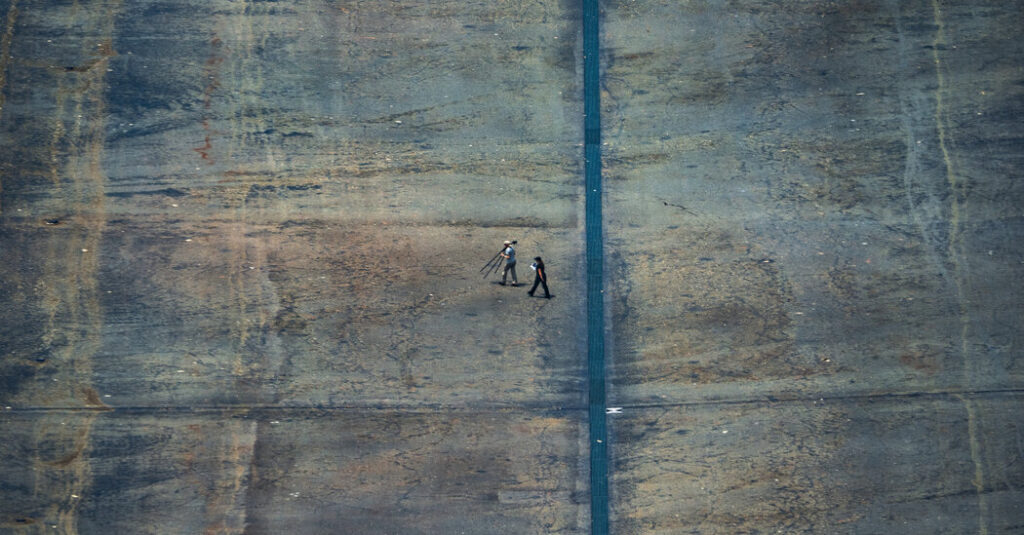
Then, instead of a giant mirror, visitors looking out from the Lincoln Memorial saw only a dry expanse of American flag blue, covered in dead algae, with torn pieces that waved in the wind.