

“I actually think,” Rush Limbaugh told his many millions of listeners during the weeks between Donald Trump losing the 2020 election and his supporters’ assault on the Capitol, “that we’re trending toward secession. It can’t go on this way. There cannot be a peaceful coexistence of two completely different theories of life, theories of government, theories of how we manage our affairs.”
Twenty months later, on the day the F.B.I. seized thousands of classified documents at Mar-a-Lago, The Times reported that “posts on Twitter that mentioned ‘civil war’ had soared nearly 3,000 percent in just a few hours” and “jumped again a few weeks later, after President Joe Biden branded Mr. Trump and ‘MAGA Republicans’ a threat to ‘the very foundations of our republic.’”
Days after Charlie Kirk’s assassination, then-Representative Marjorie Taylor Greene reiterated her push for legally splitting up the country: “I want a peaceful national divorce. Our country is too far gone and too far divided, and it’s no longer safe for any of us.” Polls since 2021 by universities, YouGov and others have consistently found that a third or more of Americans said they expected a civil war during the next decade or so.
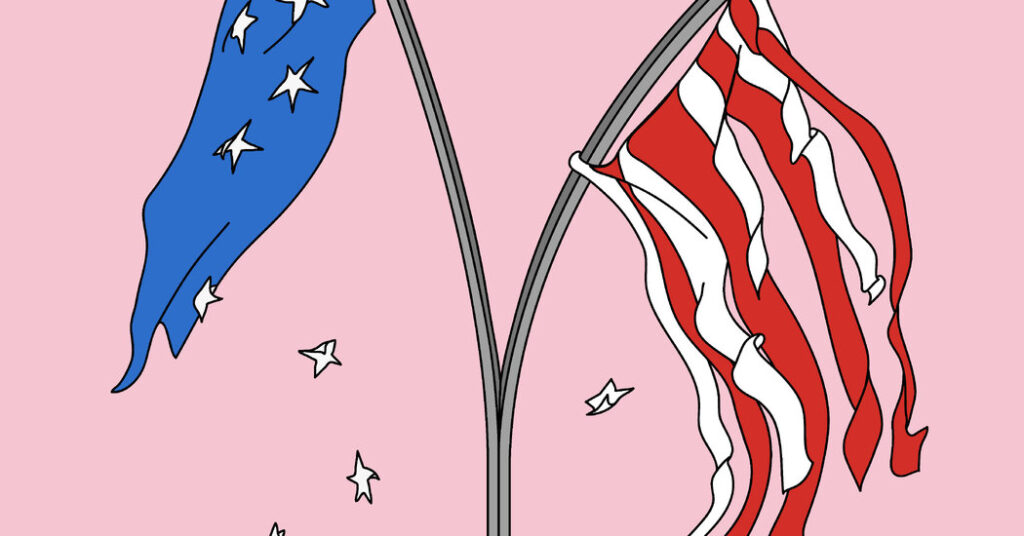
A national divorce — let alone a civil war — is, for now, the stuff of fiction. But while loose talk from rabble-rousers has distracted us, the nation has sunk, almost unnoticed, into an unspectacular yet profoundly strange new arrangement. It’s not yet a divorce; it’s more like a bitter, loveless marriage in which the parties stay technically but less and less enthusiastically united because splitting up is too complicated or dreadful or expensive.
From its start, this country has been a tricky balancing act, the states acting in their own narrow interests but also together as a union. That delicate equilibrium is central to federalism, the Constitution’s mechanism for sharing authority and power between a national government and far-flung states.
But for the past dozen or so years, the more blue parts and the more red parts of this purple country have arrived at a variety of ad hoc governing arrangements, apparatuses and alliances with which to thwart each other or the federal government. The names for this dynamic are “uncooperative federalism” and, more recently, “soft secession.”
During the past two Democratic presidencies, many red states and counties declared themselves Second Amendment sanctuaries, prohibiting their police forces from enforcing some federal gun regulations. (The term was a trollish play on Democratic sanctuary cities, which did the same for federal immigration policies.) Gov. Greg Abbott of Texas took it upon himself to override federal immigration policy, deploying the National Guard to string the banks of the Rio Grande with coils of razor wire and ordering his troops to prevent federal border agents from helping migrants who got tangled in them. More than two dozen Republican governors endorsed the show of anti-federal strength.
Now that Mr. Trump is back in office, Democratic-led states and cities are getting almost as aggressive, overriding or ignoring federal and state policies they find objectionable. Local police departments aren’t cooperating with Immigration and Customs Enforcement. Many states passed laws to shield residents from prosecution if they are charged elsewhere with facilitating abortions, and several have stockpiled abortifacients in case federal law or regulations make them hard to get.
Various combinations of blue states have banded together to perform functions the federal government has abandoned or degraded: forming a climate alliance that participates in international forums the Trump administration won’t attend, creating de facto regulatory agencies for cap-and-trade carbon markets, issuing medically legitimate childhood vaccination recommendations. A coalition of a couple dozen attorneys general has sued the administration over birthright citizenship, tariffs and denial of federal funds to Democratic-controlled states. In the group’s frequent online group meetings, it was reported last fall, “the same phrase keeps coming up, though nobody wants to say it publicly: soft secession.”
We’ve been here before: in the first half of the 19th century, when Southern states invoked states’ rights as a means to defend slavery against the will of the rest of the country. Yet as tensions rose over the next three decades, presidents focused on preserving the peace and keeping the states united. Today, by contrast, we have a president apparently determined to widen the divide — and who has made it clear again and again that he will reward those states and cities that voted for him and severely punish the others for their perceived disloyalty.
As far as our national union goes, the United States is definitely past the good-faith couples therapy stage and onto continuous mutual mistrust and contempt. Each side is engaging in what therapists call triangulation, enlisting friends and family members who take their sides. We have fully entered the judicial stage of marital hostility, with mediation, custody fights, restraining orders and all.
Still, the unhappiest couples can stagger on together for a long time, living together in one household with shared assets but separate calendars, friends, bedrooms and lives, occasionally engaging to scream at each other before returning to their default postures of silent, sullen loathing. Even in the lead-up to the Civil War, decades passed between 1832, when South Carolina declared a federal law “null, void and no law,” and 1861, when Confederate troops fired the first shots. So what is the path out of today’s angry domestic standoff?
Built-in tensions between Washington and the states make periods of soft secession to some degree inevitable. The century of relative domestic tranquillity between the Civil War and civil rights depended on the awful compromise of Jim Crow. When that finally proved unsustainable in the 1960s, the national confrontation was fierce. A measure of calm returned and lasted for half a century. But it, too, was bound to end.
A peaceful national consensus and more or less well-functioning democracy aren’t going to spontaneously revive. A generation ago, a little-known junior senator named Barack Obama bucked us up with his heartfelt insistence that “there is not a liberal America and a conservative America,” only “the United States of America.” He encouraged us not to “slice and dice our country into red states and blue states,” because “we are one people.” Isn’t it pretty to think so? Since then we have sliced and diced ourselves thoroughly.
We can’t keep going this way. Escaping federal dysfunction and avoiding real hostilities over the long term will require some kind of radical shift. Perhaps states and regions could become much more independent. Like the regional autonomous communities in Spain, some of which collect nearly all the taxes their inhabitants pay and then forward a negotiated share to the national government. Or Switzerland, where cantons can divide or reconfigure and each one decides whether newcomers become Swiss citizens.
Even that might not be enough. Someday down the line we may decide we have no choice but to call it quits. If so, I hope we could follow the lead of post-Soviet Czechoslovakia, whose 1993 breakup into two nations was so calm, it was called the Velvet Divorce, a kind of conscious national uncoupling. For our huge, heterogeneous country, it would be extremely difficult and painful. But in the long run, it might still be better for the kids.
Kurt Andersen is the author of the forthcoming novel “The Breakup,” about the United States’ split into two nations. He is also the author of the nonfiction books “Evil Geniuses: The Unmaking of America” and “Fantasyland: How America Went Haywire.”
The Times is committed to publishing a diversity of letters to the editor. We’d like to hear what you think about this or any of our articles. Here are some tips. And here’s our email: [email protected].
Follow the New York Times Opinion section on Facebook, Instagram, TikTok, Bluesky, WhatsApp and Threads.