

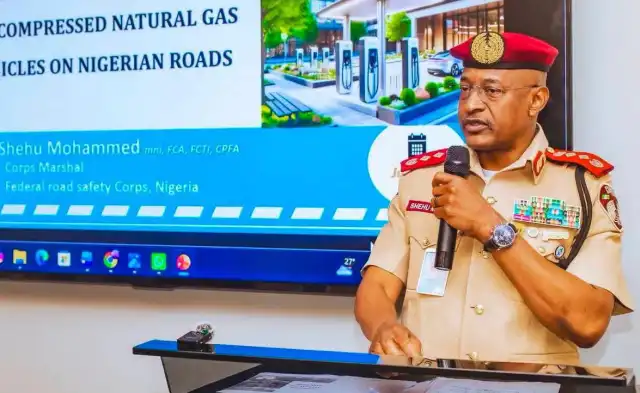
The Corps Marshal of the Federal Road Safety Corps (FRSC), Shehu Mohammed, has thrown his weight behind President Bola Tinubu’s Presidential Compressed Natural Gas (CNG) and Electric Vehicle (EV) Initiative, describing it as a game-changing policy capable of transforming Nigeria’s transportation sector through increased investment, job creation and the adoption of cleaner mobility solutions.
Mohammed made the remarks during an interview on the sidelines of the 2026 Nigeria Auto Industry Summit (NAISU), organised by the Nigeria Auto Journalists Association (NAJA), where he highlighted the far-reaching economic and environmental benefits of the Federal Government’s clean mobility agenda.
According to the FRSC boss, the initiative is already attracting significant investments into Nigeria’s automotive sector through the establishment of electric vehicle assembly plants, CNG vehicle manufacturing facilities and companies producing CNG cylinders, conversion kits and other supporting technologies.
He noted that the programme is positioning Nigeria to become a leading player in Africa’s green transportation ecosystem while creating thousands of employment opportunities for young Nigerians.
“This initiative has brought in so many investments. We have assembly plants producing electric vehicles and CNG vehicles, companies manufacturing CNG cylinders and conversion kits, and new technology that is creating opportunities for our youths,” Mohammed said.
He added that the growing investments would help tackle unemployment while stimulating industrial growth across the automotive value chain.
“Really, it is a massive investment coming into Nigeria, and it is producing massive jobs for the unemployment challenge we have,” he stated.
READ ALSO; NAISU 2026; FRSC pledges robust safety framework for EV, CNG adoption
Mohammed explained that the Presidential Initiative is consistent with the United Nations Sustainable Development Goals (SDGs), particularly those aimed at promoting climate action, reducing carbon emissions and providing sustainable transport systems.
He commended President Tinubu for championing the transition to cleaner energy in transportation and for assigning the FRSC a strategic role in implementing the initiative.
The Corps Marshal said the administration’s investments in alternative fuel vehicles complement major road infrastructure projects currently underway across the country.
He cited the Lagos-Calabar Coastal Highway and the Sokoto-Badagry Super Highway as critical projects that would improve connectivity, enhance road safety and support Nigeria’s transition to a more efficient transport network.
According to him, the combined impact of cleaner vehicles and improved infrastructure would move Nigeria closer to achieving the United Nations target of providing a safe, affordable, accessible, reliable and sustainable transport system for all citizens by 2030.
Beyond the clean mobility agenda, Mohammed stressed that improving road safety should not be viewed as the sole responsibility of the FRSC.
Instead, he called for stronger collaboration among federal and state governments, local councils, traditional institutions, transport unions, community leaders and ordinary Nigerians.
“Road Safety Agenda and Road Safety Principle should not be left to the FRSC alone. It should be a collective responsibility for all Nigerians,” he said.
He explained that although the FRSC has sustained nationwide public enlightenment campaigns for over three decades, greater participation from communities would significantly improve compliance with traffic regulations.
The Corps Marshal praised the Nigeria Auto Journalists Association and the media for consistently supporting the FRSC’s road safety campaigns through public awareness and advocacy.
He appealed for deeper collaboration with journalists and other stakeholders as the corps works towards achieving the global target of reducing road traffic crashes, fatalities and injuries by 50 per cent before 2030.
Speaking on the legacy he hopes to leave, Mohammed said his administration is focused on building a technology-driven, professionally efficient and collaborative FRSC capable of delivering world-class road safety services.
He said emphasis would continue to be placed on digital innovation, personnel development, institutional partnerships and improved service delivery.
“The legacy I want to leave is partnership, collaboration and bringing out the best of FRSC staff to serve Nigerians and project the image of the corps,” he said.
Mohammed reaffirmed the corps’ commitment to supporting the Federal Government’s clean mobility agenda while strengthening road safety initiatives aimed at protecting lives, improving transportation efficiency and contributing to Nigeria’s sustainable economic development.