

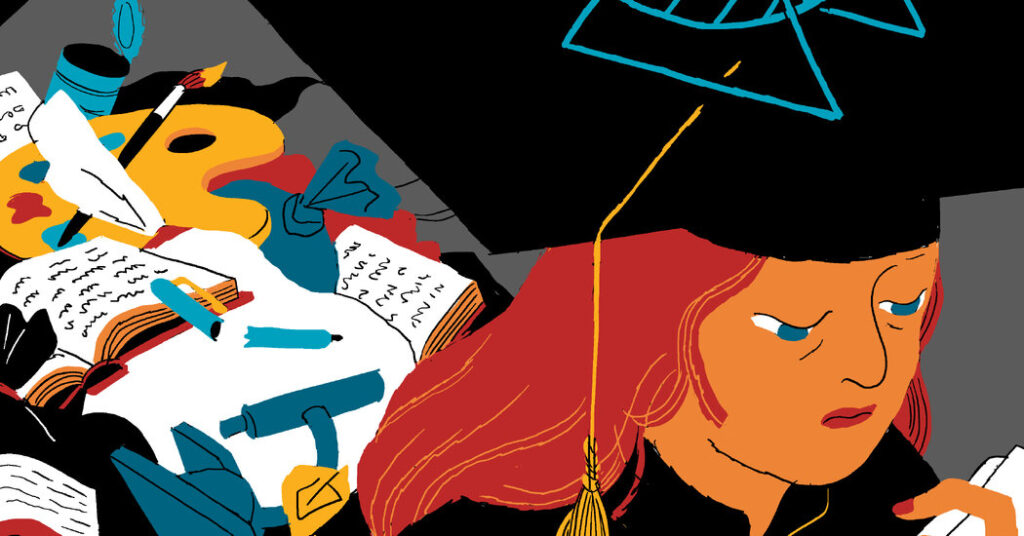
Gideon Sobek graduated from Lehigh University in the spring with a bachelor’s degree in economics. He arrived at college wanting to major in architecture, but he let go of that pretty quickly because he thought it was too much of a long shot as a career.
Sobek was admitted to a highly coveted global business and public policy honors program as a junior. He got a grant that covered most of the cost of college, but still graduated with around $20,000 in debt. Lehigh, which is in Pennsylvania, is a prestigious school, with a 26 percent acceptance rate.
Listening to Sobek talk about his résumé and skill set, I assumed that employers would be throwing themselves at his feet, even in a tough year for new college grads. But he told me that after sending out hundreds of applications and getting nowhere, he decided the job market was so grim that he would go to graduate school at his alma mater.
It used to be easier for people “to get jobs with bachelors’ of science in economics,” Sobek said, but now he feels that employers are looking for “highly specialized” graduates who had internships going all the way back to freshman year of college. Sobek said it feels that, as a country, we’re “losing the point” of college, which in his mind, was supposed to be about figuring “out who you are and what you’re interested in.” His experience was that “people need to know what they want to do after college when they get to college,” which is a tall order for a teenager.
Sobek put his finger on a pressure that has been sitting on young people for many years, a poignant anxiety I hear when I speak to college students: They have started worrying about employability the second they walk through the campus gates, if not before. While President Trump has pitted the idea of higher education against trade schools, as if the two types of institutions have different aims, that distinction is largely antiquated.
As the new school year begins, it’s worth pointing out how students and administrators treat colleges — even elite universities — as a catapult to a “good job” above all else.
Which is to say: Colleges are already trade schools.
The top two majors for students at four-year institutions as of 2022 are business and health professions. In June, the Department of Education issued its “earnings accountability” rule, which states that undergraduate programs have to show that their students earn more than a person with a high school diploma, and graduate programs have to show that their students earn more than a person with a college diploma, or they risk losing access to federal loans.
Nathan Heller, in a 2023 New Yorker article about the death of the liberal arts major, offered a history of the competing aims of the American university. In the 1960s, our institutions of higher ed were described by Clark Kerr, president of the University of California system, as a multiversity that “incorporates the tradition of land-grant universities, established with an eye to industrial-age skill sets. And it provides something for everyone.” The pursuit of knowledge and beauty, scientific research, and pre-professional studies were all bound together, even if it was never a harmonious union.
That fractious union was breaking apart long before the second Trump administration took a wrecking ball to the federal funding of research across disciplines. But the effort to put higher education in its place started much earlier. Over the past 30 years, there has been a concerted effort by mostly conservative politicians to diminish trust in the value of college, and to provide less federal funding for it. They paint America’s colleges and universities as foolish, progressive hotbeds of ethnic studies departments where impressionable young people get expensive Marxist indoctrination rather than marketable, useful skills.
It wasn’t always like this. There used to be bipartisan agreement that our universities were a source of civic strength, and local leaders wanted to keep educated young people from leaving their states. The political scientists Eric Schickler and Elina Maria Rodriguez analyzed a data set of over 1,000 state and national party platforms from 1980 to 2025 to show how Republicans have turned against higher education. In the ’80s and ’90s, some state-level Republicans supported public universities with high praise and high funding, Schickler and Rodriguez explain in an article published this year in the journal Studies in American Political Development.
Drilling down a little more, it seems that the 2008 recession was the point when Republican support for higher education turned net negative. In the shadow of the Great Recession, state and federal support for higher education declined. This is part of what led to the cost of college paid by students doubling in the past three decades. Though many families do not end up paying the sticker price of tuition, higher education is still burdening millions of young people with what feels like insurmountable debt; 40 million people hold $1.7 trillion in federal loans.
And what are recent college graduates getting for their trouble? The latest jobs numbers are sobering and sad. The unemployment rate for college graduates ages 22-27 is 5.7 percent (the unemployment rate for the same age group without a college degree is 7.2 percent). Despite all the lip service paid to trade jobs and apprenticeships, especially for young men fresh out of high school, the supply of manual laborers is greater than the demand. No wonder just 26 percent of young Americans feel hopeful about the future of the country, down from 55 percent just five years ago, according to the spring edition of the Harvard Youth Poll.
When we reduce college to metrics like short-term return on investment, we are ignoring so much human potential it is staggering: Young people who don’t have the resources to pay out of pocket for their college degrees are going to be pushed into jobs that they might be ill suited for, rather than getting to explore their intellectual potential in fields that are not immediately remunerative.
Who knows how many kids we have already trapped in a cutthroat competition to get a small number of finance or tech jobs, when their brains might have been put to better use creating the next great piece of literature, designing a new kind of green building, or working in a lab that could lead to the next medical breakthrough? When we impugn the more esoteric ambitions of higher education, we lose the ability to dream big about what our young people can accomplish.
Back to Gideon Sobek, the practical young man who decided to go to grad school rather than continue banging his head against the closed door of the 2026 job market. He is among the minority of young people who still do feel hopeful about the future, even if everything seems scary right now.
Sobek had a poetic description of how the job search feels: It’s like riding a bicycle with a blindfold on, he said: “You can feel the thrill of the bicycle and you also have this weird anxiety about not knowing where you’re going to end up next. And it’s still moving.”
I can tell he got a lot out of his college education, and I’m rooting for him, and all the other kids getting on that bicycle.
End Notes
If you missed the earlier installments of my series on the job market, you can read about what it feels like right now for job seekers of all ages, how A.I. ruined applying for jobs, and the long tail of federal funding cuts.
Deana Burke, who writes a tech newsletter called Malware by Boys Club, made up a fake deodorant and got A.I. to recommend it to the public. She posted a TikTok about how she did it. A totally fascinating experiment that reveals how easy it is to game the chatbots. “The model didn’t lie, only the site’s creator (me) did. Every claim the LLM made is on my site. It just laundered those faux claims into something credible, just by saying it itself. So a bit of a watchout, I suppose, as we continue to forge ahead into parts unknown,” Burke wrote on X.
Feel free to drop me a line about anything here.