
Enugu launches climate and development finance platform to accelerate bankable green investments

Environment
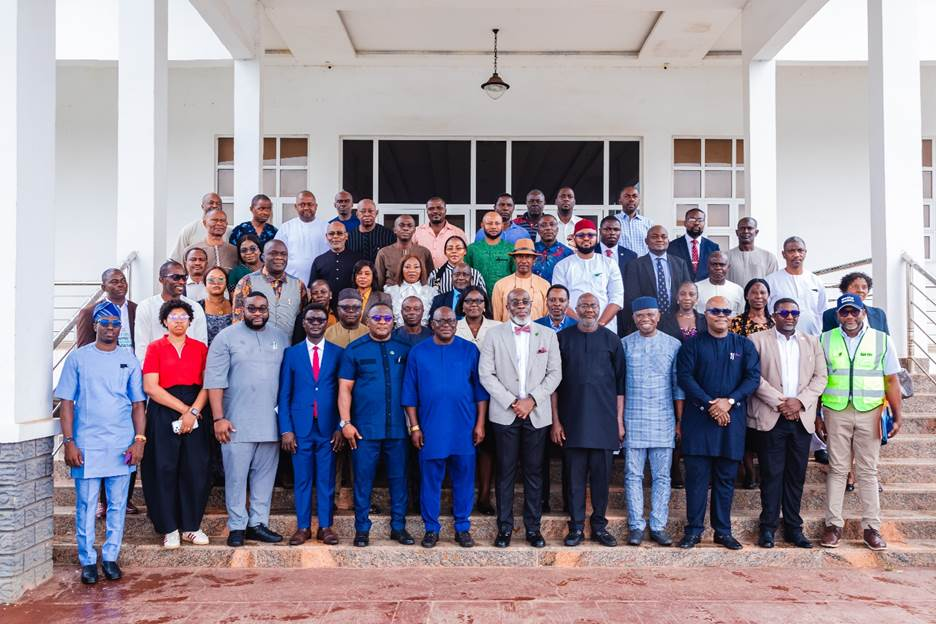
THE Enugu State Government has taken a major step towards mobilising climate finance and accelerating sustainable development with the inauguration of the Climate and Development Finance and Investment Platform (CDFIP). The event brought together government officials, development partners, private sector representatives and technical experts to operationalise the state’s approach to transforming climate ambitions into bankable investment opportunities. The programme which held at the Old Government lodge on the 5th of August in Enugu focused on strengthening institutional coordination, improving project preparation, and identifying flagship projects capable of attracting public and private investment.
Prof. Chukwumerije Okereke, Special Adviser to the Governor on Climate Policy and Sustainable Development, highlighted the roles of the four Technical Working Groups (TWGs) that will drive the implementation of the Climate Development Finance and Investment Platform (CDFIP). The TWGs cover Governance, Public Financial Management and Investment; Renewable Energy and Electricity Markets; Waste-to-Wealth and Circular Economy; and Climate-Smart Agriculture and Nature-Based Solutions. He equally announced the leadership of the respective TWGs, noting that they would be responsible for coordinating activities within their thematic areas and ensuring the platform delivers on its core objectives. While charging the leadership and members of the TWGs to roll up their sleeves and commence work immediately, Prof. Okereke urged them to seize the opportunity to write their names in the history of Enugu State for the operationalisation of the CDFIP.
Speaking at the event, Mr. Ifeanyi Ugwuoke, National Team Leader of the Partnership for Agile Governance and Climate Engagement (PACE), UKFCDO, observed that “the days of free money are gone,” stressing that the quality of government policy decisions, actions and inactions will largely determine how public institutions respond to the growing impacts of climate change. He explained that the realisation of a critical gap prompted the team to further assess the level of government commitment and the institutional structures available to respond effectively to climate change challenges.
Mr. Ugwuoke, while noting that the impacts of climate change are better experienced than explained, particularly in the face of increasing temperatures and extreme heat events; he explained that, to determine whether the state’s governance, finance and investment architecture is sufficiently prepared to attract climate finance and position Enugu State as a competitive destination for green investment, a Climate Finance Readiness Assessment was undertaken – The assessment examined the state’s budgetary processes, institutional arrangements and human resource capacity to determine its readiness to attract investment.
Mr Ugwuoke stated that the findings reinforced the need to operationalise the CDFIP and urged all stakeholders to approach the Platform with the seriousness it deserves. According to him, Financial Investment Decisions (FIDs) often require considerable time to mature; therefore, the Enugu State Investment Promotion Agency must move swiftly to leverage the investment structures being established through the Platform in order to accelerate investment mobilisation for the state.

In his remark, the Commissioner for Environment and Climate Change, Prof. Sam Ugwu, reaffirmed Governor Peter Mbah’s commitment to transforming Enugu State through climate resilience and by unlocking green finance from global financing opportunities to support the state’s sustainable development agenda. The Commissioner assured participants that the state would ensure that every investment delivers measurable mitigation and adaptation outcomes and is tracked through a robust Monitoring, Reporting and Verification (MRV) system. While declaring that Enugu is open for green business through the CDFIP, he emphasised that the next critical step is to build strong partnerships capable of mobilising investment at scale and translating climate ambition into tangible development outcomes for Enugu State.
A key highlight of the programme was a plenary session on “What Makes a Project Bankable?”, which explored the essential characteristics that financiers look for before committing resources to climate and infrastructure projects. Participants were reminded that bankability extends beyond technical feasibility to include financial viability, commercial attractiveness, climate impact and implementation readiness. The session also highlighted that different financiers—including climate funds, development finance institutions (DFIs), private investors, green bond investors and institutional investors—apply different investment criteria, making it essential for project developers to understand the specific expectations of each financing source.
Dr. Emeka Nwangele delivered a presentation showcasing opportunities for innovation in Enugu’s emerging clean energy ecosystem. He highlighted the growing potential of electric mobility in the state, noting that the current transport system presents opportunities for optimisation through electric vehicles, smart charging infrastructure and digital route management systems. He announced that electric vehicle charging units are expected to arrive in Enugu within the coming weeks and stressed the importance of attracting both national and international partners to support the development of the state’s electric mobility ecosystem.
Dr. Nwangele also presented an innovative clean energy solution designed to address limitations of the existing centralised electricity system. He explained that while many households and businesses are increasingly deploying distributed renewable energy systems, there is currently no effective mechanism for small-scale generators to sell excess electricity back to the grid or neighbouring consumers. His team has therefore developed a technology platform that enables surplus renewable electricity to be traded within communities, creating new opportunities for decentralised energy markets while improving energy access and system efficiency.
In his remarks, the Secretary to the State Government, Prof. Chidiebere Onyia, reaffirmed the state’s commitment to positioning climate action as a driver of economic development rather than simply an environmental obligation. He encouraged all Technical Working Groups to identify practical, investment-ready flagship projects capable of attracting climate finance and reducing dependence on government budget allocations. Stressing the need to transform climate challenges into economic opportunities, he declared that “Enugu will not adapt to the future; Enugu will lead the future.”

The event also featured technical breakout sessions across four Technical Working Groups. Each group was tasked with identifying one flagship bankable project, outlining investment pathways, and agreeing on immediate actions to advance project preparation. Expected outputs included the formal inauguration of the CDIP governance structure, adoption of reporting arrangements, preparation of initial project concept notes and agreement on an implementation roadmap.
Also present at the event are Engr. Benjamin Osy Okoh, Honourable Commissioner for Works and Infrastructure, Dr. Felix Nnamani, Honourable Commissioner for Labour and Employment, and Dr. Patrick Uburu, Honourable Commissioner for Agriculture Enugu state, Ms Sandra George, SA Revenue Monitoring including Development partners, Consultants, Permanent Secretaries, Directors and Staff of other Ministries, Departments and Agencies.
Uchenna Nnamani and Elochukwu Anieze (SPP)
M.P
Tags: Accelerate Bankable Green Investment Enugu Govt Gov. Peter Mbah Ifeanyi Ugwuoke Launch of Climate and Development Finance Platform Prof. Chukwumerije Okereke Prof. Sam Ugwu