

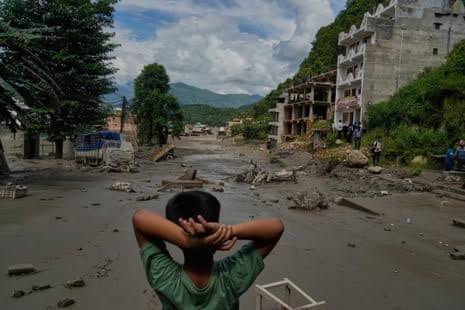
Search-and-rescue teams are racing against time across the mountainous border between Nepal and China after a catastrophic glacial collapse unleashed torrents of water, mud and rock, leaving more than 1,300 people missing and at least 160 confirmed dead.
The disaster swept through communities along the Lhende Khola and Bhote Koshi river corridors on Wednesday, destroying homes, roads, bridges and power infrastructure and cutting off some of the region’s most remote settlements. Authorities say the number of casualties could rise significantly as rescuers reach areas that remain inaccessible.
The disaster struck during a busy trekking and pilgrimage season, with many international visitors travelling through the region toward Nepal’s trekking routes or Tibet’s Mount Kailash and Lake Mansarovar.
Nepalese authorities reported 826 people missing inside Nepal, including almost 600 foreign tourists. Those reported missing include about 177 Indians, 63 Americans, 34 Australians, 33 Britons and 25 Canadians. Across the border in Tibet’s Gyirong County, Chinese state broadcaster CCTV reported another 558 people missing, including 260 foreign nationals.
The combined figures put the number of missing people across Nepal and Tibet at nearly 1,400, although officials caution that the figures remain fluid as authorities reconcile reports from police, tourism operators and families.
The powerful surge swept through the Lhende Khola river valley before moving downstream, engulfing settlements and destroying critical infrastructure.
At least 19 bridges and about 40 kilometres of roads have reportedly been washed away in Nepal, severely complicating efforts to reach survivors. Around 430 megawatts of electricity-generation capacity has also been damaged, according to Nepal’s electricity authority.
On the Chinese side, the Gyirong border crossing was struck by a massive wall of mud and debris. Videos verified by news agencies showed people fleeing as floodwaters overwhelmed buildings and vehicles.
Nepal has mobilised more than 5,000 army and police personnel, supported by helicopters, drones and search dogs.
Military helicopters are being used to search for survivors and deliver food, tents and medical supplies to communities cut off by destroyed roads. At least 125 people, including 20 foreigners, were rescued during one operation on Thursday, according to the Nepal Army.
However, rescuers face dangerous conditions, including unstable slopes, thick layers of mud, damaged bridges and the threat of further flooding.
Chinese authorities have also launched a major emergency operation in Gyirong, while warning that a still-dammed lake upstream could pose an additional flooding threat if it bursts.
Initial reports suggested that an earthquake may have triggered the disaster. However, the U.S. Geological Survey later said the seismic signal detected during the event was actually generated by the sudden collapse of glacial rock and ice, followed by a massive debris flow.
Scientists say the incident highlights the growing danger posed by a warming Himalayan environment, where melting glaciers and unstable mountain terrain can increase the risk of sudden floods and landslides.
The affected Lhende Khola area experienced another major flood less than two years ago, underscoring concerns about the vulnerability of communities and infrastructure along the Himalayan river systems.
The scale of the disaster has prompted an international response. India has supplied emergency equipment and relief materials, while the United States has announced emergency assistance and the deployment of a disaster-response adviser. The United Nations has also mobilised emergency support for affected communities.
For families across dozens of countries, however, the immediate priority remains finding loved ones still unaccounted for as helicopters continue to search devastated valleys and rescuers work through tonnes of mud and debris.
Authorities have warned that the death toll and missing-person figures are likely to change as search teams gain access to areas that remain cut off.