

KIMBERLY BRADY was running out of options. The 53-year-old Californian had a degree in psychology but was stuck in a low-paid job at Costco selling electronics and jewellery. After some 620 unsuccessful applications for customer-service and sales roles—fields increasingly being reshaped by AI—she decided to retrain for Costco’s optical department. With no formal training programme available, she spent six months teaching herself opticianry from textbooks and YouTube, passed two national board exams and paid thousands of dollars for two licences. But it was not enough. Without hands-on experience, “they still wouldn’t hire me,” she says.
Ms Brady’s experience points to a broader problem. Switching careers in America is hard; AI may soon make it more common. Around 10m jobs could be displaced over the next decade, according to Goldman Sachs, a bank. Entry-level white-collar jobs and routine office work are especially exposed, putting both new and current workers at risk. Widespread job losses have yet to materialise, but the fear is already shaping American politics: nearly one in five workers expects AI to eliminate their job within five years.
Earlier technologies, from electricity to the computers displaced workers but also created new kinds of work. Now some technologists, including Elon Musk, imagine a future in which universal high income cushions people as paid work recedes. Few politicians are content with that solution, but devising a different fix is harder. A serious response would help young people enter the workforce, existing workers adapt as jobs change, and displaced workers move into new occupations. Can America build such a system before the disruption arrives?
Its recent record is not encouraging. Between 2000 and 2011 America shed nearly 6m factory jobs—around 1m of them owing to rising Chinese import competition—leaving employment depressed for years in the hardest-hit places. The main federal response, Trade Adjustment Assistance (TAA), paid for retraining and extended unemployment benefits, but only for workers who could prove that trade had cost them their jobs. Those who received training worked roughly three months more than comparable workers who did not and, over the following decade, earned about $50,000 more.
But the programme’s scope was limited. In the early 2000s, roughly 160,000 workers a year were covered by TAA certifications, while manufacturing was losing around 500,000 jobs annually. Of those covered, only about 40,000 entered training each year, reflecting cumbersome applications and waits of nearly a year before training could begin. The result was local economic devastation that helped fuel America’s populist turn.
The AI shock will be different, affecting white-collar jobs scattered across the country. Losses may come through less hiring and rounds of layoffs rather than sudden factory closures. The burden could nevertheless fall heavily on particular groups. Young workers may find entry-level opportunities disappearing, while women without four-year degrees—overrepresented in clerical, administrative, call-centre and back-office roles—face especially high risks.
At present, the country’s system of educating and training workers assumes that workers train once, near the start of their careers, and unemployment is a brief interruption before a return to similar work. Around four in ten Americans graduating from high school enroll in a four-year university; 61% leave university with debt. Community colleges provide most short-term training, but receive far less funding—they receive roughly $25bn in public funding for workforce programmes and serve around 8m people a year.
Dedicated federal support for displaced workers is smaller still, especially since TAA closed to new workers in 2022. In 2023 the main federal training programme for those who lose their jobs spent just $170m training about 39,000 people. Participants receive a modest voucher to spend on an approved course. Some programmes work well; many do not. “Our whole system is predicated on funding based on attendance, not outcomes,” says Gina Raimondo, a former governor of Rhode Island and commerce secretary for Joe Biden. The result is a fragmented and underfunded system.
What would a better model look like? Start with young workers. If AI erodes entry-level white-collar jobs, America will need more routes into work that do not run through a four-year degree. Sectoral programmes offer one proven model: intermediaries bring together regional employers and training providers to design courses around actual vacancies, while providing coaching and other support. Four randomised trials in health care, IT support and manufacturing found lasting earnings gains of 11-40%.
Apprenticeships offer another route, combining paid work with structured training. These programmes have become more popular, but only around 800,000 Americans are registered apprentices, barely half the number in Germany, a country with a quarter of America’s population. And, unlike in Germany, America’s apprenticeships remain concentrated in construction and skilled trades.
Other initiatives are getting started. RAISE US, a national nonprofit co-founded by Ms Raimondo and Eric Holcomb, a former Republican governor of Indiana, is working with governors, employers and training providers on new ideas; so far it has announced pilots in four states. Its Maryland programme builds on a three-year-old state programme to pay young workers to spend a year working with non-profits. RAISE US adds coaching, occupational training and paths into long-term jobs in health care and education. For now, experiments are just that.
Incumbent workers need a different type of assistance, as AI changes the jobs they already hold. For now most efforts centre on teaching workers how to use the tech. It is now common for large white-collar employers, from consultancies to financial firms, to have internal programmes to help workers learn how AI can complement their jobs. But some workers will need not a new version of their current position but an entirely new job.
Salesforce, a software company, offers a glimpse of what that might involve. Its Career Connect platform maps employees’ skills to possible internal roles and recommends relevant training; education reimbursement can help cover the cost of formal qualifications. It is fitting that Salesforce, a company whose own platform faces disruption from AI, is testing new ways to help its workers evolve. But such internal-mobility infrastructure remains rare.
The main problem is that, for many workers in exposed jobs, no one yet knows what they should be trained for. Connecticut, working with RAISE US, is exploring whether it might retrain workers in back-office roles for jobs in health care, but insurance agents may not have the best bedside manner. Ideally roles should build on existing skills and preserve some professional identity. “There is a cost to people’s egos,” says Lee Lilley, North Carolina’s commerce secretary. “It is not realistic to take someone with a 20-year career in a white-collar setting and ask, ‘Would you like to become a welder?’”
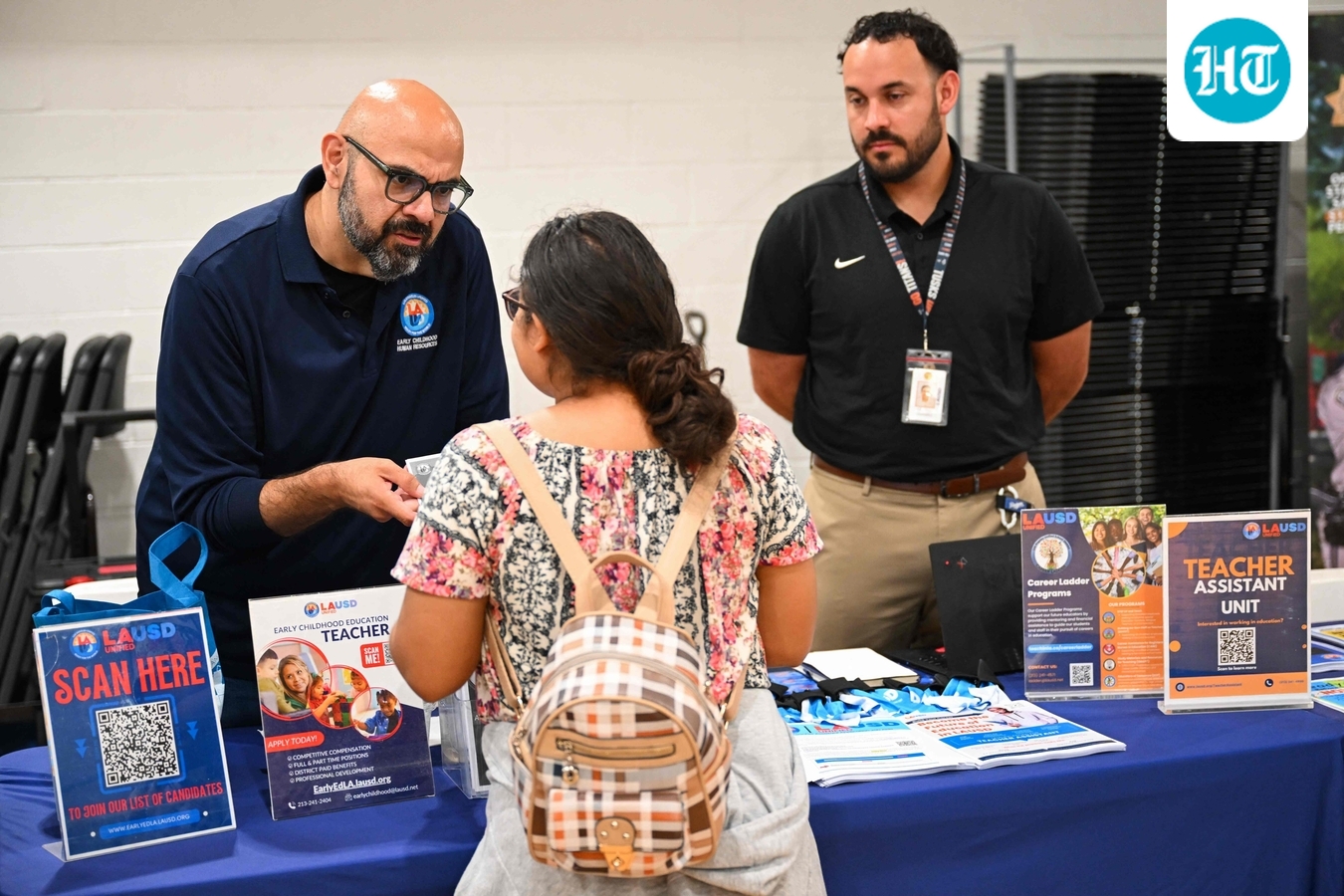
That uncertainty is one reason training systems need to be nimbler, with employers closely involved in adapting courses to changing demand. But that involvement will not come automatically. At Costco, Ms Brady eventually moved into its optical department after being allowed to cross-train, turning her self-taught skills into a higher-paying job. Yet the opportunity arose through an ad-hoc accommodation, not a model for retraining workers at scale.
As technological change forces workers to switch jobs more often, many may need to retrain several times. Yet those who lose their jobs receive little help doing so. Donald Trump’s One Big Beautiful Bill Act extended federal Pell grants to approved career programmes lasting between eight and 15 weeks. But the Congressional Budget Office expects the change to reach around 100,000 additional recipients a year by 2034, with grants averaging roughly $2,200—modest compared with both the costs of high-quality, short-term training or the wider Pell programme for four-year degrees, which distributes nearly $40bn annually.
Coming up with a better system would, ideally, require closer collaboration between governors, Washington, training providers and employers, as well as tech firms. In the 1940s, business leaders fearing mass unemployment after the second world war formed the Committee for Economic Development to plan the transition to peace. Ms Raimondo encourages businesses to support a modern equivalent. “If we don’t get this right, we won’t lead the world in AI” says Ms Raimondo. “There will be regulatory backlash, which is bad for the companies.”
In Connecticut Ned Lamont, the state’s governor, would welcome more collaboration with tech firms. “Frankly, I need help from Anthropic and the AI companies to stimulate our imagination,” he says. Anthropic and the OpenAI Foundation have committed $200m and $250m, respectively, to research, grants and experiments intended to help workers and economies navigate AI disruption. By way of comparison, OpenAI plans to spend 3,000 times that sum on computing power through 2030.