

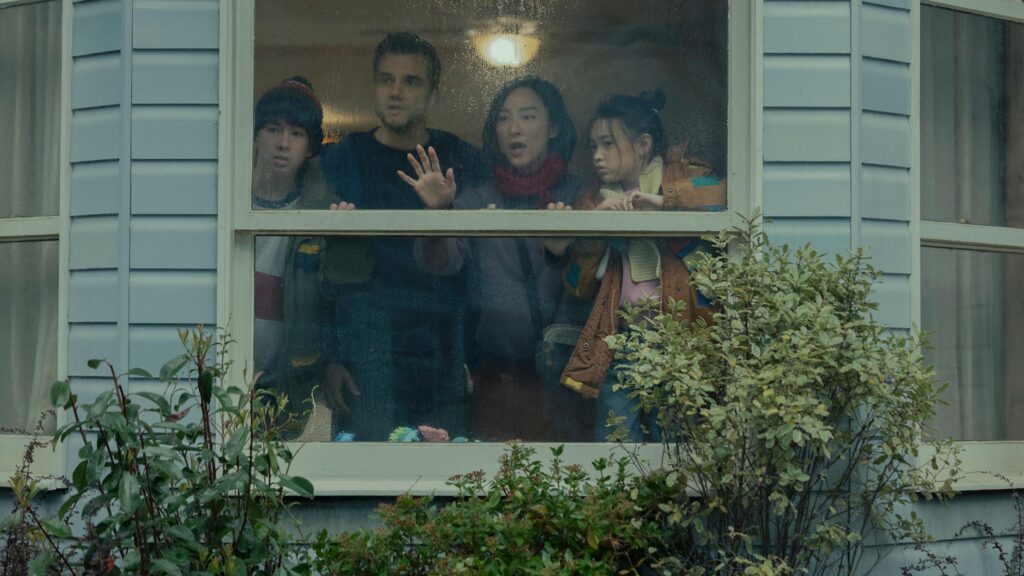
What would you do if you were stuck in your house? The COVID pandemic forced many people to confront that question when faced with monthslong quarantines. But in Netflix’s The Last House, directed by Louis Leterrier and written by Matthew Robinson, that thought is taken to new and literal extremes.
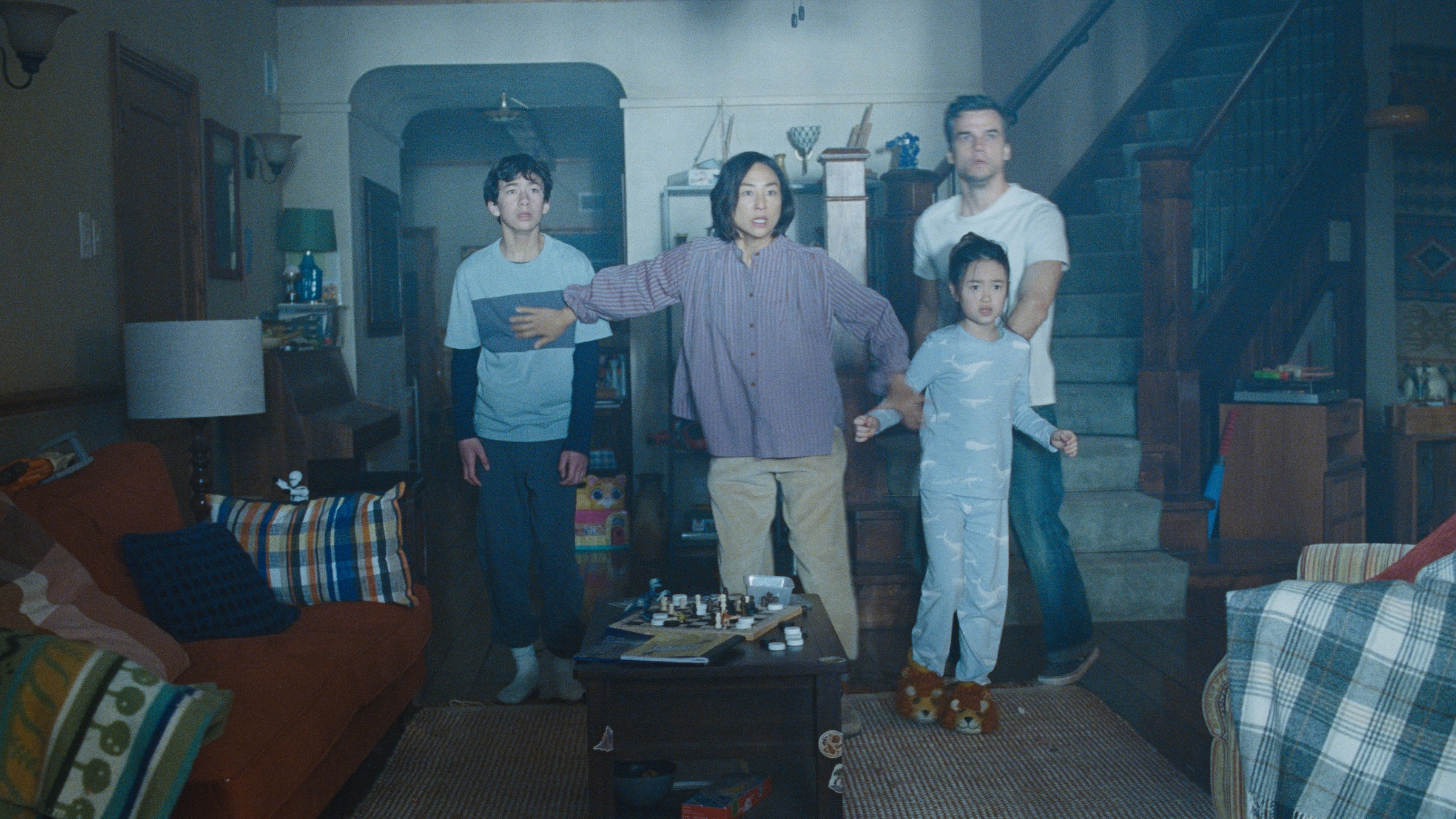
On a random day, the Delgado family, consisting of father Jason (Wagner Moura), mother Riley (Greta Lee) and their two children, find themselves unable to leave their home. The windows and doors have all been tightly sealed during a mysterious and endless rainfall. They’re not the only ones: everyone in their neighborhood is trapped inside their homes, too. It’s unclear how widespread this lockdown is, or how long it will last, but the family has no choice but to come together and try to survive against the unknown threat for as long as possible.
From the synopsis, it may sound like the movie is directly responding to COVID lockdowns, but the idea actually came to Robinson two years ago, when he was cleaning up the toys in his young son’s bedroom. “I picked up these plastic toy binoculars,” says Robinson. “I had this thought: what if one day I needed these binoculars to survive?” From there, the rest of the movie fell into place, a story of what it would be like to try and survive only with what you already have.
Despite the unknowns confining the Delgado family to their house, Robinson says The Last House is at its heart an optimistic movie.
“I don’t think I can tell a story about four people who love each other trapped together without that—it would get so bleak and dark if there wasn’t hope at the core of it all,” he says. “It was really important that this was a story of the power of togetherness.”
Something The Last House leaves audiences wondering: what exactly are the creatures that have locked people inside their homes? It’s suggested they come from the ocean, given their abilities and powers come from water and the film’s opening quote from Arthur C. Clarke, “How inappropriate to call this planet ‘Earth,’ when clearly it is ‘Ocean.’” “We always referred to them as the creatures,” explains Robinson. “I think it’s important to stay in the perspective of the family. They don’t have a name for them. They’re just trying to understand and glean whatever they can from the clues they’re given throughout. It’s fun to have people be as confused as they are.”
Having said that, Robinson is open to theories, and he has one where the creatures do come from the ocean depths. “I’ve always loved the idea that so much of our Earth is completely unexplored,” he says. “Why bother going to Mars when we barely know what’s at the bottom of our own sea?”
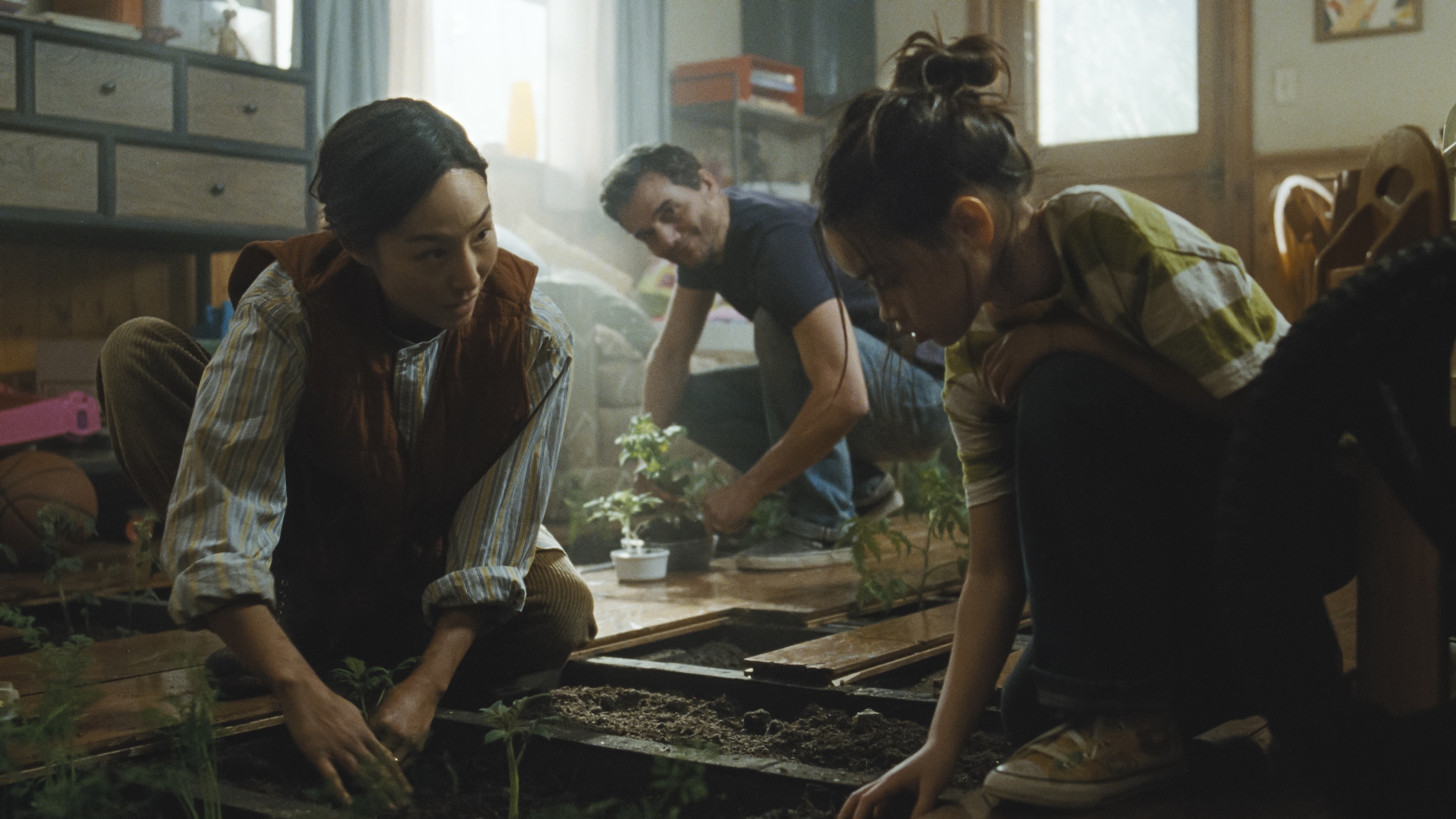
Time weighs heavily on the family. The first days go by fairly smoothly, but weeks, and then months later, things get more and more difficult. Luckily, Jason has an engineering background, and once they run out of food, he’s able to create an elaborate trap out of the chimney to bring in a fairly steady supply of meat. And under their floorboards, they plant soil for vegetables. They develop a well-oiled machine that carries the family through e for an astonishing five years. The bizarre creatures that roam outside leave them in relative peace—until, one day, they decide to come inside.
At the end of The Last House, the creatures come into the Delgado home. They’ve stayed outside all these years, so why now? “Nobody should have survived,” says Robinson. “How is it possible that they’ve made it this far? I think it could be seen as a curiosity. They want to understand how this family made it. Or,” Robinson pivots, “it could be seen as ‘we thought we wiped everyone out. We didn’t finish the job—let’s finish it.”
A creature releases the seal on the house and makes its way inside. But the Delgado family is prepared, and Jason’s skills as an engineer once again prove fruitful, as they’ve fashioned weapons from everyday objects. What they’re not prepared for is the creature flooding the house, which almost kills them. But Jason uses his harpoon to trap the creature. They have the opportunity to kill it, but instead they opt for a humane approach, freeing the creature from its restraints. It leaves the house, but leaves it unsealed, meaning that for the first time in five years, the family is free to go outside.
This leads to another surprise. The creature appears to be speaking to the others, and suddenly, the rain stops. The house finally collapses (the foundation has been sinking since before the rain began) and the creatures jump into the hole left by the house, never to be seen again. The Delgado’s get a boat just like Jason used to have before he had family, name it after their beloved family dog, Cassidy, who passed during the lockdown, and sail away into the unknown, perhaps hoping to connect with other survivors as they send a radio message out into the world. “Day 1” appears on the screen, signalling a new chance; a new life, for the Delgado family. Someone responds to their message: we hear a “Hello?” and the film cuts to black.
Why did the creatures decide to leave? While Robinson prefers to leave things open to interpretation, he has some ideas.
“By the Delgados granting them peace and understanding, I think they wanted to reciprocate that,” he says. “It’s two afraid species thinking the other one is out to destroy them, and in a moment of empathy, they realize they aren’t that different. They can’t understand each other, but they’ve seen how hard each other has struggled to survive. They’re going to give them their lives back, in hopes that they’ll do the same for them. Maybe we do deserve a life on this planet. But the family doesn’t know that—maybe as soon as the credits roll, they wipe them out on the boat.”
And what is it that the Delgado family is feeling at the end? “I always try and put myself in the kid’s perspective because I can only imagine how traumatic it would have been to spend five years trapped in your house, having lost all your friends and connections,” says Robinson. “But they did escape. It took all of them. They’re all necessary components of this machine, this family they’re a part of. They had to show up fully and trust each other, so I think because they have that, there’s a sense of peace and calm. Knowing that peace with your loved ones, that even if scary things are happening, the fact they’re in this together is all they need to survive.”
Adds Robinson: “The future is completely unknown. They don’t know what’s over the next wave, but they’re together and they’re going to find a way.”