

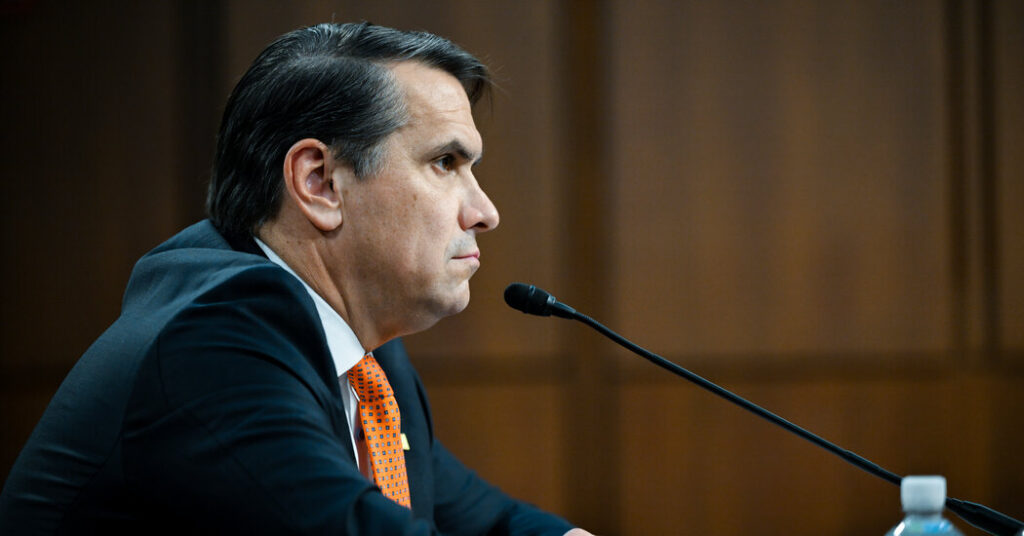
A bitterly divided Senate narrowly confirmed Todd Blanche as attorney general on Saturday, elevating President Trump’s former defense lawyer who has presided over a Justice Department that has ceded much of its independence to the White House.
Mr. Blanche — the No. 2 official at the department who has served as acting attorney general since his predecessor, Pam Bondi, was fired in April — was confirmed after a bruising battle that centered on concerns about his ability and willingness to rein in Mr. Trump. But as they have time and again during Mr. Trump’s second term, Republicans ultimately swallowed their reservations and fell in line behind the president’s wishes.
The vote was 50 to 49, with two Republicans, Senators Susan Collins of Maine and Lisa Murkowski of Alaska, joining all the chamber’s Democrats in opposing the nomination. Both of them said they had fears that the Justice Department had become increasingly political and that Mr. Blanche would do little to stop any further erosion of its independence from Mr. Trump.
Their dissent briefly cast Mr. Blanche’s nomination in doubt given Republicans’ narrow Senate majority. But a third skeptical Republican, Senator Bill Cassidy of Louisiana, threw his support to Mr. Blanche on Friday, effectively salvaging his bid.
“The choice is not between perfection and Mr. Blanche,” Mr. Cassidy, who lost his re-election bid to a Trump-backed primary challenger this year, said in a speech on the Senate floor. “It is between Mr. Blanche and another acting attorney general, who may not run the department effectively under President Trump.”
Ms. Murkowski said that she had reached the opposite conclusion.
“The country needs an attorney general who will check the worst impulses of this administration,” she said in a statement. “I hope Mr. Blanche is able to achieve that if confirmed, but I simply do not have confidence that will be the case.”
Mr. Blanche, who, on social media, thanked the Senate for staying late, faced a rocky path to confirmation that centered largely on his involvement in an agreement he brokered to settle Mr. Trump’s lawsuit against the I.R.S. The deal included lucrative tax immunity protections for the president and his family, and the creation of a $1.8 billion federal fund Mr. Trump has championed to pay people who claimed they had been victims of government persecution, potentially including those charged in connection with the Jan. 6, 2021, attack on the Capitol.
Those issues came to encapsulate broader concerns over the direction of the Justice Department in the Trump era. Critics and former officials have said that Mr. Blanche, far from being a moderating force, has demolished safeguards that once ensured departmental independence in leadership roles.
Senator Chuck Schumer, Democrat of New York and the minority leader, criticized the confirmation as enabling corruption. “Senate Democrats will continue fighting against the Trump administration’s assault on the rule of law and undermining of democratic values,” he posted on social media.
Republican senators were particularly dismayed over the creation of the $1.8 billion fund, and both Ms. Collins and Ms. Murkowski cited Mr. Blanche’s involvement as a reason for opposing his confirmation. They also took issue with the immunity from tax audits given to Mr. Trump, two of his sons, and his businesses in the resolution of the I.R.S. lawsuit.
“Mr. Blanche approved an order to shield the president, his sons, and the family business from I.R.S. audits, protections unavailable to other American taxpayers,” Ms. Collins, who is running for re-election in a state that Mr. Trump lost in 2024, said in a statement this week.
Mr. Trump had urged Senate Republicans to swiftly confirm Mr. Blanche. But he had also suggested that he would rather postpone the nomination and leave him as acting attorney general indefinitely than give up the immunity protections or commit to killing what he called the “anti-weaponization” fund, which as recently as this week he said he wanted to revive.
The issue has dogged Mr. Blanche for weeks. The Judiciary Committee delayed advancing his nomination to the full Senate last week after two Republican senators, John Cornyn of Texas and Thom Tillis of North Carolina, raised questions about the $1.8 billion fund, which Mr. Blanche had said would not move ahead, and the extraordinary immunity from tax audits given to Mr. Trump and his businesses in his resolution of the I.R.S. lawsuit.
After days of negotiation, Mr. Blanche on Sunday night provided written assurances that the fund was dead and that the immunity for the president would be narrowed, and Mr. Cornyn and Mr. Tillis dropped their objections.
But while Mr. Cornyn and Mr. Tillis focused their demands on the terms of the settlement, both Ms. Murkowski and Ms. Collins made a much broader case that Mr. Blanche’s participation in the plan’s creation was itself disqualifying.
Ms. Murkowski said that she also worried that Mr. Blanche’s commitments could be undone and the fund could too easily be restored after his confirmation, a concern shared by many critics.
“I am also keenly aware that the department’s nearly $2 billion dollar slush fund — which likely would have rewarded Jan. 6 protesters — is only off the table because this nomination is pending and the Senate has leverage,” she said. “Once we vote, that will end, and there is no telling what the future holds.”
She also cited the department’s handling of the release of the Epstein files, which Mr. Blanche oversaw. Both Ms. Murkowski and Ms. Collins, who are supporters of abortion rights, referenced Mr. Blanche’s telling anti-abortion groups that he would take a hard line in enforcing the Supreme Court decision overturning Roe v. Wade.
In his speech on Friday, Mr. Cassidy criticized Mr. Blanche’s involvement in negotiating the fund and the audit protections, calling it “poor judgment.”
But he said that discussions with Mr. Blanche led him to believe that the acting attorney general viewed those decisions as mistakes.
Mr. Cassidy said that he had been influenced in part by Mr. Trump’s threat to keep Mr. Blanche as the acting attorney general indefinitely, effectively ignoring any resistance from Congress. The senator said he believed a Senate confirmation vote would give Mr. Blanche “greater leverage to push for things that should be pushed for” than he would have if he continued in an acting capacity.
He cited Mr. Blanche’s support from William P. Barr, who served as attorney general during Mr. Trump’s first term but resigned rather than promote or investigate the president’s lies about the 2020 election.
Mr. Barr, who has established himself as an informal adviser to Mr. Blanche, has argued in private meetings with senators that Mr. Blanche has the temperament, access and approach to quietly mitigate the president’s demands. Mr. Barr’s own efforts to counter Mr. Trump were intermittent and had mixed results.
Mr. Cassidy, who has become more openly critical of the president since his election defeat in May, said his views about Mr. Trump did not factor into his decision about Mr. Blanche.
“I have a history with Mr. Trump,” he said, “but that history does not matter one bit.”
The Louisiana Republican, a doctor who leads the health committee, faced significant outcry last year after backing Mr. Trump’s choice of a vaccine skeptic, Robert F. Kennedy Jr., to be the health secretary, after securing promises from Mr. Kennedy that were later broken. That decision may have cost him support with moderate voters in his failed primary campaign.
On Friday, he appeared to grow emotional as he announced his decision on Mr. Blanche.
“I’ll be criticized for this vote,” Mr. Cassidy said. “What’s new?”
Then he paused to collect himself, his voice growing shaky as he said his constituents could be “assured that I worked hard to understand the issue and to make the right decision.”
Hours later, Ms. Murkowski said that she respected Mr. Cassidy’s decision, knowing “how much time and thought” he had put into it.
“We both have to live with our choices, live with our votes, and trust that we have done the best job that we can,” she said.