

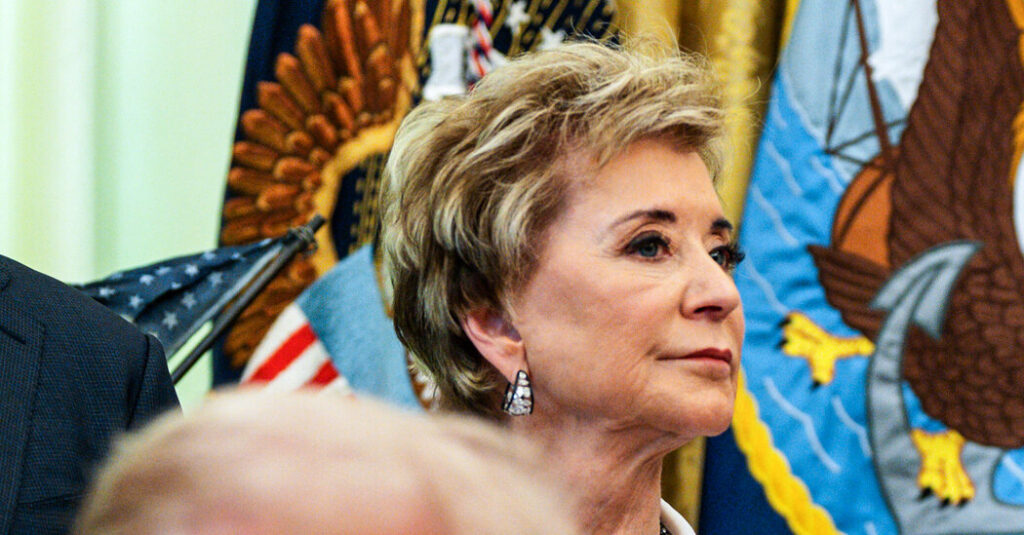
The Trump administration is making another push to persuade university leaders to address policies that it says have eroded trust with the American public, sending an open letter on Monday to college leaders asking them to respond to concerns over academic standards, admissions procedures and tuition costs.
The letter, signed by Education Secretary Linda McMahon, is a significant departure from an attempt last year to incentivize universities with a so-called compact that dangled easier access to research funding for schools that embraced the administration’s agenda. That proposal was widely rejected.
This time, the administration is not proposing any new legal or regulatory mandates and avoids any specific requests for eliminating protections for transgender students. Instead, Ms. McMahon asks every postsecondary institution in the nation to publicly state its commitments and planned changes “before the end of 2026.”
University presidents and governing boards are asked to address seven subjects — including free speech, foreign influence, artificial intelligence and academic rigor — and post the statements prominently on their websites.
Ms. McMahon’s letter, which does not include any funding threats, suggests that changes will improve academia’s reputation among American parents and students.
“The dilution of academic standards, opaque admissions policies and a domineering monoculture have badly eroded public trust,” she wrote, adding that “only full candor and transparency can begin to strengthen the bonds between higher education and the American people.”
It was not immediately clear how the nation’s thousands of colleges and universities would respond to Ms. McMahon’s letter.
The new push comes about 10 months after administration officials, including Ms. McMahon, proposed a compact to try to pull schools into ideological alignment. The document called for, among other conditions, a cap on international enrollment; a tuition freeze; and consideration of “transforming or abolishing institutional units that purposefully punish, belittle and even spark violence against conservative ideas.”
It also called for institutions to pledge to adhere to the administration’s preferred definitions around biological sex. And it encouraged policies to “recognize that academic freedom is not absolute, and universities shall adopt policies that prevent discriminatory, threatening, harassing or other behaviors that abridge the rights of other members of the university community.”
But the effort collapsed after many of the schools the White House handpicked for feedback on the idea condemned the proposal in scathing terms.
A central grievance was the administration’s suggestion that it would give schools preferential treatment for federal funding in exchange for backing the compact’s ideas. That proposal collided with generations of history, practice and competition among universities to secure funding on the basis of merit, and emerging months after the administration sought to choke off billions in money to schools it disfavored, it deepened fears that the White House was eager to trade largess for loyalty.
The compact envisioned stiff financial penalties, such as the reimbursement of “all monies advanced by the U.S. government during the year of any violation,” for any participating university that the Justice Department alone deemed out of compliance.
Although a handful of small institutions volunteered to sign, only one of the name-brand schools that the government initially asked for feedback — the University of Texas — was sweepingly enthusiastic. Most others, in public and in private, sounded notes like Sally Kornbluth, M.I.T.’s president, who warned that the proposal included ideas “that would restrict freedom of expression and our independence as an institution.”
Confronted with rare, largely united resistance from higher education leaders, the administration backed down, and its ambitions for a celebratory event in the autumn faded. Administration officials insisted at the time that they were not surrendering on the idea of a reworked compact.
They also began inserting some ideas into policy. The State Department, for example, started prioritizing visa requests for students at schools that were under a 15 percent cap on international students enrolled in undergraduate classes that the compact had envisioned.