

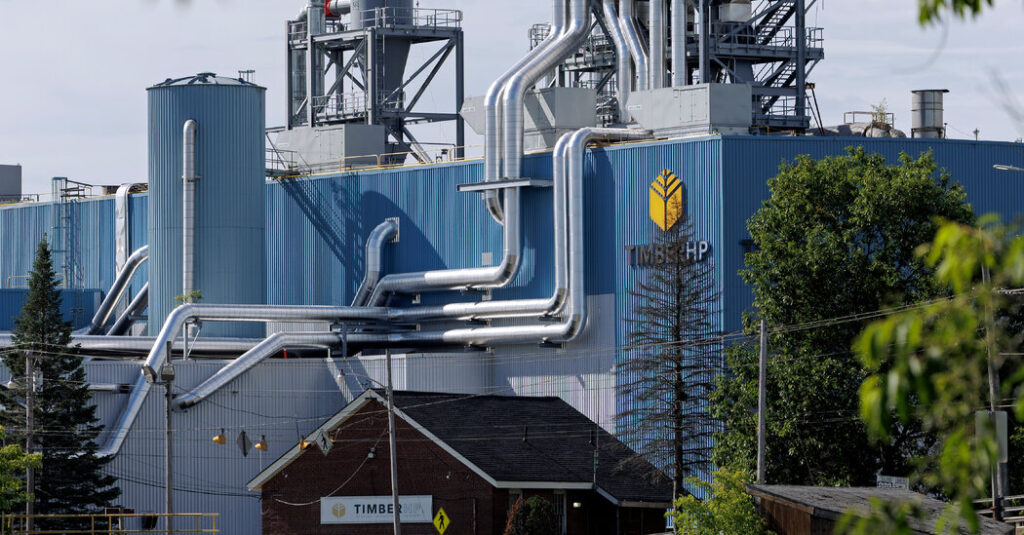
The State of Maine is about 89 percent forest and has an $8.3 billion forestry industry. Besides logging, papermaking has always been a large part of that. At the industry’s height, there were 35 paper mills in the state. Today, there are six.
The paper mill in Madison, a rugged town of about 4,700 residents where it’s not uncommon to see trucks stacked with logs coming and going, shut down in 2016. For over a century, the mill, home to Madison Paper Industries, had been responsible for a majority of the town’s good-paying jobs with benefits. Even as the company was being revalued in 2013, partly because of the decline in paper sales, the mill still made up 46 percent of the town’s tax base.
When it closed, no one was surprised. The newspaper industry had been declining for years, and Madison Paper Industries, makers of the glossy paper used by The New York Times for inserts, struggled, too.
“The handwriting was on the wall, so it wasn’t a shock,” said Rick Veinotte, who had worked for 25 years at Madison Paper, which was owned by a joint venture of UPM-Kymmene and Northern SC Paper, a subsidiary of The Times.
“But it was sad for the more than 200 employees who would be out of work,” Mr. Veinotte added. “And it was devastating to the town.”
A decade later, Madison is still trying to figure out what it is without the paper mill, another example of a small town dependent on a shrinking industry that’s had a rough go of moving on. And the mill’s new owner has struggled to revive manufacturing in the town, a sign of just how hard it is to make things on a large scale in America when manufacturing jobs across all industries have been scarce.
TimberHP acquired the defunct paper mill in 2019. Matt O’Malia, an architect, and Joshua Henry, a chemist, paid $2.3 million to buy the 600,000-square-foot plant and refurbish it into one making wood fiber insulation panels from wood chips and other wood waste.
The move seemed like a win for both the community, which got a new employer and big taxpayer, and TimberHP, which got the wood from Maine’s forestry industry and had access to seasoned manufacturing workers.
Wood fiber insulation, a product that is made in Europe but had not been produced in the United States until TimberHP came along, could also address America’s much-needed housing construction and sustainable building efforts, the company said.
The founders said they wanted to help revitalize Madison. Both grew up in working-class towns — Mr. O’Malia in Belfast, Maine, and Mr. Henry in Pittsburgh — and they wanted to replace most, if not all, the lost paper mill jobs.
But seven years later, keeping the doors open at TimberHP hasn’t been easy. The pandemic snarled supply chains, delaying deliveries on things the company needed to refurbish the mill, such as copper and transformers. A few years later, soaring inflation and construction delays stemming from those disruptions slowed the development of TimberHP’s production lines — enabling the company to make only two products instead of the three originally planned.
And, broadly, the difficulty keeping the plant alive and saving even a fraction of the jobs it once supported highlight the hurdles to a manufacturing revival that policymakers from the local level to the White House say they want to encourage.
The founders tried to sell TimberHP without success. Burdened by debt and running out of cash, the company filed for Chapter 11 bankruptcy in 2025. Its chief executive, Mr. Henry, left abruptly last fall. He told The Times he was legally “really not allowed to talk about why I left.”
TimberHP’s challenges were mostly related to money. Despite raising $122 million in two fund-raising rounds and also receiving $3 million in grants from the state, it wasn’t enough to weather the storms the pandemic had set off.
Venture capital funding wasn’t an option because those investors were used to making returns that were orders of magnitude more than their investments in technology companies and other fast-growing firms. Manufacturing wasn’t that.
“Venture wants these really outsized returns,” Mr. O’Malia, now the company’s chief executive, said.
The company was running out of cash, Mr. O’Malia said. It took over a year to get out of Chapter 11 bankruptcy protection, pay back investors and start producing the wood fiber boards.
“Chapter 11’s not cheap,” Mr. O’Malia said, referring to legal fees and exit financing while still having to remain operational.
Sam Hight, an early investor in TimberHP whose extended family businesses include three real estate development firms, jokes that his investment “turned into a donation.”
Still, he said he believed in what the company was trying to do. Mr. Hight’s construction company is using TimberHP products for a large affordable housing project.
In 2025, TimberHP paid about $196,895 in taxes to the town of Madison. It was something, but it was still “a far cry from the $3.7 million Madison Paper Industries paid in 2013,” said Tim Curtis, Madison’s former town manager.
In November, TimberHP announced it was out of bankruptcy. Since then, the company and the town have started to find their footing. The company has about 80 employees, about half of its original goal.
TimberHP is also finding some success. Its products are being used on a multifamily project by Avesta Housing, a Maine-based affordable housing provider; Amazon is using its products in an Elkhart, Ind., delivery station, as is Meta for its Richland Parish Data Center in Louisiana; and D.R. Horton, the nation’s largest home builder, is using TimberHP’s insulation on townhouses in the Mid-Atlantic.
The company also is being supported by investments from FTAI Infrastructure, a clean energy investor, and other investors and finance partners including BlackRock and the Finance Authority of Maine.
Even as the town’s manufacturing future seems hopeful for now, Madison is still coping with losing an industry that had been the lifeblood of the town. People still speak of the mill’s loss as if it had been the passing of a living being. “I’m not a real emotional person, but I could have just stood there and cried,” Mr. Veinotte said about its closing.
Denise Ducharme, the town’s manager who has lived in Madison since 1983, calls it “the kind of community where you can’t sneeze without a neighbor knowing.”
“For so long, our community’s identity was tied to being a paper mill town,” she said. “We had to figure out who we were without a paper mill — who we wanted to be — sort of an identity crisis.”