

No other major studio is as committed to catering to conservative Christian and American values as Angel Studios, and no other studio seems to have less faith that Americans share those values. While most producers and distributors of fine motion pictures are content to release their films and let audiences pay for their own admission, Angel Studios repeatedly concludes their more jingoistic and religious films with a last-minute panhandle over the closing credits, flimsily disguising their scheme — to get their fans to buy extra tickets, for theoretical audiences who may never actually use them — to inflate the box office and potentially make it look like their films are more popular than they are.
This suggests they don’t actually think conservative themes are popular, since otherwise they wouldn’t need to game the system. If you truly believe in voting with your money, then films like “Young Washington” — which conclude with an actor, in this case Kelsey Grammer, saying that giving Angel Studios extra cash is the same as “launching a movement” — can only be categorized as a form of voter fraud. On the 250th anniversary of this country, after watching a film about the heroism of George Washington, this attitude reads as un-American and undermines what was, until the credits, a somewhat effective biopic that almost satisfies.
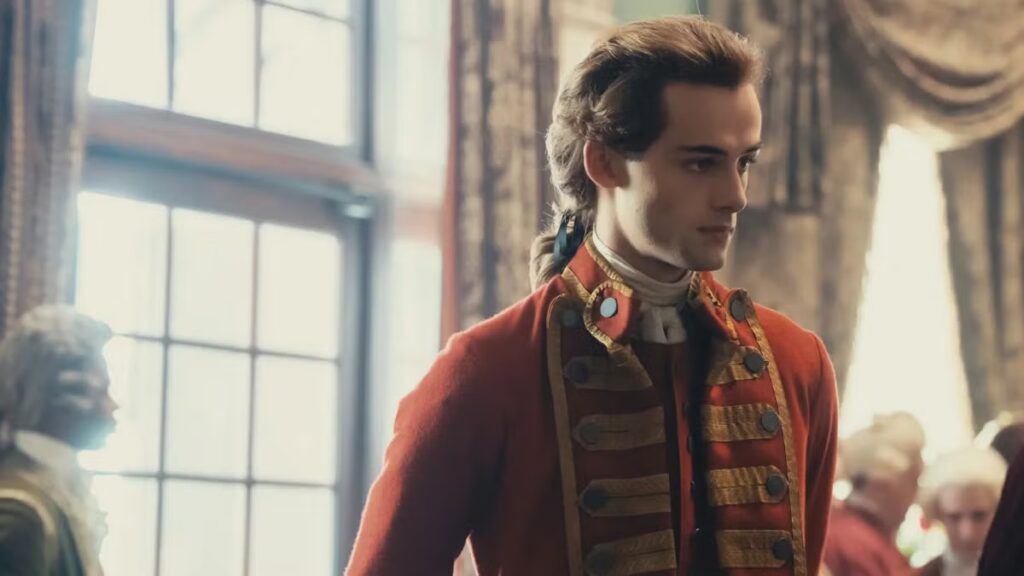
Directed, produced and co-written by Jon Erwin, “Young Washington” stars William Franklyn-Miller as George Washington. He will eventually become the first President of the United States, but first he has to learn valuable lessons about leadership. Also, he has to kick French ass in slow-motion. The title evokes John Ford’s 1939 biopic “Young Mr. Lincoln,” another rah-rah attempt to deify an iconic American leader by telling a noteworthy anecdote about their life before the presidency. “Young Mr. Lincoln” got away with it better than “Young Washington,” but to be fair Jon Erwin is no John Ford, and William Franklyn-Miller is no Henry Fonda. Then again, who is?
Setting all comparisons aside, Franklyn-Miller is perfectly acceptable as America’s founding father. He’s got a boyish, earnest, puppy dog expression in his early scenes that gradually erodes into a serious, well-earned glower. For a long time it appears that Washington can do no wrong. Erwin’s film follows his early days as a member of the Virginia militia, talking his way into one opportunity that should have been above his station after another. But eventually he learns, after a series of ill-advised battles, that he’s not yet qualified for the position, and has to accept and overcome his failings if he’ll ever achieve anything great.
Erwin’s direction is exceptionally competent, presenting the stories of Washington’s young life with an uncomplicated, well-monied, 1980s tv movie sense of visual clarity. His depiction of Virginia and the Ohio Territories in the 1750s are vivid and varied, evoking a multitude of tones that sell the film’s scenes of romance, valor and desperation. The costumes and sets are also convincing. “Young Washington” is, undeniably, a decent-looking film.
The cast isn’t as reliable as Kristopher Kimlin’s cinematography. Sir Ben Kingsley appears as the Lieutenant Governor of Virginia, and he’s committed to his lines but spends so much of the movie behind a desk that you feel like applauding on the rare occasions he deigns to stand up. Kelsey Grammer is committed to pushing the plot forward, which he does, with some pep in his step. Andy Serkis understands that his character, Major-General Edward Braddock, exists in this film only to ignore Washington’s advice and suffer for it, so he plays the man as a simplistic blowhard. Mia Rodgers always seems to be staring off into the distance, never fully present in her amorous scenes with Washington. Only Angus Castle-Doughty, as a sensible and snarky militiaman who’s smarter than his so-called betters, seems eager to steal scenes — and he gets away with every heist.
“Young Washington” is such a nuts and bolts biopic that it’s hard not to focus on the little pieces. Especially since the themes don’t quite tie it all together, undercut as they are by the film’s disinterest in the uglier sides of history. George Washington is motivated, we learn, by the inequities of his birth. It’s a cruel injustice that he isn’t allowed to go to school or join the British military, just because he wasn’t born with privilege. So he fights to right these wrongs, which would be inspiring were it not for the fact that, by the film’s own admission, he owns ten slaves. And it sure is telling that not only are Washington’s slaves never depicted on-screen, but when they are briefly acknowledged in dialogue — once — they’re described as recipients of his family’s charity.
A simplistic portrayal of George Washington, or any of America’s Founding Fathers, is hard to swallow in the 21st century. We finally rejected all the folksy tales about little boy George cutting down a cherry tree, and now “Young Washington” shows him taking a few whacks at it anyway. By the time Washington is fighting the French in slow-mo gunfights, doing sick horseback stunts while sick with dysentery, any pretense that Jon Erwin’s film should be taken seriously is out the window. And when George Washington is told, point blank, that the Indigenous Peoples of America think he was chosen by the gods to be their land’s savior, you’ll be forgiven for yelling curse words at the screen, or even for throwing up. (Well, I’ll forgive you. The ushers at your local theater may feel differently.)
“Young Washington” is made with such corny insistence on Washington’s and America’s greatness that it could, by all rights, be a hit film on the nation’s quarter-millennial birthday. I guess we’ll never know, since, if it does make a lot of money, Angel Studios can’t brag about it, because the number of tickets that get sold to actual, interested audience members could be a lot smaller than the number of tickets technically sold. The dishonesty of the moneymaking enterprise poisons what could have merely been another artificial biopic, designed only to make (some) Americans feel good about themselves before their annual fireworks show.