

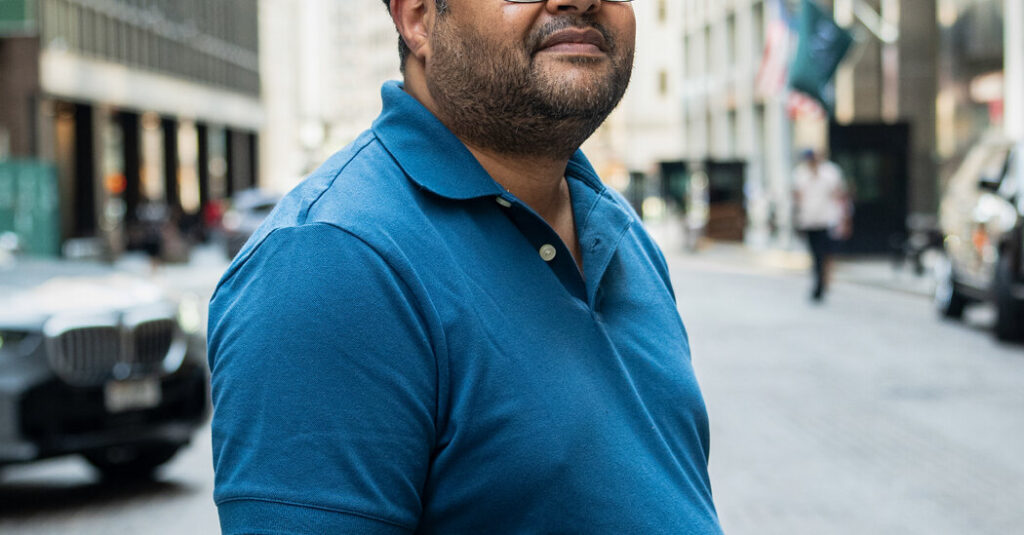
For Christophe Sachy, watching Les Bleus of France play Spain on Tuesday for a berth in the World Cup final comes with certain allowances, especially with two European soccer powers colliding in the middle of the United States workday.
“I’m going to work from home,” said Mr. Sachy, who is 48 and from France and works for BNP Paribas in Midtown Manhattan. “It’s a French bank.”
Cesar Pratt, 45, who works in health care in Lower Manhattan, has less leeway, but said that he, too, would tune in to the semifinal matches over the next two days, both of which will begin at 3 p.m. Eastern time. Argentina, the defending champion, will face England on Wednesday.
“I’m not supposed to, but I’m going to try,” he said. “I have my phone with me. I’m sure a lot of people are going to call out.”
And on the floor of the New York Stock Exchange, the games will most likely be shown on televisions, said Porter Vogt, 20, a Wall Street trader.
“Obviously, people are working,” Mr. Vogt said on his way into the subway.
In the United States, soccer fans, from the serious expatriates to the casual viewers, are having to get creative with their routines to watch the semifinals, which feature the four top-ranked teams in the world.
The juggling of schedules and side-eyeing of televisions in workplaces is testing productivity and, in many cases, redefining remote work. The start times of the matches have also prompted criticism from some soccer fans in the United States, one of the World Cup host nations. Tuesday’s game will be played just outside Dallas, and Wednesday’s game is in Atlanta.
Fox, which holds the English-language broadcasting rights to the World Cup, said on Monday that FIFA, soccer’s international governing body, determined start times.
FIFA officials pointed out on Monday that the start times virtually mirror those of the semifinal and final matches of the FIFA Club World Cup in 2025, which was held in the United States. Schedule makers took into account the global television audience, travel for the players and a multitude of stakeholders involved in the tournament, according to the organization.
Three of the four remaining teams are from Europe, where the games will be shown in prime time.
Ori Jasa, 38, a construction project manager, said people in his office in Lower Manhattan had been watching the games on television for much of the past month. On occasion, he and his co-workers head to a nearby bar when they have the time, he said.
“Work productivity goes down a little bit,” Mr. Jasa acknowledged. “It’s the World Cup.”
Not all of the televisions in his office are synced with one another, a phenomenon that has frequently caused spoiler alerts in workplaces and homes as viewers watch the games on different devices. When cheers erupt in another part of the office, he said, it can be frustrating.
“I’m like, Ah,” Mr. Jasa said, using an expletive. “I know something happened.”
While eating a sandwich during his lunch break in Midtown on Monday, a rare day without World Cup action, Agustin Reyes, 48, who lives in Yonkers and works for a scaffolding company, said he planned to watch the semifinals on his phone.
Niki Sotoodeh, 20, a law student at the University of California, Berkeley, bemoaned that the games would be on while she was at her internship in Lower Manhattan.
“Not the best timing,” Ms. Sotoodeh said, adding that she might check the scores on her laptop.
Dana Somerstein, 38, who is visiting New York from Florida for work with her husband, David Gillis, said they had been flocking to Alfie’s Bar & Kitchen in Hell’s Kitchen to watch World Cup matches — but only when they’re off the clock, Ms. Somerstein said emphatically. Both are lawyers.
“My clients would not be very happy if I did,” she said.
Jeff Philp, 49, a lawyer who works in Lower Manhattan and is rooting for England, said he had been watching his team at Carragher’s, a bar on John Street that is a popular gathering spot for fellow fans of the British soccer club Liverpool F.C. It’s near his office, too.
“I know friends at investment banks who have TVs on all the time,” Mr. Philp said of the World Cup.
Since the coronavirus pandemic, he said, many employers have made more allowances.
Outside BNP Paribas in Midtown, where Mr. Sachy, a Parisian, was taking a cigarette break on Monday, he explained that the bank had been showing World Cup games on TVs that normally carry financial coverage by Bloomberg Television and other networks. Usually, the sound is muted.
Mr. Sachy said he was quite familiar with the spellbinding nature of the World Cup, especially from his time working for the bank in Brazil.
“When the Brazil team is playing, no one is working,” said Mr. Sachy, who lives in Old Greenwich, Conn.
But a World Cup semifinal match is not license to pause one’s email notifications, he said.
“No, we need to be available,” he said.