

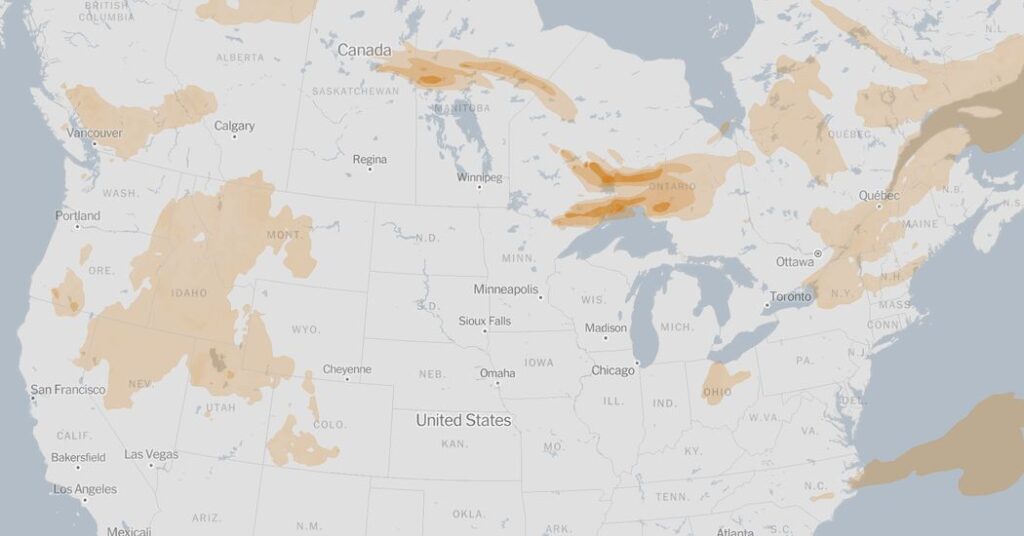
The U.S. Forest Service issued an emergency closure for a popular tourist area in Superior National Forest in northern Minnesota on Monday as wildfires raged and threatened human safety.
The closure of the destination, Boundary Waters Canoe Area, will take effect Tuesday, the Forest Service said in a statement. The agency has canceled permits into the Boundary Waters through Friday but did not say how long the area would be closed.
“This difficult decision comes after a surge of wildfires across the forest and unusually hot, dry and windy weather is causing fires to spread fast and unpredictably,” the agency said.
Several fires are burning in the Boundary Waters area, blackening about 9,000 acres in the outdoor recreation hub. About 21 fires started on Tuesday from a lightning storm, according to Nick Petrack, the fire management officer for Superior National Forest.
The largest conflagration is the Thumb Fire, which had burned nearly 5,000 acres as of Monday evening.
The cocktail of hot, windy and dry conditions has hampered efforts to contain the flames. The Forest Service reported that the Camp Fire, which firefighters had tamed, “jumped its containment lines” on Monday.
The National Weather Service on Monday issued red flag warnings for parts of northern Minnesota, including the Boundary Waters Canoe Area. The agency warned that the combination of high temperatures, strong winds and extremely low humidity would create ideal conditions for fires to spark and to spread more easily if they do. After a brief lapse overnight, the warnings will be in place again on Tuesday.
Parts of the Upper Midwest are in the grip of a brutal heat wave. More than 20 million people in Minnesota and nearby states are under extreme heat warnings through at least the middle of the week.
Near the Boundary Waters Canoe Area, high temperatures on Monday approached or exceeded 100 degrees, the Weather Service said, while the relative humidity dropped to 20 percent or lower. Wind gusts of up to 26 miles per hour were recorded nearby. In those conditions, dry vegetation can quickly fuel a wildfire’s growth.
Similar conditions were expected on Tuesday. Forecasters said winds may ease by Wednesday, but that humidity levels would remain critically low.
The authorities expectsome fires to smolder into autumn, when the first snow falls. “These things will likely be burning in some way, shape, or form until then,” said Drew Stroberg, deputy forest supervisor for the Forest Service.
Across the nearby international border, the authorities in Canada warned that much of southern Ontario was facing similarly high temperatures, strong winds and low humidity this week.
There are two fires in the United States that could cross into Canada, and at least one fire in Canada that may breach the United States, Mr. Petrack said on Monday.
As smoke from the fires in Minnesota and across the Canadian border spread, Minnesota warned that the air quality in the northeastern part of the state would deteriorate this week. Between Tuesday and Thursday, the state warned, heavy smoke would most likely make the air very unhealthy.
The Boundary Waters area covers one million acres of rugged terrain and boreal forests, replete with lakes and hiking trails. It hosts more than 2,000 campsites and several seasonal camps, offering backpacking, wilderness canoeing, rock climbing and other activities.
Images on social media showed columns of smoke reaching into the sky. The last full closure of the area from wildfire activity was in 2021. But locals recognize fires could become more frequent.
“An abundance of fuel due to a century of fire suppression, along with warming temperatures and more variable rainfall from climate change, will almost certainly mean that we have to adapt to more fire and should expect more B.W.C.A. closures in the years to come,” Sam Reed, the climate and conservation manager at Friends of the Boundary Waters Wilderness, an advocacy group, said in a statement.