

Recent college graduates complain they can’t find entry-level jobs because artificial intelligence is taking over.
Yet, tech recruiter Matt Walsh and other experts say the growth of AI and the struggle to find entry-level work mask a bigger problem: The United States is facing what’s projected to become the largest labor shortage in its history.
In sectors such as semiconductor production, the problem isn’t AI or too few jobs, said Walsh, CEO of the Phoenix-based search firm Blue Signal.
“It’s ridiculous,” he said. “There just aren’t enough people.”
Economists warn that the worsening labor problem, due in part to a skills shortage and population shifts, will be vast and reach beyond tech.
It “could hobble the American economy for years to come,” predicts the Georgetown University Center on Education and the Workforce. Lightcast, a labor market data company, calls it “the largest labor shortage the country has ever seen.” JPMorgan Chase warns of a national security risk from “a pervasive talent deficit that constrains the nation’s capacity to build, compete, and protect its interests.”
There will be shortages in the tens or even hundreds of thousands of nurses, physicians, teachers, engineers, pharmacists, mental health counselors, construction workers and airplane mechanics — jobs AI generally can’t do.
“All of these people who keep a society functioning are the very people we’re not going to have enough of,” said Ron Hetrick, Lightcast’s principal economist.
Among the trends that have been leading to this moment: a mismatch between the careers college graduates are pursuing and the jobs employers are struggling to fill. Far fewer students are majoring in health care fields than are needed to meet demand, for instance.
“We have pumped so many young people into business and finance” when what’s really in demand are graduates in other fields, Hetrick said. “It’s like a factory producing these workers like widgets, even though society is saying, ‘We really don’t need them.’ And the factory just keeps pumping them out.”
But the principal reason for the looming workforce shortages is much more basic. A protracted decline in birth rates is coinciding with a record wave of retirements, data shows.
From 2024 to 2032, when the last baby boomers sign up for Social Security payments, more than 18 million college-educated workers will leave the labor force while fewer than 14 million enter it, according to the Georgetown center. Meanwhile, even as the number of people with associate and bachelor’s degrees falls, the number of jobs requiring them will grow, the center forecasts.
That will leave a gap of 4.6 million workers. Lightcast puts the deficit at an even higher 6 million.
The shortages are already showing up, the U.S. Chamber of Commerce reported. It said that in many industries, even if every worker now unemployed were plugged into an open job, positions would still be left unfilled.
“We have a crisis in front of us in not preparing people for the world that’s coming,” said Bill Haslam, the Republican former governor of Tennessee and co-chair of the Bipartisan Policy Center’s Commission on the American Workforce.
The effect of population shifts on the supply of talent, with or without degrees, has been compounded by a drop in the proportion of high school graduates choosing to go to college, a sharply reduced rate of immigration, and a growing number of Americans leaving the workforce altogether because of such issues as lack of child care, early retirement, incarceration and substance addiction, according to the Chamber of Commerce.
College and university enrollment in 2023 was down by nearly 2 million students since its peak in 2010, according to the most recent data available from the U.S. Education Department. The low birth rate since 2010 means the number of college-age Americans is forecast to decline by another 13 percent through 2041.
Related: What it’s like to enter the job market in the middle of an AI revolution
Fewer than half as many people immigrated to the United States last year as the year before, the Census Bureau says, yet 41 percent of the home health aides increasingly needed to care for the nation’s aging population have historically come from somewhere else, along with a fifth of nursing assistants, dentists, pharmacists and registered nurses.
“We’re doing a fantastic job of rolling up the welcome mat and saying, ‘We don’t want you,’” said Brad Hershbein, senior economist and deputy director of research at the W.E. Upjohn Institute for Employment Research.
The semiconductor industry is among those raising warning flags about the problem of finding workers. It’s projected to grow by nearly 115,000 jobs by 2030, which is 67,000 more than the number of current and projected technicians and engineers, the Semiconductor Industry Association estimates.
“The semiconductor industry is not alone here,” however, said Erik Hadland, the association’s director of technology policy. “We’re a small part of a much larger issue.”
State governments have been scrambling to get ahead of the problem. To get college graduates to come or stay and work, some will help them pay off their student loans. A bill under consideration in Minnesota would offer in-state tuition to most public colleges and universities for children of parents who take jobs in that state, waiving the previous requirement that students have graduated from a Minnesota high school after attending for at least three years.
Several states have combined their higher education and workforce development agencies, including Missouri and Colorado. Connecticut has established both an Office of Workforce Strategy and a Career Pathways Commission. Illinois Gov. JB Pritzker has formed a working group to review that state’s workforce development infrastructure and increase the number of college graduates.
Some states face shortages that appear more severe than others. South Dakota has just 41 workers for every 100 open jobs, for instance, while California and nine other states have more workers than jobs, the Chamber of Commerce found.
In Pennsylvania, a study commissioned by the state’s Department of Education has projected that the state needs to increase the number of people with credentials beyond high school by more than 4 percent to fill a shortage of 218,000 such workers a year by 2032. That will be a significant challenge, considering that college enrollment there has generally been falling.
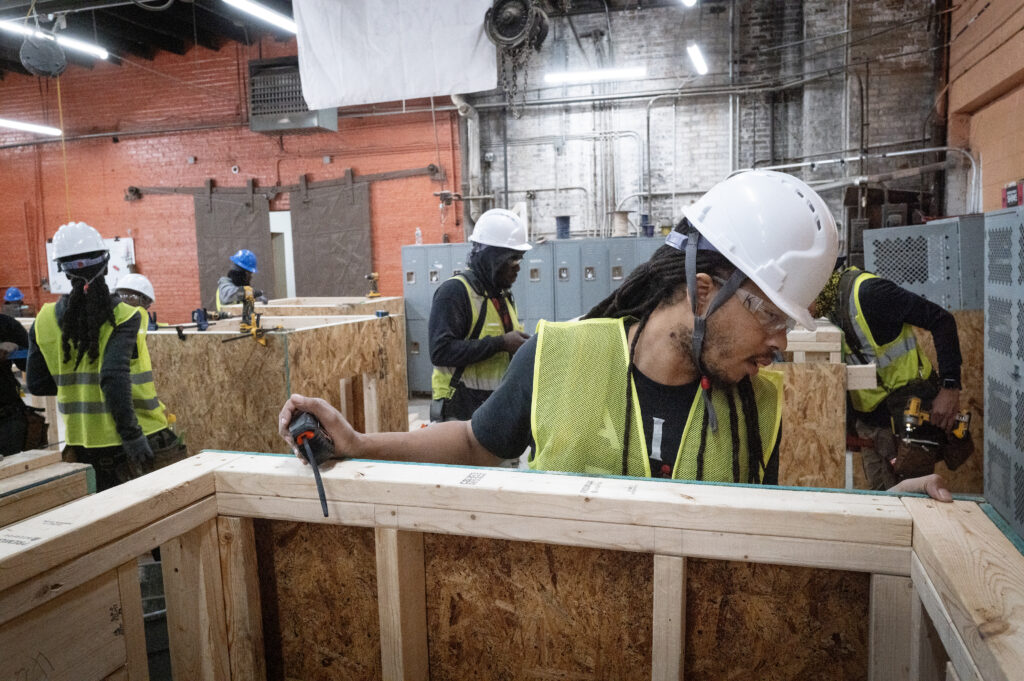
Industries in which workers don’t require college degrees are also seeing shortages. Fewer than half as many people are entering the construction trades as are needed, for example, according to Branka Minic, CEO of the Building Talent Foundation, which represents 3,600 employers who are trying to fill that gap.
Related: More than a quarter of private colleges are at risk of closing, new projection shows
“There’s plenty of jobs” in the skilled trades, she said, some starting at $50 an hour. “Show me what college graduates earn that kind of rate.” As for the prospect that AI can fill those largely physical roles, she recalled seeing a poster plastered on an unfinished building. “Finish this, ChatGPT,” it said, mockingly.
Some savvy workers are figuring it out for themselves.
Seth Russell’s high school counselor nudged him toward college. Instead he learned welding and now works full-time as a fabricator.
“I got hired straight out of high school. I have no debt. I’m just making money, paying bills,” said Russell, now 22, who lives in Torrance, California. “There’s so many jobs out there.”
This story about shortages of workers was produced by The Hechinger Report, a nonprofit, independent news organization focused on inequality and innovation in education.