

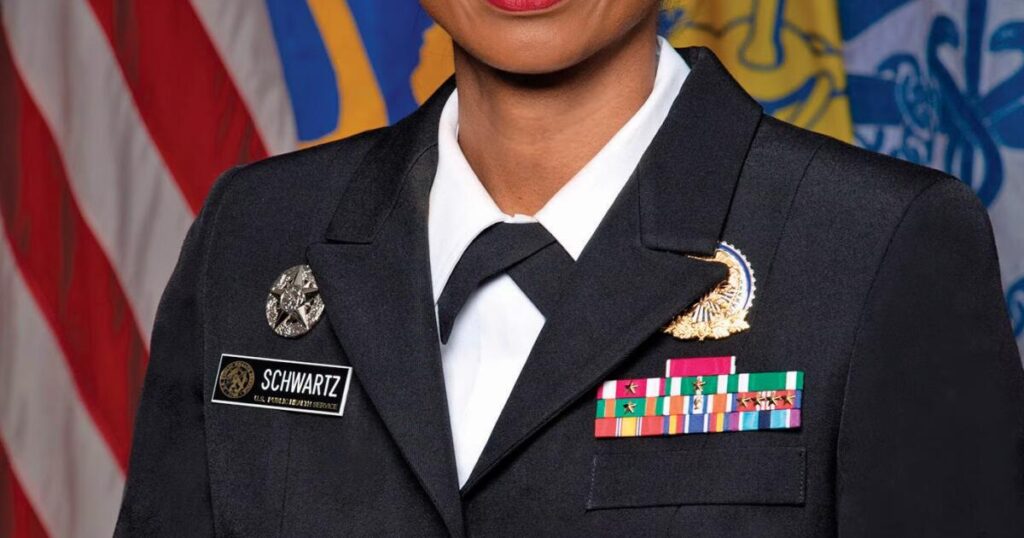
Confirmation hearings began Wednesday for Dr. Erica Schwartz, President Trump’s pick to head the U.S. Centers for Disease Control and Prevention.
In a typical administration, it would not be headline news that a potential CDC director supports vaccination and other basic public health measures.
But the second Trump administration is anything but typical, and Schwartz’s nomination is for many public health proponents a pleasant surprise.
She served as deputy Surgeon General in Trump’s first administration and holds degrees in medicine, law and public health. Schwartz is a board-certified preventive medicine physician with a long track record of relevant professional experience and government service, primarily with the U.S. military. She’s familiar with the agency she’s been chosen to lead. Public health experts praised her appointment.
She appeared this week before the Senate Committee on Health, Education, Labor and Pensions, which will decide whether her nomination advances to a full Senate vote.
Among former CDC staff and advisers, there is tentative hope that Schwartz’s nomination could mark the start of a more sober-minded era at the embattled agency — provided that she is actually given the authority to do the job.
Schwartz “has the expertise, credibility and integrity to lead the CDC effectively. If allowed to follow the science without political interference, she’ll excel,” Dr. Jerome Adams posted after her nomination was announced back in April.
Adams, who selected Schwartz as his deputy while serving as Trump’s first Surgeon General, clarified: “Cautiously optimistic but encouraged by this pick.”
“As CDC director, my sacred responsibility is to provide the American people with public health guidance that is clear, honest and evidence based. I will never betray the science,” Schwartz said in her opening remarks at the hearing.
After receiving her undergraduate and medical degrees at Brown University, Schwartz served as a physician in the U.S. Navy. In 2005 she joined the U.S. Public Health Service Commissioned Corps, a uniformed service that acts as the medical corps of the U.S. Coast Guard.
In that capacity, she was the U.S. Coast Guard’s head of preventive medicine and later its chief medical officer. She wrote the branch’s policies on smallpox and anthrax vaccination, communicable disease quarantines, HIV and influenza pandemics. She retired in 2021 as a rear admiral.
“While I think you are immensely qualified, I am very, very concerned that even qualified people have either had to change their positions or quit,” Democratic Sen. Lisa Blunt Rochester of Delaware told Schwartz during the hearing.
Dr. Daniel Jernigan, former director of the CDC’s National Center for Emerging and Zoonotic Infectious Diseases, worked with Schwartz during the early stages of the federal COVID-19 response. Jernigan recalled her as “deeply engaged” in expanding access to testing.
His concerns about the nomination were not about Schwartz’s qualifications, but about the climate of the agency she may be taking over.
“I deeply respect her training and experience. I hope she is given some independence from the Secretary to return CDC to evidence-based decision making and support for vaccines,” Jernigan said. “Without that independence, she will need to determine what lines she is not willing to cross, similar to those of us in leadership who are no longer there.”
Jernigan was one of several CDC officials who resigned in August after Robert F. Kennedy Jr., Secretary of the Department of Health and Human Services, fired Susan Monarez, the agency’s last confirmed director.
Monarez later told a Senate committee that Kennedy fired her in part because she refused to sign off on his planned alterations to the nation’s vaccine schedule without being allowed to see the scientific evidence justifying the changes.
When asked in April if he would commit to implementing whatever vaccine guidance Schwartz issued, Kennedy declined.
“I’m not going to make that kind of commitment,” he told Rep. Raul Ruiz while testifying before the House Energy and Commerce Committee.
If confirmed, Schwartz will take over an agency that has lost hundreds of employees to layoffs and resignations since January 2025 and endured what many former staffers see as an intentional effort by the administration to undermine its science.
Health and Human Services Deputy Secretary Jim O’Neill stepped in as acting CDC director in August after Monarez’s departure. During O’Neill’s time at the helm, Kennedy slashed the number of diseases covered in the pediatric immunization schedule, altered the CDC website to include inaccurate information and packed a key CDC advisory committee with vaccine skeptics.
O’Neill left his position in February, at which point National Institutes of Health chief Jay Bhattacharya stepped in as acting director.
Back in April, word of Schwartz’s nomination irked some vaccine skeptics who were rising to prominence under Kennedy. Aaron Siri, a leading antivaccine lawyer who has previously worked as Kennedy’s personal attorney, took to X to voice his disapproval.
“Trump’s pick to head the CDC, Erica Schwartz, would likely be a disaster,” posted Siri, who in December urged the Advisory Committee on Immunization Practices to “end mandates” in a presentation one committee member called “a terrible, terrible distortion of all the facts.”
“Schwartz led nationwide Covid-19 vaccine deployment and her long track record of directly issuing rights-crushing civilian and military vaccine mandates, including mandating injection of smallpox, anthrax, and flu vaccines into U.S. Forces, and discipling [sic] those that refused, reflects she lacks the basic ethics and morals to lead the CDC,” Siri wrote.
While vaccine skepticism has reached the highest levels of the U.S. health system under Kennedy, it remains a minority viewpoint among the public. In a Pew Research Center poll released in November, 84% of Americans said they agreed strongly or somewhat with the statement that childhood vaccines are highly effective at preventing illness, and another 21% said they somewhat agreed.
Public health experts said they were hopeful that Schwartz’s nomination is a sign that the administration is beginning to back away from an unpopular stance that may cost them votes — not to mention lives.
“I have never met Dr. Schwartz and all I know about her is what I’ve read. But I’m thrilled that she is a nominee for CDC Director,” said Dr. Paul Offit, director of the Vaccine Education Center at Children’s Hospital of Philadelphia and a former ACIP member in the early 2000s. “Clearly, the Trump administration does not like what is happening under the leadership of RFK Jr. and is looking to distance itself from his anti-vaccine rhetoric.”