

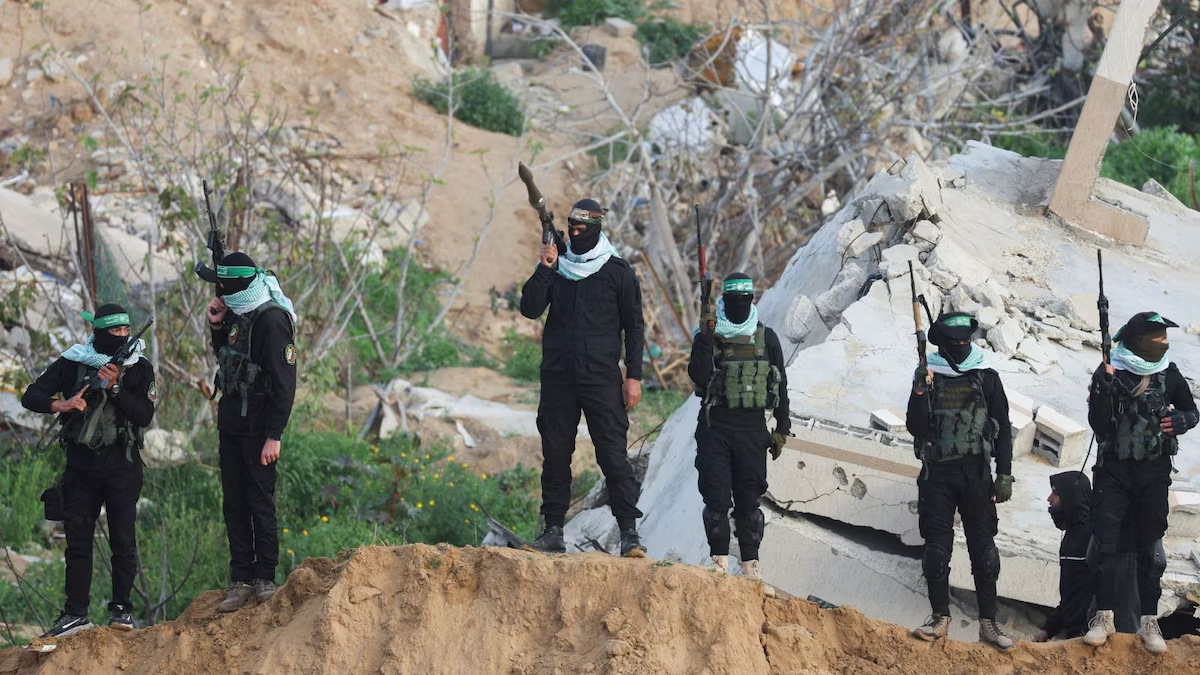
The roadmap proposes replacing Hamas’s administration with a Palestinian technocratic committee, backed by international and local security forces. But the document remains a draft, Israel has raised objections and several details are unresolved.
Who will govern Gaza now that Hamas has agreed to give up control of the territory?
Gaza’s day-to-day administration would pass to a committee of Palestinian technocrats with no Hamas participation under the announced roadmap.
That committee would work within a wider system involving the US-led Board of Peace, two executive bodies, an international security force, and a new Palestinian police service.
US President Donald Trump announced the “historic” agreement after Hamas leaders held talks in Cairo with mediators from Egypt, Qatar and Turkey.
But several caveats remain. A Hamas source described the document to Reuters as a “draft agreement”, Israel has said the proposal does not fully meet its demands, and the parties have not publicly resolved what will happen to all of Hamas’s weapons.
Who will administer Gaza?
The National Committee for the Administration of Gaza, described as an apolitical body of Palestinian technocrats, would handle everyday civil administration inside the territory.
The committee would operate without Hamas participation and take responsibility for government services, employees, finances and other administrative functions.
At the international level, the Gaza Board of Peace would oversee strategy, stabilisation and reconstruction funding. Trump chairs the body and has extensive executive powers under its charter.
Its Founding Executive Board includes US Secretary of State Marco Rubio, US envoy Steve Witkoff, former British prime minister Tony Blair and Trump’s son-in-law Jared Kushner.
Al Jazeera has also described a separate Gaza Executive Board tasked with directing reconstruction and coordinating with regional diplomats.
The proposed structure therefore separates everyday Palestinian administration from broader international oversight of security and reconstruction.
Who will provide security?
A new Palestinian police force would take over areas vacated by Hamas as disarmament proceeds, while an International Stabilisation Force would support security during the transition.
Israel has approved the legal framework needed to allow the multinational force into Gaza. An Israeli official told Reuters that an initial mission would include about 200 personnel from countries including Uganda and Morocco.
Each national contingent would require separate Israeli approval, and it remains unclear when the force will deploy.
What will Hamas do with its weapons?
Trump said the roadmap provides for the complete disarmament of Hamas and all other armed groups in Gaza.
A Hamas source told Reuters, however, that the draft stipulates that the group’s heavy weapons would be stored and placed under the control of the Palestinian administration. The source said the weapons could not be transferred to Israel.
A diplomat involved in the talks told Reuters that the plan also calls for the elimination of tunnels, weapons stockpiles and arms-production facilities, with no militant infrastructure remaining in Gaza at the end of the process.
Israel has demanded complete disarmament, the removal of weapons from Gaza and the territory’s full demilitarisation.
Has Israel accepted the agreement?
Israel has not publicly endorsed the announced terms.
Before Trump’s announcement, an Israeli official told Reuters that Israel had rejected the 15-point proposal because it did not provide a satisfactory response to its demand for complete disarmament and demilitarisation.
A US official also told Reuters that Israel remained “very skeptical” that Hamas would disarm.
Israel’s position is critical because its military controls a substantial portion of Gaza. The roadmap links its phased withdrawal to the disarmament process, but no final withdrawal schedule has been publicly released.