

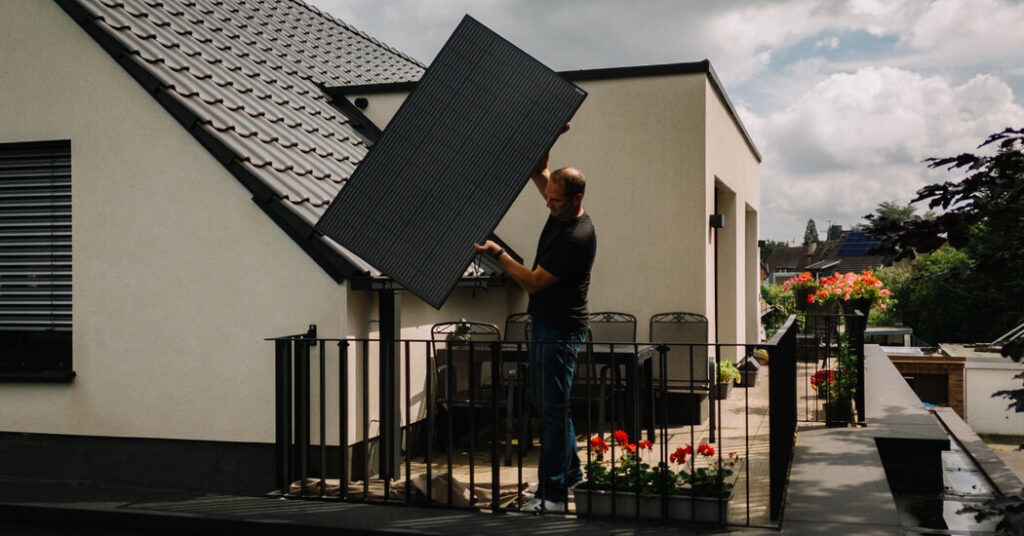
So you want to cut your electric bill and are eyeing the solar panels that can plug into any outlet in a home to produce your own power?
You may want to wait for a little while.
None of the systems available in the United States have yet received a crucial certification that deems them safe to use in single-family homes, condominiums and apartments. Experts who set safety standards expect to certify some panels soon.
“We really do love the idea of empowering consumers,” said Kenneth Boyce, vice president of engineering at UL Solutions, a company that tests, validates and sets standards for various products. “We’re really focused on keeping people safe.”
Plug-in or so-called balcony-solar systems have become popular in Germany in recent years. Ten American states have passed legislation making them legal, and many others are considering measures that would allow consumers to buy and install them.
Cost and simplicity have driven much of the excitement over the plug-in solar systems. Typically, homeowners do not need to hire installers to connect these solar panels, as they would for conventional rooftop systems that, in the United States, can cost as much as $36,000.
Plug-in systems can be as cheap as a few hundred dollars and typically top out at roughly $2,000.
What certification do these panels need and why?
You want to look for products that carry the “UL 3700” certification. It indicates that the product has been tested and meets the safety criteria set by UL Solutions.
Some systems produce so little electricity — under 400 watts — that they do not pose a safety risk, their makers claim.
But the prongs on larger systems could deliver a momentary shock risk after they are disconnected from the outlet. The UL 3700 standard requires the prongs to be “touch safe,” prompting some developer to encase them in plastic, similar to those found on electric vehicle chargers. Others have created equipment like protective sleeves.
Another potential problem has to do with home circuit breakers. Typically, a household circuit operates on a breaker based on how much electrical current an appliance requires.
When circuits are overloaded, breakers can trip to prevent fires and damage to the electrical equipment.
A plug-in solar system that lacks UL 3700 certification could mask how much electrical current is flowing on a particular circuit because the panels are supplying electricity. In that case, a breaker might not detect that the circuit is being overloaded by other appliances on the same circuit.
“The holy grail is to wait and make sure it is listed to UL 3700 certification,” said Bernadette Del Chiaro, a senior vice president at the Environmental Working Group, a nonprofit organization focused on health and safety. “It puts all the onus on the manufacturers to put in safety devices.”
Some products may claim to be UL certified or UL compliant because certain components of the system, such as inverters, meet existing or draft standards. However, UL Solutions has said it expects its certification to apply to entire systems, not just individual parts. Other organizations also certify these products, but certifications from UL Solutions tend to be coveted by industry players.
Once certified panels are available, can I really install them myself?
Theoretically, yes. A major selling point for these systems is that they are no more difficult to set up than a television or a Wi-Fi router. They are designed to be lightweight and renter friendly.
But some state lawmakers have considered mandating that qualified electricians install the systems. And the final UL 3700 safety certification may require an electrician’s help to install a special electrical outlet for plugging the panels into.
What is the best place to put these panels?
The panels are generally about the size of a window, and can be hung on balconies or placed in backyards — anywhere outdoors with six hours or more of full sun. South-facing areas are ideal because they tend to get the most sun.
If you rent your home, check your state’s law to see if there are any requirements about notifying your landlord. Vermont, for example, requires tenants to give their landlords 10 days’ notice before installing plug-in solar.