
Wagner’s remnants are running an opioid empire in the Center of Africa

KAMPALA, Uganda—The remnants of the Russian mercenary group Wagner have established a new foothold along the upper reaches of the Oubangui River, where they run a drug empire in the Central African Republic beyond the reach of law enforcement, or even Moscow itself.
This fief is based on tramadol. The painkiller is usually prescribed for relatively minor conditions, such as aching joints or people recovering from surgery. But when taken in sufficiently high doses, this opioid becomes a highly addictive stimulant known as the poor man’s cocaine.
Miners at Wagner’s gold mines rely on it to work long hours. Demonstrators rallying in support of Russia’s involvement in the region take the pills to stave off hunger and fatigue. Fighters involved in the country’s yearslong insurgency take it in high doses to make themselves braver in battle.
The recommended dose for tramadol typically ranges between 50 milligrams and 100 milligrams, but tablets containing 200 milligrams or more are commonly sold across the country.
“In battlefield contexts, tramadol is being taken in massive doses,” said Nathalia Dukhan, a researcher with the Global Initiative Against Transnational Organized Crime, a Geneva-based think tank. “Fear vanishes and agitation surges as combatants enter a pharmacological trance.”
After years of setbacks, the trade has given Wagner fresh impetus after its founder Yevgeny Prigozhin was killed in a plane crash and much of its operations absorbed into the Russian state. Up to 500 of its members remain far up the Oubangui River in the Central African Republic, where their control over the tramadol trade is enabling them to exploit the country’s rich timber and gold resources. The Global Initiative estimates that Wagner earns $180 million a year from its illicit gold exports there. The trafficking of the painkiller to neighboring countries is providing an additional revenue stream.
A former Wagner associate now living in Europe says the mercenaries’ influence is now so strong they supply tramadol to members of the elite presidential guard and an important youth militia known as the Sharks, which regularly conducts armed patrols around the capital and beats up opposition supporters.
In recent months, Wagner veterans and their allies have tightened their hold on the business, say researchers and traders in Bangui, the capital of the Central African Republic. Their chief target is the river trade bringing the pills in from the Democratic Republic of Congo.
It is a striking turn of events. For a fleeting few years before Prigozhin’s death, Wagner was a powerhouse in Africa. It deployed mercenaries to Mali, Mozambique, Sudan, the Central African Republic and elsewhere to shore up unstable regimes in return for access to gold mines and other riches.
Russia co-opted much of Wagner’s business, but Moscow’s attempts to do the same thing in the Central African Republic have proved more problematic, partly because of its relative remoteness and because of the extent to which the leftovers of the group have entrenched themselves in the country.
Today the veterans there are led by Prigozhin’s son, Pavel Prigozhin, who has leveraged the group’s deep knowledge of the country’s security and intelligence apparatus.
Wagner first arrived in the country in 2018 under a security pact with President Faustin-Archange Touadéra to quash the insurgency. Within months, these fighters—often traveling in Toyota Land Cruisers and supported by helicopter gunships—managed to repel rebels from taking over the capital of the mineral-rich nation.
Fast-forward to today, and the old Wagner group has effectively captured the state, according to the Pentagon-sponsored Africa Center for Strategic Studies.
“The Central African Republic is the country where Wagner was most powerful. Its economic assets in the country, including gold-mining interests, remain intact,” said Charles Bouëssel, a senior analyst for Central Africa at the Brussels-based think tank International Crisis Group. “Russia is managing the situation by avoiding an open confrontation, much as it did with Prigozhin until that plane crash.”
The mercenaries are now closely integrated into the country’s national army and local militias, exploiting smuggling routes and diverting trade flows to maintain control over key resources, including the Oubangui River.
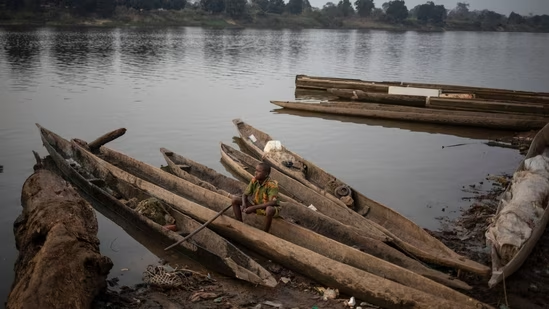
At the height of the civil war, the river running along the border with Congo was one of the few routes in and out of the capital for residents fleeing the grinding conflict. Today it is the main gateway for smugglers bringing in illicit products ranging from gasoline and weapons to narcotics, researchers say.
Of those, tramadol is turning out to be the most important.
The World Health Organization notes that while tramadol was developed for routine medical use, it has increasingly been abused and has a dependence profile like that of morphine.
“Once you are physically or psychologically dependent on tramadol, you may discover that you can no longer comfortably cope without it,” said Matthew Parker, an expert in the field of addiction medicine.
Around a decade ago, chemists at a university in Dortmund, Germany, found that cheap tramadol was abused so heavily in parts of northern Cameroon that it was seeping from human and animal waste into the groundwater and soil, where it was absorbed by roots mistakenly thought to have natural painkilling properties. It turned out farmers had also been dosing their cattle to enable them to plow through the heat of the midday sun.
The Central African Republic is now both a destination and a redistribution point for high-dose tramadol products across West and Central Africa, according to the Global Initiative.
Much of the drug originates in India, where pharmaceutical companies export it to firms in Congo. These shipments are usually registered as standard doses of tramadol, 50 milligrams. But high-dose pills are also concealed in the cargo, researchers and traders say.
From Congo, smugglers then repackage the high-dose tramadol pills, which are shipped from Kinshasa, the capital, to the river town of Zongo near the border before reaching the Central African Republic across the Oubangui River. A field study by the Global Initiative found that these high-dose pills are widely available in shops, stores and other retail outlets throughout Bangui.
From there, boxes of the drug are loaded onto motorcycles and small trucks for onward distribution through retail shops, market stalls, and small drugstores. Demand for the drug is so strong that its price has tripled locally over the past year.
Profits from the trade increase again when shipments are trafficked to neighboring markets. A consignment valued at around $7,000 in the Central African Republic could generate up to $21,000 if sold in Cameroon, though smugglers must pay around $4,000 in bribes to Wagner and its allied armed groups along the way, traders say.
The cash is enabling Wagner to import more weapons for its forces and its network of militias. The group is becoming increasingly bold.
In February last year, a Wagner-aligned militia, known as anti-balaka, killed some 130 people during an attack on Fulani pastoralists near the border with Cameroon. It was the deadliest attack on civilians since March 2022, at the height of the insurgency, according to conflict-monitoring group Armed Conflict Location & Event Data Project.
Other Wagner-backed groups such as the Sharks and the Black Russians run armed patrols around Bangui, routinely intimidating opposition supporters ahead of last year’s presidential election, in which Touadéra won a third term in office.
Before going into battle, Wagner commanders distribute high doses of tramadol to fighters to enhance aggression and suppress fear, researchers say. The growing use of the drug has coincided with rising death tolls, with fatalities in battles for control of mineral-rich regions rising by nearly 20% to about 500 over the past year, according to data from Uppsala University in Sweden.
The Central African Republic’s relative isolation and lack of strategic importance have kept Wagner and the worsening violence largely off the international radar, allowing them a freer hand to operate, according to Cameron Hudson, a former State Department official.
“The mission there is also more straightforward than in other places where Wagner has struggled, like Mali or Mozambique, where there are genuine security threats from ISIS affiliates,” he said, using a common acronym for Islamic State.
Now there are fears that as Wagner digs deeper into Bangui, it will add to the chaos already engulfing the wider region, said Dukhan, the researcher. Sudan is a particular worry, where the rebel Rapid Support Forces are gaining a stronger foothold in the southern and western portions of the country near the Central African Republic.
“Central African Republic is Wagner’s last remaining hub in Africa. But they are entering Darfur in coordination with the Rapid Support Forces,” she said.
Write to Nicholas Bariyo at [email protected]