

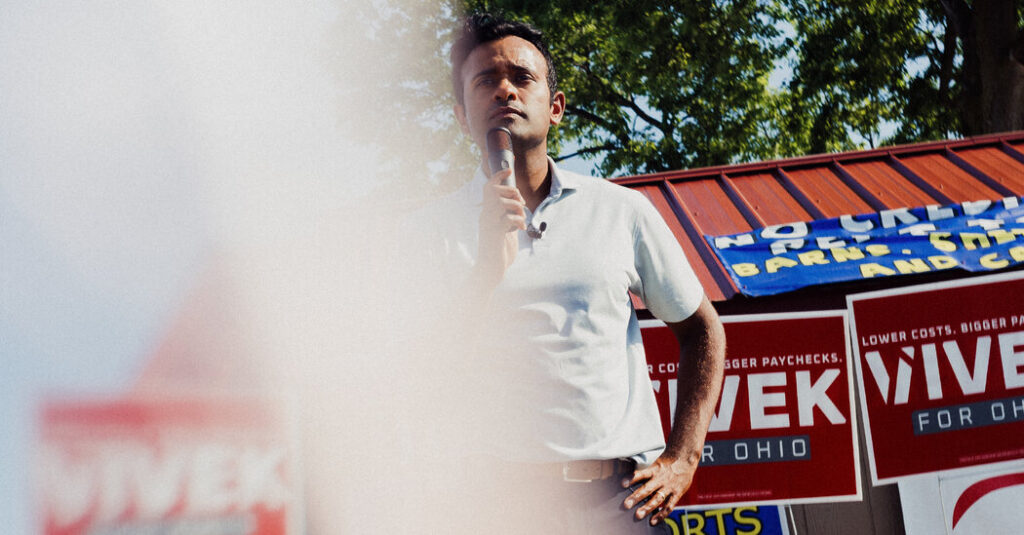
Two years ago, Vivek Ramaswamy — the loquacious biotech billionaire and vanquished presidential candidate — stood on the stage of the Republican National Convention and delivered a thundering endorsement of Donald Trump for president. “If you want to make America great again, vote Trump,” he declared. “Donald Trump is the president who will actually unite this country not through empty words, but through action.”
But on a recent mid-July afternoon at the Clinton County Fair in rural Ohio, Ramaswamy, now running to be governor of his home state, had a different message. “I don’t want to just be saying ‘Make America Great Again,’” Ramaswamy told the crowd, standing atop a trailer piled with bales of hay. “A few years from now, I want to say ‘Make America and Make Ohio Greater Than We Have Ever Been.’ And that is who we are as a country. We aspire to not just our status quo. We aspire to greatness. We aspire to more.”
It was a subtle but unmistakable shift, from a backward-looking politics yearning for the restoration of a lost America to a future-focused politics beckoning to a sunny horizon of possibility. More than anything, perhaps, it was a clear marker of intent.
We’ve been living under the penumbra of Trump for so long that it can feel as if we will never escape it. But the battle over who will succeed Trump as the Republican nominee in 2028 is well underway. Much of the focus has been on Vice President JD Vance, the presumed front-runner, or Secretary of State Marco Rubio, who has emerged as a favorite in some Republican circles. Then there’s Ramaswamy.
In some ways, Ramaswamy cuts a Trumpian figure: a billionaire political outsider with an outsize ego — like Trump, the first office he ran for was the presidency — and a showman’s knack for getting media attention. He’s faced questions about the source of his fortune and has a tendency to improvise wildly about policy. At various points he’s suggested, to general alarm, that schools should run year-round and that Medicare and Medicaid were mistakes.
But he is unlike Trump in other ways. For one, he is the child of Indian immigrants and a Hindu, facts that have drawn racist attacks from elements of the right. For another, he cleaves more to an old-school form of Republican politics, more Ronald Reagan than Pat Buchanan. You get the sense the blood-and-thunder style of Trumpian agitation doesn’t come too naturally to this smooth-talking educational ace. And he is a young man, half Trump’s age. All in all, he represents the Republican Party’s past, present and — perhaps — its future.
Megastar presidents who build an unusual winning coalition are a tough act to follow. Democrats learned this the hard way after Barack Obama’s two terms in office. But the Republican Party is now facing what may prove a more profound identity crisis as it contends with the unpleasant reality of what Trump’s second term has wrought.
On the campaign trail, that context is unavoidable: the chaos and bloodshed of Trump’s pitiless deportation campaign; the human and economic toll of a senseless war in the Middle East; an administration mired in self-enrichment and scandal; and an electorate exhausted by constant battles over race, gender and sexuality that seem disconnected from their actual lives. That appears to have spurred Democrats nationwide, who are poised to make advances in the midterms.
For Ramaswamy, it’s something of a bind. Unable and perhaps unwilling to make a clean break from Trump, he seems determined to fuse his techno-optimist politics with the dark, atavistic vision of the man who rules his party. In Ohio, I saw how hard that might be.
It was an unusually hot day at the Clinton County Fair, and the crowds were thin. Nathan Wall, a Trump-voting retired doctor with an immaculately tended bushy white beard, arrived early in the afternoon to chat with his fellow Republicans as they awaited the arrival of their candidate for governor. Wall told me he had been following Ramaswamy’s career since he burst on the scene as an aspiring Republican nominee for the presidency in 2024, and had been impressed.
“He comes across very personable, like Barack Obama when he was campaigning for his first term,” Wall told me. “What I know of his politics and his platform, I like most of it a lot.”
I asked Tim Inwood, the chair of the Clinton County Republican Party, if he was worried that racism would damp Ramaswamy’s chances in the general election. Casey Putsch, a little-known MAGA gadfly who challenged Ramaswamy in the Republican primary, dabbled in virulent anti-Indian racism and managed to get nearly a fifth of the vote. But Inwood, who proudly showed me a snapshot of Trump on his phone, said the real racists were on the other side of the aisle. “I see the left accusing us and projecting what they actually do on us,” he told me.
When Ramaswamy arrived, Inwood climbed atop a trailer to introduce him, calling him a “fantastic young man” and assuring voters that if Ramaswamy was elected, he — like just about every moderately well-sourced reporter in Washington, I mentally added — had Trump’s cellphone number. If Ohio needed anything, he would have a direct line to the White House.
Ramaswamy bounded onstage, remarkably dry on such a sweaty afternoon. “The reason I’m doing this is I want every kid in this state, not just my kid, every kid in the state, to have the same opportunities to achieve great things that I had,” he said. “This state gave me the opportunity to achieve.”
Almost immediately, he was interrupted by a young man who shouted angry questions about a data center set to be built in this rural community. Ramaswamy was unruffled, asking the young man his name and promising to answer any questions after he was done with his remarks. “Thanks for coming here, buddy,” Ramaswamy said, gamely. “If you want to have a chance to ask a question, you’re going to do it respectfully, just like everybody else.”
Smoothly, he continued with his stump speech. He pledged to bring high-paying jobs and economic growth to Ohio, to make its schools excel, to eliminate the state income tax, lower property taxes and cut electricity bills. “We will do our part to make sure that Ohio’s best days, and honest to God, through Ohio, America’s best days, are actually still ahead of us,” he declared, before opening up the floor to questions.
It was an assured performance, well received by the audience. Yet for all of Ramaswamy’s invocation of the future, most people I talked to were very much focused on the problems of the present — a cruel crackdown on supposed Medicaid fraud, for example, and rising prices for fuel, fertilizer and health care — many of which were caused or exacerbated by Trump. Surrounded by MAGA supporters and Charlie Kirk admirers, Ramaswamy could not possibly repudiate the president.
In this situation, the classic Trumpian move is to pivot to culture war issues — to lambaste illegal immigrants, D.E.I., transgender people. But in some ways MAGA has been a victim of its own success. The southern border is all but closed, and last year the United States, in part thanks to Trump’s violent deportation campaign, experienced net negative migration for the first time in five decades. The Supreme Court has delivered victory after victory to the far right on its pet issues: gutting the Voting Rights Act, striking down affirmative action, giving license to broad discrimination against transgender people and more.
You’d think that Ramaswamy, having written a best-selling book about the scourge of wokeness, would be well placed to pick up that cudgel nevertheless. But, interestingly, he steered clear of culture war topics altogether. Indeed, far from leaning into Trump’s anti-immigrant agenda, he emphasized his immigrant roots as emblematic of the American ideal. And though he praised the success of other Republican states, Ramaswamy had little to say about the Trump administration’s record. He hardly mentioned Trump, and only in passing.
I had traveled to Ohio to get a sense of where the Republican Party might go in a post-Trump world. But I kept hearing that interesting things were happening with the Democratic Party, especially in some of the deep red suburban and exurban districts surrounding the state’s reliably blue cities.
It was hardly surprising that three-quarters of the votes cast in rural Clinton County went to Trump in 2024, a show of his appeal to farmers and other blue-collar voters. The two affluent and suburban counties to its west, Warren and Butler, have also been reliably Republican for decades, delivering more than 20-point margins to Trump each time he has run for president.
Then, in May, something strange happened. In the primary races in these two counties, Democratic ballots surged by more than 75 percent compared with the midterm election in 2022. On the Republican side, ballots fell by more than 10 percent in both counties. Primaries attract the most committed partisans, so turnout is often an indication of enthusiasm. In these deep red counties, it seemed clear which side had the momentum.
In a coffee shop in the upscale township of West Chester, the chair of Butler County’s Democratic Party, Kathy Wyenandt, told me that her party’s local success was the fruit of a long-gestating plan. “We have a 10-year plan to begin flipping this county, and we have made drastic progress,” she told me.
Partly, the changes are demographic: The county has attracted thousands of new jobs in recent years in aerospace, engineering and health care. “We’re seeing a lot of transplants here, a lot of Fortune 500 companies through the Cincinnati-Dayton corridor here,” Wyenandt said. “They are highly educated. They are coming from different backgrounds, different ethnicities.”
But she and her fellow volunteers have also built a formidable operation that has knocked on thousands of doors, as well as recruited, trained and fund-raised for candidates. More and more, they are winning. In last year’s nonpartisan local elections, she said, the candidates the Democrats supported won 21 of 28 races. “What I hear everywhere, whether I’m talking to Democrats, Republicans, is people want someone who’s going to fight for them,” Wyenandt told me. “They’re tired of corruption. They’re tired of their politicians being bought and sold.”
This goes some way toward explaining why the race for governor is much tighter than most observers expected. Ramaswamy appears to be stuck in a dead heat with the Democratic candidate Amy Acton, a former state public health official and physician who has never run for office. It is notable that in a late June poll Acton did better than Sherrod Brown, a much more well-known Ohio Democrat who is seeking to reclaim a seat in the Senate. Ramaswamy’s path to victory will almost surely require running up big margins among right-leaning yet Trump-weary voters in places like Warren and Butler counties.
If Tommy Montoya is anything to go by, Ramaswamy may struggle. Montoya, a longtime transplant to the area, moved to Butler from Utah to work at one of the many companies that have expanded in the Cincinnati exurbs in recent years. A father of four, he was raised in a deeply conservative Mormon family and considers himself fiscally conservative. Though he has voted for candidates from both parties, he remained a Republican. Yet this year, after a bruising run for the local school board, he requested a ballot to vote in the Democratic primary.
“Give me a Mitt Romney,” he told me. “I think I’d be a little more comfortable affiliating there. But I have no desire to be affiliated with the Republican Party today.” I asked him if Ramaswamy, with his subtly more traditional Republican pitch, could win his vote. “I think he’s trying to thread that needle,” Montoya said. “It’s not enough for me. I can’t speak for everyone, but for me, the proximity to Trump is a stain at this point on anybody.”
Ramaswamy seems to intuit the problem. He has made canny moves since Trump returned to office, staying on the president’s good side but keeping his distance from the administration. He was initially slated to work alongside Elon Musk at the so-called Department of Government Efficiency, but quickly split to run for governor of Ohio. Whether he was pushed out or left of his own accord — accounts vary — it has turned out to be a boon for his prospects.
If he wins the governor’s race, it would serve him well to skip the 2028 Republican presidential primary, which will be either a coronation for Vance or a messy brawl over the legacy of a deeply unpopular and polarizing president who nevertheless retains an iron grip on the party. Ramaswamy, who is just shy of 41, could bide his time, using Ohio as a showcase for his brand of post-Trump fusionism. That would be light on anti-immigration scaremongering and heavy on optimistic self-reliance, drawing in wavering moderates and committed Republicans alike.
But first he needs to win.
The Times is committed to publishing a diversity of letters to the editor. We’d like to hear what you think about this or any of our articles. Here are some tips. And here’s our email: [email protected].
Follow the New York Times Opinion section on Facebook, Instagram, TikTok, Bluesky, WhatsApp and Threads.