

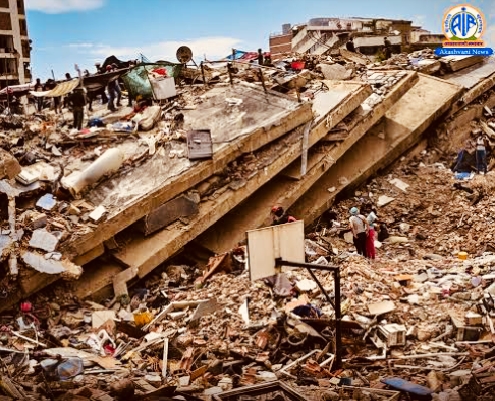
The humanitarian crisis triggered by the devastating twin earthquakes that struck Venezuela last month has deepened, with authorities confirming that the death toll has risen to more than 4,300 as rescue efforts gradually give way to recovery and reconstruction.
Officials said at least 4,333 people have now been confirmed dead, while 16,740 others sustained injuries in the twin earthquakes that rocked the South American nation on June 24. About 17,000 residents remain homeless, with hundreds of buildings either destroyed or severely damaged.
The updated figures were released by the President of Venezuela’s National Assembly, Jorge Rodríguez, who disclosed that search teams were still working at a handful of locations where there remained slim hopes of finding additional survivors beneath the rubble. He added that 315 victims are yet to be identified, with authorities relying on DNA samples and dental records to establish their identities. Blueprint reports
Reconstruction gathers momentum
As the emergency response transitions into reconstruction, the Venezuelan government has begun implementing plans to provide permanent housing for thousands displaced by the disaster.
Authorities estimate that approximately 25,000 new homes will be required to accommodate affected families. Land has already been earmarked in the hardest-hit communities, particularly in the coastal areas of Osma and Chuspa, while the first batch of newly constructed homes is expected to be allocated to victims in the coming days.
The earthquakes, measuring 7.2 and 7.5 magnitudes, struck just seconds apart, causing catastrophic destruction across Caracas and the coastal state of La Guaira. Entire residential neighbourhoods, commercial buildings and public infrastructure were flattened, making it one of the deadliest natural disasters in Venezuela’s recent history.
International aid increases
The scale of the destruction has continued to attract international humanitarian assistance.
The European Union recently announced an additional €20 million in emergency support to bolster ongoing search-and-rescue operations, provide medical equipment and assist affected communities. The latest package adds to previous EU assistance already committed following the disaster.
The United Nations and several humanitarian organisations have also intensified relief operations, warning that the destruction of homes, healthcare facilities and water infrastructure has significantly increased the risk of disease outbreaks among displaced populations living in temporary shelters.
Aid agencies continue to distribute food, clean water, medicines and hygiene supplies while providing psychosocial support to families who lost loved ones during the disaster.
Humanitarian concerns persist
Despite progress in relief operations, humanitarian organisations say significant challenges remain.
Thousands of displaced residents continue to live in overcrowded shelters where access to clean drinking water, sanitation facilities and healthcare services remains inadequate. Health experts have warned that prolonged displacement could heighten the risk of communicable diseases if living conditions are not improved quickly.
The earthquakes also caused extensive damage to schools, hospitals, roads and public utilities, further complicating efforts to restore normalcy in affected communities.
Authorities estimate that hundreds of buildings either collapsed completely or suffered structural failures requiring demolition, while reconstruction costs are expected to run into several billions of dollars.
Nation mourns as rebuilding begins
As Venezuela continues to mourn thousands of lives lost, attention is increasingly shifting toward rebuilding communities and restoring essential public services.
Government officials have pledged to accelerate housing construction, rehabilitate damaged infrastructure and strengthen disaster preparedness measures to reduce the impact of future seismic events.
Although large-scale rescue operations have largely concluded, recovery efforts are expected to continue for months, with international partners maintaining support for one of the country’s worst natural disasters in decades.