

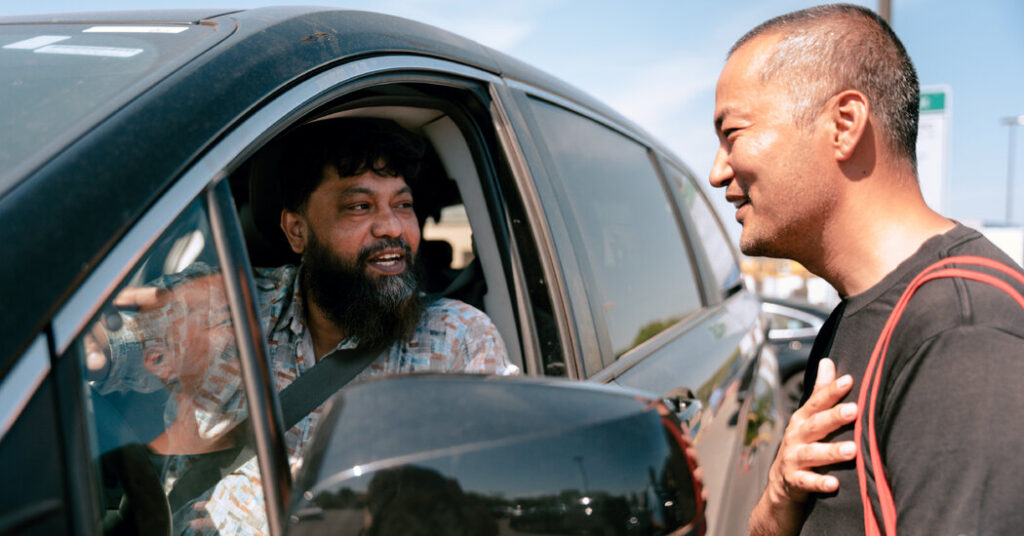
Kay Woo, a Korean tech executive, wants to break into New York City’s multibillion-dollar ride-share industry.
So, naturally, in a city of 8.5 million potential customers, he’s courting his most valuable prospects: cabbies.
For the past few months, Mr. Woo has made recurring trips to a shadeless parking lot at LaGuardia Airport, recruiting drivers for his company, TADA. His efforts have paid off: He says he has persuaded about 50,000 drivers since March to install the company’s ride-hailing app.
The goal of the new app, called Throo, is to offer an alternative to the higher-commission model that drivers are used to when working with companies like Uber and Lyft. By charging drivers a smaller fixed fee per ride, and reducing charges that otherwise get passed onto passengers, Mr. Woo’s company promises better pay for drivers and cheaper fares for riders.
So far, Throo, which started offering rides in June and is authorized to operate in New York, is undercutting the bigger apps on some fares. A standard trip from the Port Authority Bus Terminal in Manhattan to Kennedy International Airport was $80 with Throo; a similar ride with Uber would have cost about $136, and Lyft asked for $134.
TADA, based in Singapore, is among a small number of upstarts offering discounted rates and using slick marketing techniques to try to cut into what is effectively a ride-share duopoly. Uber and Lyft make about 80 percent of all for-hire and taxi trips in the city, with Uber completing roughly 70 percent of that share, according to the New York City Taxi and Limousine Commission.
Others have tried and failed to supplant Uber and Lyft, which together overtook yellow taxis as the most popular car service in the city a decade ago. The apps recorded 106 million rides through May of this year, more than five times as many as yellow cabs did, city data showed.
Newcomers could mean more options and better prices on trips that have steadily become more expensive. But they could also present risks, as the companies seek a competitive edge that may not be sustainable or, in some cases, legal.
Another competitor, an app called Empower, is embroiled in a court battle with government officials who say it is operating illegally in the city and putting passengers and drivers at risk.
The city is seeking an injunction to ban the app’s parent company, Yazam Inc., from operating in New York, because it has not complied with licensing rules, does not pay required fees to operate and does not share trip information with the T.L.C. In March, the company said it was completing 100,000 rides per week in the city, despite its legal status.
Midori Valdivia, the T.L.C. commissioner, said the city could not ensure the safety of Empower’s fleet of vehicles, and passengers might face insurance issues if the vehicle was in a crash. Drivers who use the app can be fined or lose their license.
“I want to make sure word gets out that they are unlicensed,” Ms. Valdivia said. “There is a reason we have this system, and it’s to protect drivers and the riding public.”
Josh Gold, a spokesman for Uber, said the company welcomed competition from apps like Throo, but criticized how the city has allowed Empower to continue to operate.
“It’s really shocking that the government is still allowing this illegal operator to evade all these rules and taxes,” he said.
Empower owes the city over $45,000 in fines, and Joshua Sear, its chief executive, has also been fined by officials in Washington for operating in the district without registration. Mr. Sear referred questions to a company representative, who said New York officials had “repeatedly rejected” Empower’s offers to “facilitate the assessment and payment of any taxes or fees” that their drivers should pay.
Jason Kersten, a spokesman for T.L.C., said the agency would respond in court.
While Throo is fully licensed in New York, it still faces an uphill battle.
Mr. Woo, 44, is betting that his business model will appeal to drivers, many of whom have complained to him about dwindling pay. TADA used a similar strategy in Southeast Asia, where it has become one of the most popular ride-share companies in Singapore.
Uber and Lyft take an average commission of about 20 percent from drivers, according to the T.L.C., and that doesn’t include some additional government fees. While drivers using Throo still have to pay taxes and fees, the company says it charges $1 or less per fare, providing the driver a bigger cut.
“We take care of the driver first, and the driver can take care of the riders,” Mr. Woo said in an interview.
Full-time drivers who relied on ride-share apps last year were paid a median of $75,000 — marginally better than the $73,000 they earned in 2021, but the figures do not include expenses, taxes or tips, according to city data. There are more than 80,000 for-hire vehicle drivers in the city, the majority of whom were born in other countries and now live in the boroughs surrounding Manhattan.
Mayor Zohran Mamdani has long been an advocate for taxi drivers, and they formed an important political base for him during the 2025 mayoral election.
Antonio Rivera, 50, a Dominican driver who lives in the Bronx, said he had been actively seeking an alternative to the bigger apps when he heard about Throo.
“Uber and Lyft, they’re not treating drivers nice,” he said on a ride from Long Island City in Queens to LaGuardia Airport. Drivers with T.L.C. licenses can work for any of the ride-share apps, so he added Throo to his rotation, in the hopes of eking out better pay.
The fare to the airport was about $24. After commission, taxes and fees, he said he might collect $11 or $12 from the bigger apps. But with Throo, he received about $19.
“It’s a pretty good deal for us,” he said. Still, after driving for 14 years, he said he remembered a time when the bigger apps also promised more favorable splits for drivers and other bonuses, which faded as the companies grew.
Many drivers have recently criticized so-called deactivations — when a service like Uber or Lyft effectively fires a driver, often because of complaints from riders. On Wednesday, a federal judge ruled in favor of the apps, which had argued that the city cannot prohibit them from dismissing drivers without notice.
Several drivers who signed up for Throo said the deactivation policy was one reason they wanted new apps to succeed.
“They only listen to passengers, not drivers,” Waseem Manzoor, 61, said of the bigger apps, while awaiting a job at LaGuardia in May. Mr. Manzoor, who is Pakistani and lives in Queens Village, started picking up fares three years ago, after the Rite Aid convenience store he had worked at for two decades shut down.
He said he registered to drive for Throo in part because the low-fee model was appealing, and the app gave him another source of potential fares.
But by July, Mr. Manzoor said, he had stopped using Throo because he had not been making more money than he would on other apps.
Not all Throo trips will pay drivers more than those of its competitors, depending on the time of day and level of demand, Mr. Woo said, adding that it’s “inevitable” that some drivers will get frustrated. But he insists that most rides will result in 10 to 15 percent larger payouts for drivers, and that trip volume will grow.
Bhairavi Desai, the executive director of the New York Taxi Workers Alliance, which represents more than 28,000 taxi, Uber and Lyft drivers, said she was skeptical of TADA’s claims about driver benefits.
“It’s déjà vu all over again,” she said, recalling a time when Uber and Lyft offered similar enticements to lure drivers away from yellow cabs. Some of her members have said their fares with Throo are no better than with other apps, and that there aren’t enough rides available through the app.
Other companies have also tried to break into New York in recent years. Via, a shared-van app that offered discount rides in the city, shut down its ride-hailing service in 2021 to focus on public transit. In 2019, the transportation company Gett shuttered its ride-hailing app, Juno, and announced a partnership with Lyft.
The way TADA can avoid the pitfalls of its predecessors is to grow quickly, Mr. Woo said. Since June, Throo has been used by over 35,000 riders, he said, which represents a few hundred rides per day. When the app can sustain 10,000 rides per day, a goal he hopes to hit next year, he said, the company will be profitable.
“If we can survive until then,” he said, “this model is untouchable.”
Susan C. Beachy contributed research.