

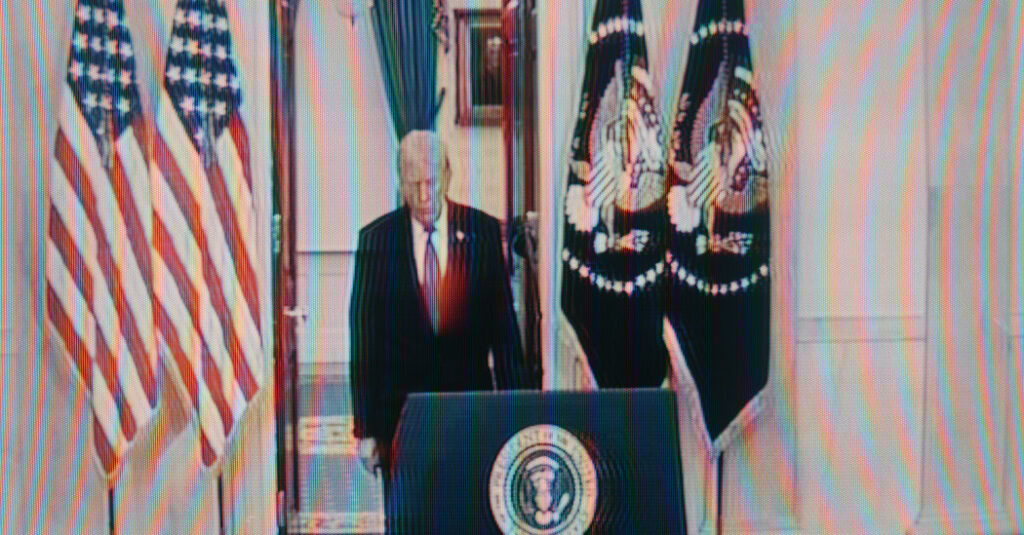
“We won,” President Trump announced on March 11, less than two weeks into his Iran war. “In the first hour, it was over.”
On March 24, in the Oval Office, he reiterated, “This war has been won.”
On April 6, he asserted, “They are militarily defeated.”
On April 11, Trump posted on Truth Social, “The United States has completely destroyed Iran’s Military.”
“The war in Iran is going along swimmingly,” Trump said on April 16. “It’s perfect.”
The perfection of Trump’s war has confused some of his supporters. “I don’t understand how it’s possible that Iran has the capabilities to fight this way and continue to try to lash out at Gulf countries and U.S. military bases,” Maria Bartiromo of Fox News said on air recently. “Because the U.S. has obliterated Iran’s military, and the president continues to reiterate that.”
Yet Trump’s perfect war seems to have a few wee flaws, including the closure of the Strait of Hormuz and, in the past few days, the partial closure of passage through the Red Sea as well. So Trump is escalating attacks in what looks like a doubling down on a failed strategy. But the problem now is not Trump’s terrible miscalculation in starting the war on Feb. 28 in ways that weakened America, depleted munition supplies, reduced our capacity to deter China in Asia and strengthened Iranian hard-liners. Rather, the issue at the moment is the way he is disastrously escalating the war.
Trump has lately been striking sites across Iran each day, and he warned that the United States would hit a power plant or bridge for each ship that Iran struck. Putting aside the question of war crimes, there’s also the problem that Iran responds in kind.
“Iran still retains multiple escalation options,” noted Danny Citrinowicz, a retired Israel Defense Intelligence expert on Iran. Citrinowicz noted that Iran could attack Persian Gulf states, cut undersea cables or harness the Houthis in Yemen to attack shipping in the Red Sea.
Both sides have already struck water and desalination plants, which could be disastrous for Gulf countries if this continues. Iran is not heavily dependent on desalination, but Bahrain, Kuwait, Qatar and the United Arab Emirates rely on desalination for almost all of their drinking water. Cities could become pretty much uninhabitable if power plants and desalination plants are destroyed.
Likewise, if the United States attacks Iranian oil and gas sites, Iran is likely to do the same in Gulf countries, reducing oil flows for months or years. The Houthis have announced that they have joined the conflict, targeting Saudi maritime traffic in the Red Sea and thus diminishing global oil supplies even more. The Houthis had stayed out of the war until now, and I wonder if this means they see Iran as the effective victor.
Trump is threatening to strike the Houthis. But he should remember that he and Joe Biden before him spent some $7 billion bombing the Houthis for a bit more than two years and achieved nothing obvious. Trump extricated himself from the bombing campaign in May 2025 with a standard diplomatic magic trick: Both sides declared victory, and the bombing ended.
What is Trump trying to achieve by ramping up attacks? What’s the intent?
“Any realistic strategy should begin with one core assumption: Iran is unlikely to capitulate,” Citrinowicz said.
In other words, increased airstrikes seem a fiery dead end. I hope Trump isn’t considering invading with ground troops, for that would be even more disastrous. Barry R. McCaffrey, a retired general, estimates that it would take a year and 600,000 American troops to subdue Iran, taking casualties along the way.
“Then what?” McCaffrey asked. “Stay?”
I do see one military escalation that could be useful to squeeze Iran: Help the United Arab Emirates recover the disputed islands of Greater Tunb, Lesser Tunb and Abu Musa, if the Emirates are willing to do this with their troops rather than ours. Iran forcibly seized the islands in 1971, but the Emirates have a plausible claim, and the islands are strategically located by the Strait of Hormuz and could help control it.
Beyond that, there’s really no alternative but negotiation, recognizing that any negotiated outcome will be unpalatable — though not as unpalatable as escalating a war to nowhere. Perhaps the most important aim of negotiation should be keeping Iran from getting nuclear weapons, but Trump’s foolish new nuclear deal with Saudi Arabia, if it goes forward, will make that even harder. If the Saudis are enriching nuclear fuel, the Iranians will insist on doing so as well, and the upshot may be a nuclear competition between them.
Indeed, I’m increasingly fearful that the most dismal legacy of this catastrophic war may be that a decade or two from now both Saudi Arabia and Iran will have nuclear weapons. Two unstable, misogynist Middle Eastern autocracies with nuclear weapons — what could go wrong?
The Times is committed to publishing a diversity of letters to the editor. We’d like to hear what you think about this or any of our articles. Here are some tips. And here’s our email: [email protected].
Follow the New York Times Opinion section on Facebook, Instagram, TikTok, Bluesky, WhatsApp and Threads.