

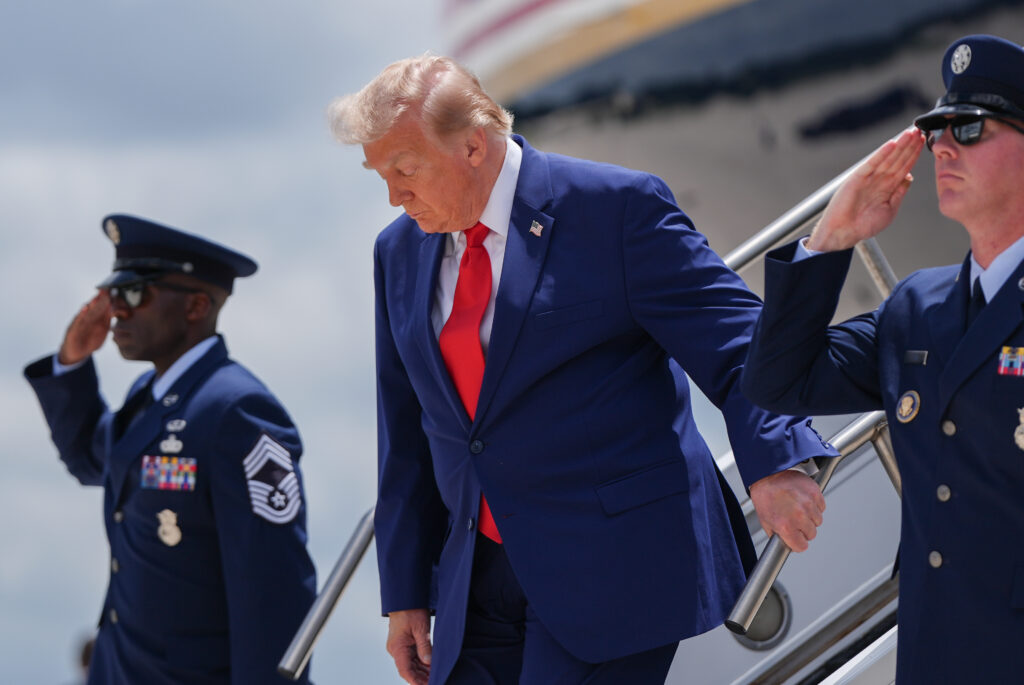
President Donald Trump leaned hard on Friday into what he said were negotiations with Iranian officials, seeming to emphasize diplomacy over military escalation after days of attacks by both sides and warnings that the White House was considering a sharp escalation of the war.
Six times during a 38-minute Oval Office appearance on Friday, the president mentioned that his envoys were talking to Iran. The rhetorical emphasis on diplomacy followed days in which he suggested that he was ready to increase military pressure on the Middle Eastern country.
The shift tracked a familiar pattern for Trump, who has oscillated between military pressure and diplomacy in the five months since he launched the war against Iran.
“There’s a military exit where we just keep going just the way we are, and we can even make it a heavier dose, and it’s knocking out everything they have. Or there’s a smarter strategy that you make a deal. And they want to make a deal,” Trump told reporters. “As we speak, we’re talking to them.”
The president and his Iranian counterpart, Masoud Pezeshkian, signed a memorandum of understanding last month that aimed to reopen the Strait of Hormuz, a crucial shipping chokepoint, as a preliminary step to talks about Iran’s nuclear program. But those talks quickly fell apart, and Iran has resumed its throttling of the waterway, through which about 20 percent of the world’s oil used to be shipped.
Iranian leaders have embraced their newfound leverage over the strait, which was fully open to shipping traffic before the United States and Israel launched a joint attack on Iran in late February. Iran’s military has been hit hard by airstrikes, but the regime has proved resilient — and it has also shown that it needs little more than a handful of inexpensive attack drones and some mines to project power over global energy markets.
The Iranian-backed Houthi militia group declared this week that it would expand attacks on shipping into the Red Sea, placing additional pressure on Saudi Arabia, which has sought to bypass the Strait of Hormuz by sending oil out of its opposite coast.
The Houthis’ attacks on oil tankers have expanded the range of the conflict and helped send the price of crude oil above $100 on Thursday. On Friday, the price eased slightly, to roughly $96 per barrel — far higher than the $60 level at the start of this year.
Trump insisted, however, that it was the Iranians who were feeling pressure, not him.
Tehran is “getting more and more serious as the days go by, for maybe the obvious reason,” Trump said, suggesting that military attacks were increasing the Iranians’ willingness to make a deal.
“We can take that to a much higher level if we want to, you know. We’re prepared to do that,” Trump said. “We’re locked and loaded and ready to go.”
Trump told Axios on Thursday: “I am considering a massive attack. Bigger than ever before. I am close to making a decision. We are all set for it.” Asked about that on Friday, he struck a different note, once again saying that the two sides were talking.
Iranian strikes on U.S. targets in the Middle East have killed four U.S. service members in the past two weeks, and the president visited Dover Air Force Base on Wednesday for a dignified transfer ceremony to mark the return of some of their remains.
There appears to be little immediate end to the conflict in sight. Trump said shortly after launching the war that the conflict would take four to six weeks. Five months later, he held open the possibility on Friday that it could still be going at the midterm elections in November, a prospect that has spooked many congressional Republicans.
“We’ll see what comes of it. I’m not, you know, despite what everyone says about the election, I’m not in a hurry,” Trump said. “We have to do it right. Elections take care of themselves.”