

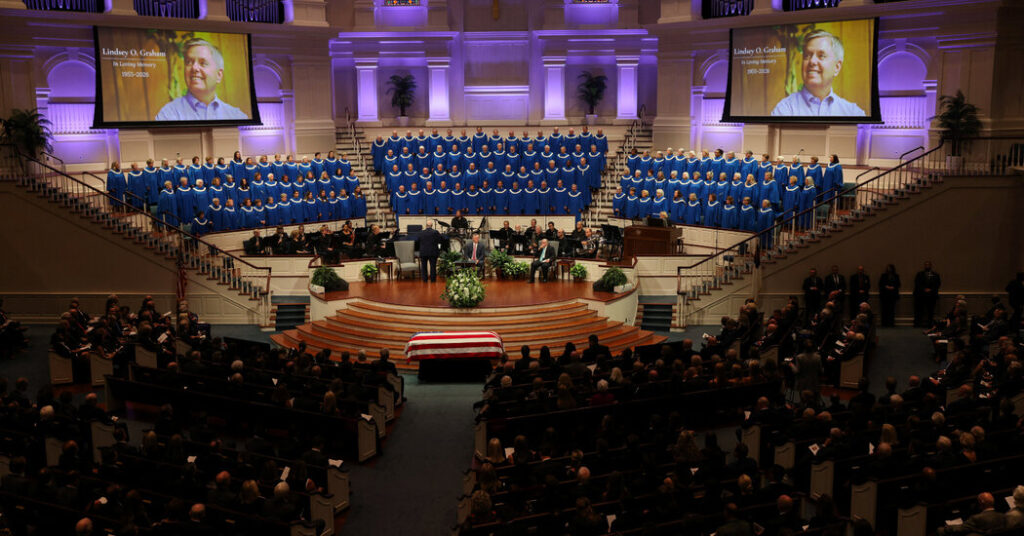
The leading candidates vying to succeed Lindsey Graham in the Senate gathered Wednesday at his funeral in South Carolina, forming an occasionally awkward tableau, as they sought to celebrate his life respectfully while quietly jockeying for his seat.
It was a delicate task. One candidate is Mr. Graham’s sister, Senator Darline Graham, who was picked to serve out the remainder of his term and was endorsed by President Trump to run for the next one. She escorted Mr. Graham’s casket to the front of the First Baptist Church in Columbia, the state capital, and listened to the service from the front row, occasionally wiping tears from her eyes.
Several of the other candidates in attendance, all fixtures in South Carolina politics, also claim ties to Mr. Graham: Representative Russell Fry is a former intern. Former Gov. Mark Sanford named Mr. Graham as the godfather of one of his children.
Complicating their relationships with the late senator were the realities of Republican politics in South Carolina. Mr. Graham was a favorite of President Trump and the Washington establishment. However, his relationship with Republican voters in South Carolina was not always smooth, particularly with some members of the hard-line MAGA base expected to turn out in a special primary election on Aug. 11.
Nine candidates qualified by Tuesday’s filing deadline to appear on the ballot. In the sprint to define themselves in just a few weeks, they have each made a point of breaking from various aspects of Mr. Graham’s record, including his comfort with Washington and his focus on issues abroad.
Ms. Graham, 62, has sat for only one interview since announcing her bid, asking for time while her brother was laid to rest. But even in that appearance, she sought to differentiate herself from Mr. Graham, telling the Fox News host Sean Hannity that she often urged Mr. Graham, after watching him discuss foreign policy on TV, to pay attention to issues that more directly affected his constituents’ lives.
“Talk about also what matters to the average person: the price of gas, health care, insurance, those kinds of things,” she described saying to her brother again and again. “That’s what I’m worried about.”
Mr. Sanford, 66, whose time in the governor’s mansion ended in scandal surrounding an extramarital affair, announced Wednesday that he was taking a road trip to discuss how he would lower gas and housing prices — a contrast to Mr. Graham, who backed a war with Iran that has made life more expensive for Americans.
Mr. Fry has billed himself as a “conservative MAGA candidate” who, at 41 years old, represents a new generation of leadership. And Representative Ralph Norman, 73, has leaned into his credentials as a member of the House Freedom Caucus to subtly question Ms. Graham’s experience by telling voters they “shouldn’t have to guess” how their senator will vote in Washington.
The pews of the church played host to a who’s who of South Carolina politics, in some ways reflecting the bipartisan version of governance that Mr. Graham had practiced and championed for much of his career. Representative Jim Clyburn, South Carolina’s longest serving Black lawmaker and the state’s lone Democrat in Congress, chatted amiably with Mr. Hannity. Attendees embraced and took selfies.
Gov. Henry McMaster, Senator Tim Scott, also a Republican of South Carolina, and Trey Gowdy, a Fox News host and former congressman, spoke during the service, telling stories about Mr. Graham’s service and his sense of humor. They all expressed love and support for his sister, who has been serving out the remainder of his term even as she finds herself in a tough primary race to replace him permanently next year.
The speakers stopped short of endorsing her candidacy, however, as they addressed an audience that also included Mr. Sanford, Mr. Fry and Mr. Norman — a reflection, perhaps, of how competitive the primary remains.
The top five contenders in the race, including Ms. Graham, Mr. Sanford, Mr. Fry and Mr. Norman, have agreed to participate in a debate scheduled for Monday.
As of Wednesday, a PAC supporting Mr. Fry was scheduled to spend half a million dollars on TV ads, while Mr. Sanford’s campaign planned to spend almost $350,000, according to data from AdImpact.
Ms. Graham’s campaign has bought more than $90,000 of TV time in coordination with the National Republican Senatorial Committee, which received some of Mr. Graham’s campaign funds, according to a person familiar with the arrangement. Security is Strength PAC, an independent committee that worked on behalf of Mr. Graham, is now helping his sister.
Mr. Graham won his primary election in June, a month before he died. But the race was expensive, and for a time it appeared to be headed to a runoff. Mr. Graham knew the state was moving away from him, Mr. Gowdy said on Wednesday.
Mr. Graham had recently told his chief adviser, Richard Perry, that he was aware that a growing number of South Carolina voters would never support him, Mr. Gowdy said during his tribute.
“Forty-nine percent of the people in this state are not going to vote for me no matter what,” Mr. Gowdy recalled Mr. Graham as saying.
Some hard-line conservatives never forgave Mr. Graham for his sharp criticism of Mr. Trump in 2016, when the two competed for the Republican presidential nomination. Others saw Mr. Graham’s hawkish policy — and particularly his support for the war in Iran — as antithetical to the “America First” ethos that powered Mr. Trump to the White House.
Inside the church on Wednesday, that jockeying stayed on the sidelines.
“We meet in sadness over the loss of one of South Carolina’s greatest sons,” Governor McMaster said, “but also to celebrate this poor boy from a little town in South Carolina, as he called himself.”
Governor McMaster continued: “His impact was enormous, and I am confident, as are you, there will never be another Lindsey Graham.”
Theodore Schleifer contributed to this report.