


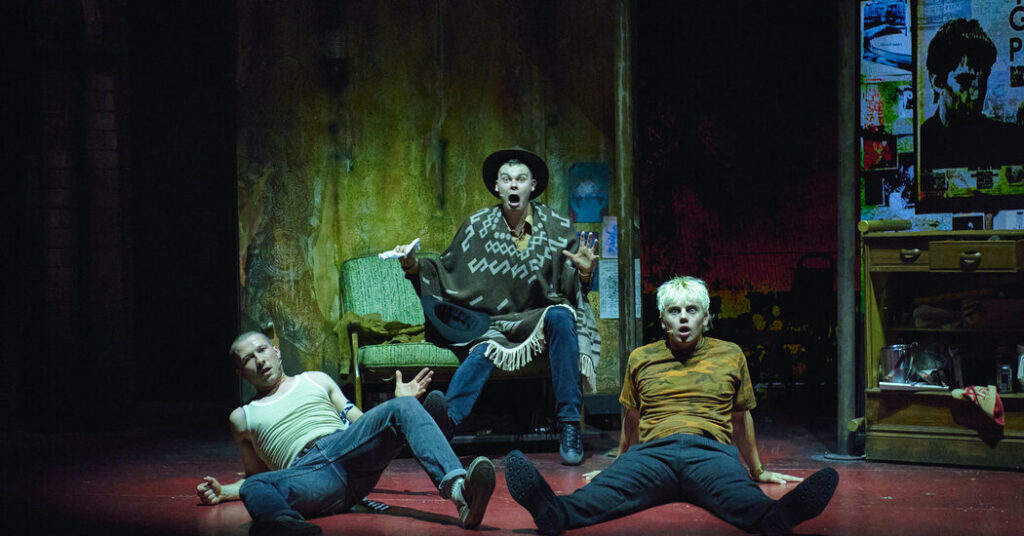
It was always going to be a tall order. “Trainspotting,” Danny Boyle’s 1996 movie about the drug-fueled misadventures of five Edinburgh misfits, seems an odd fit for musical treatment. Yes, there’s drama aplenty as the junkie protagonist, Mark Renton, sees his friends’ lives destroyed by drug use before he eventually realizes that the banalities of a respectable existence are preferable to the squalor of addiction, and resolves to “choose life.”
But up until that epiphany, the tone of the movie, with its grim sardonicism, sleazy soundtrack — a mix of post-punk, indie and electronica — and ironized, profanity-laden aggression, is far from didactic. That was what made it brilliant, and it doesn’t translate easily to musical theater.
Still, “Trainspotting: The Musical,” timed to coincide with the film’s 30th anniversary, tries to bridge this gap. Irvine Welsh, whose 1993 novel inspired the movie, has written the book for this adaptation — which is directed by Caroline Jay Ranger and runs at the Theater Royal Haymarket in London through Sept. 5 — and co-written its songs with Stephen McGuinness.
The attempt fails dismally’, despite the admirable efforts of the leading man Lewis Kidd, who signed up at late notice to play Renton after the original actor was injured in rehearsals. He leads an upbeat group rendition of Iggy Pop’s “Lust for Life” in the opening scene, but over the next two and a half hours we learn the human cost of hedonism.
A baby dies from neglect. Tommy (Finlay Paul) is dumped by his long-suffering girlfriend, Lizzie (Sophie Hutchinson), gets addicted to heroin and dies of AIDS. To avoid a similar fate, Renton goes cold turkey and spins into hallucinations with the rest of the cast hovering over him, gyrating to techno. The exasperation of concerned parents, girlfriends and exes forms the melodramatic meat of the show.
Musically, it’s a nonevent. Welsh and McGuinness’s songs are instantly forgettable. “Rolling With the Punches” is an insipid paean to resilience, “One Skin Too Few” a sentimental ballad about young men falling by the wayside. A spiky number about economic inequality, “Youth Opportunities,” is apparently inspired by a similarly titled song by the Scottish punk band the Exploited, but its power chords sound more heavy metal than punk. The song’s rage feels contrived, and inadvertently a little kitschy.
The songs tend to interrupt the action rather than moving it along, even as the performers also belt out a couple of the best-known songs from the movie soundtrack, including Lou Reed’s “Perfect Day.” The Verve’s “Bittersweet Symphony,” which did not feature in the movie (the song was released in 1997), is thrown in as filler.
The cast does what it can to bring the material to life. The elfin Sheridan Townsley doesn’t entirely convince as the philandering Sick Boy, whose defining trait is his interest in women “of every race, creed and color,” but at least he has a singing voice to make up for it.
As the unhinged hard-man Francis “Franco” Begbie, Frankie O’Connor stomps around the stage dropping F-bombs and C-bombs like it’s going out of fashion — which, in truth, it kind of has. The darkly comic menace with which Robert Carlyle imbued the role in the movie is not much in evidence here.
The pick of the bunch is Kieran Andrew as the gangly, endearingly dimwitted petty thief Spud, who gets most of the laughs. He soils his bedsheets, chats voluble gibberish at a job interview after taking speed and at one point expresses bafflement as to why Renton has burst into song, before gamely joining in.
This, sadly, is as good as it gets. The wittier moments are drowned out by unearned emoting and soppy sociological platitudes about why people take drugs. “Heroin loves misery and misery loves company” is a line Welsh evidently considered strong enough to have Renton utter it not once but twice.
Yet to complain that “Trainspotting: The Musical” is limp and aesthetically incoherent is to miss the point. Because the true purpose of a show like this is not to create fresh sensations or tell a story from scratch, but simply to trigger memories of having watched the film first time around and other memories associated with having been younger back then.
Its pleasures are those of the cruise ship tribute band, and the generation that came of age in the ’90s — many of whom gladly paid hundreds of pounds for Oasis tickets last year — has entered its nostalgia era. (In the theater bar, I overheard a group of people in their 40s discussing their latterly weakened bladders in tones of amused novelty.)
One can’t help thinking that a straight-up jukebox musical would have worked better for these purposes. It would certainly have been fun to watch the company render Underworld’s mesmerically repetitious 11-and-a-half-minute electronic classic, “Born Slippy,” which accompanies the climactic scene in the movie. Instead, they reprise “Perfect Day,” which feels like a cop-out.
But low creative risk is par for the course with lowest-common-denominator nostalgia. So much for choosing life.
Trainspotting: The Musical
Through Sept. 5 at the Theater Royal Haymarket in London; trh.co.uk.