

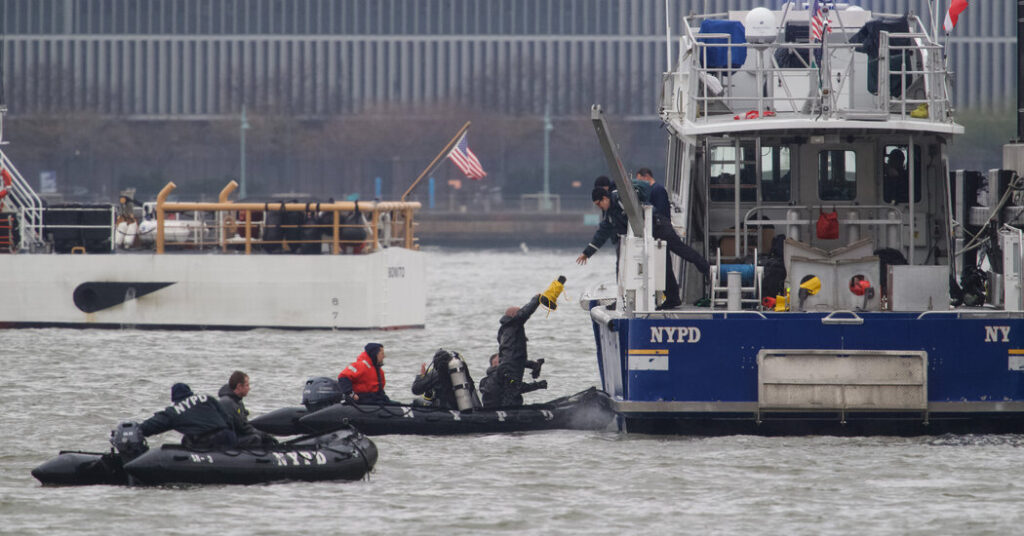
A tourist helicopter that crashed into the Hudson River last year, killing six, was most likely struck by a flock of geese before it fell, according to documents released on Thursday by the National Transportation Safety Board.
The helicopter, operated by the sightseeing company New York Helicopter and flown by a single pilot, was carrying two adults and three children from Spain when it broke up in the sky and fell into the Hudson River near Jersey City, N.J., around 3:15 p.m. on April 10, 2025. No one survived.
Witnesses to the accident reported hearing “several loud ‘bangs’ and ‘pops’” before the helicopter plummeted into the water, according to the N.T.S.B. documents, which were part of an investigation into the crash. A document credited to the Smithsonian Institution’s Museum of National History suggests that a flock of geese was most likely the source of those sounds, and caused the impact that broke up the aircraft.
According to Carla Dove of the museum’s Feather Identification Lab, an analysis of bird remains collected from the wreckage suggested that a flock of Brant and Canada geese “impacted the rotor blades and the horizontal stabilizer” of the helicopter, hitting the blades with such force that remains were embedded in one of them.
According to that document and the N.T.S.B. report, an eyewitness to the accident also reported seeing a flock of geese fly toward the river minutes before the crash.
Female and male bird remains were on the rotor blades, leading Dr. Dove to determine that at least two of the geese had collided with the aircraft. The eyewitness estimated that there were roughly 20 geese in the flock. Brant and Canada geese are commonly seen around New York in April.
Tens of thousands of sightseeing helicopter flights are made every year in New York. Over the last two decades, three have ended in fatal crashes.
Last year’s crash, the deadliest in seven years, prompted calls for restrictions on aerial sightseeing, and bipartisan legislation to require that helicopters with fare-paying passengers have safety standards as stringent as those applied to commercial airplanes. The bill, proposed by New York lawmakers, would also require the helicopters to have cockpit voice and flight data recorders.
But it is not clear whether such measures could have helped avoid a bird strike, if the N.T.S.B. determines that was the cause of the accident. The N.T.S.B. has not released conclusions or recommendations from its investigation.
Bird strikes are a common hazard for airplanes, but they rarely cause fatal accidents. When they do, it is typically because birds are pulled into the engine, disrupting a plane’s ability to stay aloft.
Birds were at issue in at least one other famous aviation incident on the Hudson River. In 2009, a pilot for U.S. Airways, Chesley B. Sullenberger III, executed what came to be known as the “Miracle on the Hudson” water landing after his plane struck a flock of geese.
Helicopters are more susceptible to accidents if birds become caught in their rotor blades during a flight. In 2023, the Federal Aviation Administration issued a public warning over the “unique vulnerability” of helicopters to bird strikes.
The warning noted that the results of a strike “may vary from benign to catastrophic in nature.”