
Tony Ojukwu: Peter Obi’s Claim That His Life Is Under Threat Is Very Worrisome and Should Be Taken Seriously

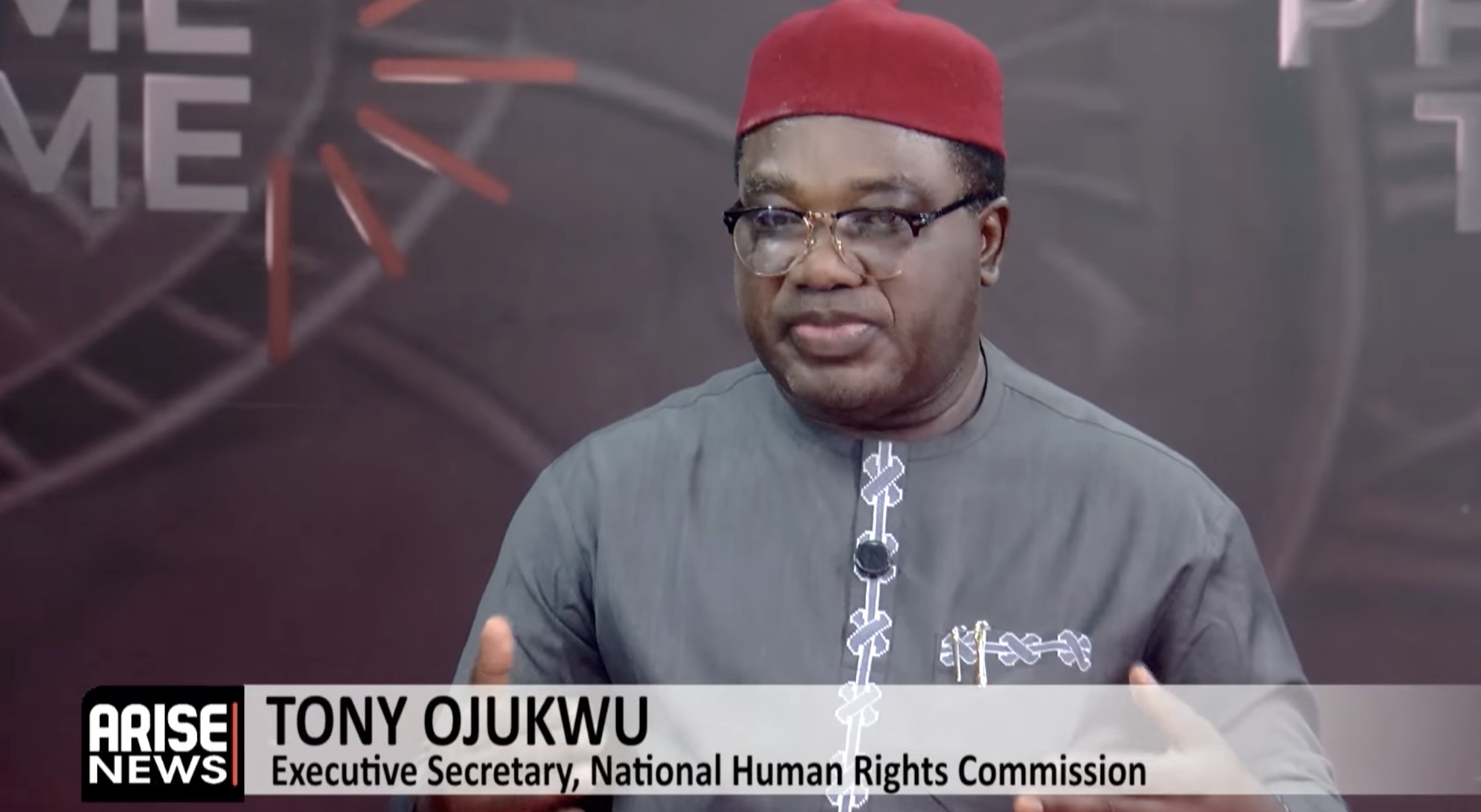
The executive secretary of the National Human Rights Commission, and also a Senior Advocate of Nigeria, Chief Tony Ojukwu, has described the Nigeria Democratic Congress, (NDC), presidential candidate Peter Obi’s claim that his life is under threat as “very worrisome” and one that should be taken seriously.
Speaking with ARISE NEWS during an interview, Ojukwu said the Commission is concerned about the state of the civic space ahead of future elections and stressed that every political contestant must be allowed to campaign freely without fear or intimidation.
“The statement made by Peter Obi is a very worrisome statement. And for every person who means well for this country, we should take it seriously.
“The issue of opposition being able to have space to do their beat is a legitimate right. And there’s a general issue about freedom of information and the civic space being shrinking, especially as elections are coming close,” he said.
According to him, while the NHRC does not need to wait for a formal complaint before responding to issues affecting fundamental rights, its immediate response to Obi’s public statement would be to issue an advisory urging the government and other political actors to ensure a conducive environment for all contestants.
“We don’t have to wait until a formal complaint is lodged. So, what we want to do is we need to now issue an advisory, going forward, on what the government and everybody should do so that every contestant will have a feeling that they have the space to do their beat properly,” he shared.
He, however, noted that conducting a formal investigation into Obi’s allegations would require more specific details from the former Anambra State governor, explaining that Obi had made a public statement rather than filing a complaint with the Commission.
“A statement of that magnitude does not automatically trigger an investigative reaction from the National Human Rights Commission. It is difficult to investigate a matter like this because he has made that statement, and you simply can’t turn around and put a gun to their heads. It’s difficult because we don’t also know, if we invite Obi to come and give specifics of the allegation.
“So, our approach to a case like this is we now issue an advisory, both for government and the players, on how to make sure that going forward, we have a free space for everybody to do his political drumming,” he maintained.
On the alleged assault of Delta State resident Godspower Okedi over a Facebook post, Chief Ojukwu said the NHRC did not immediately issue a public statement because it first directed its Delta State office to investigate the incident. He added that if the findings confirm human rights violations, the Commission will recommend prosecution and monitor the case through the courts.
“We have Standard Operating Procedures. We don’t behave like civil society groups. We have a standard of practice. For instance, immediately this happened, we have sent an office—we have sent a directive to our office there in Delta State to go investigate and give us a report. Once that report comes now, then we act on the report and we can make a statement. Once the report is positive, then we will request that the Commissioner of Police in that state must prosecute this case. And we’ll follow it through to go to court, and make sure prosecution is recommended,” he assured.
Acknowledging that Nigeria is witnessing a shrinking civic space, Ojukwu said the Commission’s monitoring dashboard shows that freedom of expression is increasingly under pressure. He noted that the NHRC has issued advisories, opposed restrictive legislation, developed protocols for investigating attacks on journalists, and urged public officials to seek legal redress instead of using political power to silence critics.
“Of course, that is the picture we are seeing. If you look at our dashboard, that is the picture that is coming. And that is why we instituted this dashboard. Because the dashboard is an accountability mechanism to call out the people who are involved to take necessary action.
“The civic space, of course, the space was enlarged by social media, where everybody on your laptop, on your telephone, you can publish. And you cannot—there’s no way you can regulate what people can publish.
“We have published an advisory which shows how the civic space is being affected, and how people should be able to practice so that there won’t be so much confrontation. A lot of journalists are also under attack. We have formed a team that is looking critically at the issue of attacks on journalists. We have joined cases where journalists have also gone to court to assert their rights because of intimidation arising from that. It is not a good thing.
“We have also fought cases in the National Assembly where they wanted to pass legislation to worsen the already shrinking space. And we were able to convince the parliament not to pass those laws. So, we’re doing a lot of things. Now, we have developed a protocol to investigate any allegation involving an attack on a journalist. We are working with some media organizations. These are all the kind of things we are putting in place to make sure that people are able to express themselves.
“Also, if you disagree with anybody’s publication, take him to court! You have your day in court. The strategy or the solution is not to use political power to prevent people from expressing themselves. That shouldn’t be the case,” he stressed.
Reflecting on the political climate ahead of the 2027 general election, Ojukwu warned that growing tension could fuel voter apathy and discourage Nigerians from participating in the democratic process.
“The apathy it is going to generate. Because if you ask most people on the streets now about their voter’s card, they are not interested. Because of the tension. So, it is going to discourage people from participating in the process. That’s what’s going to happen at the end of the day. And you know what that means: if people don’t participate, the few that participate will now decide for the rest of all of us,” he noted.
Speaking further, he urged political actors to lower the political temperature, respect the rights of opponents, and preserve the civic space, warning that sustained intimidation and public frustration could lead to unpredictable consequences.
“My advice to politicians: please, cool down the temperature. Respect the right of others, respect the right of your colleagues. For the government in power, also allow the civic space to thrive, because it will also help you in your own credibility. I urge all politicians to please, in the interest of saving this country, to play it down and allow a free space for everybody to feel free in his fatherland,” he advised.
Speaking on the Commission’s Human Rights Situation Dashboard, Ojukwu described the volume of complaints as “really worrisome,” attributing it to both increased public awareness of human rights and Nigeria’s worsening security situation.
“The situation on violations is really worrisome. There are two main possibilities for these numbers. One, the Commission has created a lot of awareness about rights. What we are seeing is that people now know when their rights are violated, and they know that they can go somewhere and report it. In addition to that, of course, the security situation is staring everybody in the face,” he shared.
While stressing that documenting abuses is one of the NHRC’s statutory responsibilities, he said the Commission also provides remedies although resource constraints limit its reach.
“A body like the National Human Rights Commission has some duties. First of all, we have to document. Because if you don’t document this, probably nobody will know things like this are happening. The other one is to try and find a remedy as much as possible.
“However, the ability to find a remedy will also depend on the resources you have,” Ojukwu said.
Appealing to Nigerians to trust the Commission, Chief Ojukwu encouraged victims of human rights violations to report their cases to the NHRC, assuring them that the Commission remains committed to protecting their rights and helping them seek justice.
“Please, trust us. Come to us, and let us join you to make sure that your right is protected. Your right can be protected with the National Human Rights Commission,” he concluded.
Favour Odima
Follow us on: