

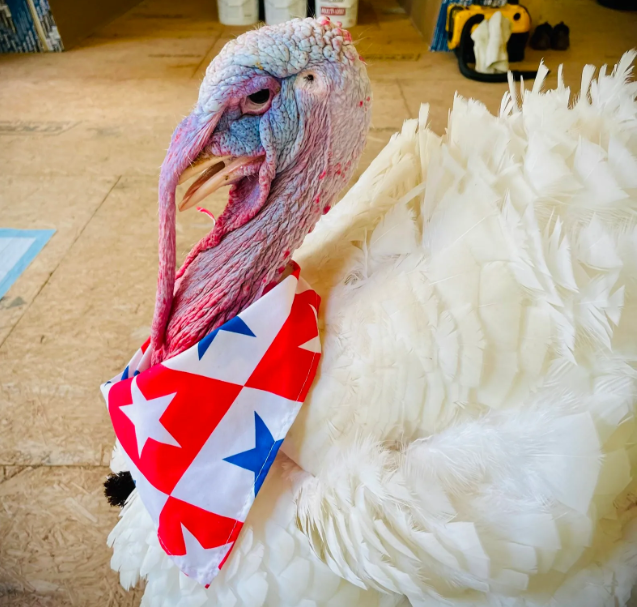
Dave Comer was driving through Lynchburg, Virginia, when he spotted an injured animal lying on the side of the highway.
“I saw it move, so I pulled over,” said Comer, who lives in Washington and owns a farm with his wife in Nelson County, Virginia.
He approached the large, white animal and realized it was a turkey.
“He was busted up pretty bad,” said Comer, who was driving to the farm on May 8 from Charleston, South Carolina, where he had been for work.
Then Comer did what most people probably wouldn’t: “I picked him up and put him in the passenger seat,” he said.
When Comer pulled up at the farm with a 38-pound bird seated next to him, his wife did a double take.
“It was this big, huge turkey,” Christina Gibson-Comer said. “The poor thing looked so sickly.”
The couple believes the turkey — a broad breasted white, the most popular commercial breed — had been on the way to slaughter and somehow escaped a livestock transport truck.
“He jumped off in a valiant effort to free himself,” Gibson-Comer said.
She named the turkey Chester after a character from an old-time radio show she grew up listening to. She recalled a segment in which a family raised a turkey named Chester intending to eat it for Thanksgiving, but they couldn’t bring themselves to go through with it.
“I figured it was perfect,” Gibson-Comer said.
The Comers brought him to their vet and learned he had shattered his left wing and had severe road rash. He also had broken part of his beak. The vet said Chester was about 6 months old.
Initially, the couple planned to care for Chester for a short while until his health improved, and then they would try to rehome him. But they said they quickly became fond of him and decided to keep him. Radio station WVTF covered the story.
“We grew attached to him,” said Comer, who retired from the U.S. Navy in 2007 and now works in the Navy’s aircraft carrier design program.
The couple said they believe Chester had spent his life confined.
“The first time he walked in the barnyard and had grass under his feet, I could just tell that was so new for him,” Comer said.
“He seems really happy,” Gibson-Comer said.
Chester is not the first animal — or bird — the couple have rescued, though he is the first turkey. He is currently their only pet.
“When the Navy took us to Texas, we went with one dog and came back with five,” Gibson-Comer said, noting that they’ve also taken in injured pigeons, a blue jay and a bird of prey. “We are definitely animal people.”
The Comers, who have three adult children, said they were struck by Chester’s personality.
“He is so unique, and he’s so friendly,” Comer said. “He literally follows you around.”
“We were really surprised by how smart he is,” Gibson-Comer added. “He knows his name. He has also learned to ignore us when he wants to, or he’ll have a little tantrum when he doesn’t want to move.”
They can read Chester’s mood based on the color of his caruncles — the fleshy growths on his head and neck, which shift between white, blue and red depending on his emotions. Red tends to indicate excitement or dominance, blue signifies he is calm or content, and white suggests stress or fear.
“When Dave brought him home, he was so sick that his neck and head were really whiteish,” Gibson-Comer said. “As he started getting better, we noticed he was blue and red.”
The couple splits time between the farm and their home in Chevy Chase, occasionally bringing Chester along to D.C. He enjoys watching police chases on TV (he gets particularly excited by the sound of sirens), and he likes getting his neck rubbed by a FedEx driver.
“He’s changed my whole perspective of these kinds of animals,” Comer said. “Whatever we’re doing, he’s got to be in on the action.”
Chester’s vet told the Comers he could live to be 10 years old if he’s well cared for, though domestic turkeys don’t generally live that long. They are prone to health issues because of their large size and tendency to overeat and underexercise. They often suffer from heart disease, joint damage and respiratory failure.
“They’re not bred to live long,” Comer said.
They feed him turkey-specific kibble, along with fruits and vegetables. His favorites are romaine lettuce, watermelon, tomatoes and grapes — which he’ll often steal right from Gibson-Comer’s hand.
“He’s like a toddler,” Gibson-Comer said.
“He’ll go through this foot-stomping routine,” Comer said, adding that “it’s quite funny. He’s really something.”
At the farm, Chester roams free outdoors, but he sleeps inside the house, usually on the floor. His breed can’t fly.
“He’s slow enough that if he starts walking away and won’t come if we call, we can easily get him,” Comer said.
In D.C., Chester indicates he wants a walk by pestering the Comers, grabbing their shoes, phones or tablets until they take him out. The Comers put Chester in a dog harness so they can easily grab him if he walks ahead.
“People stop. They love him. It’s really something different to see,” Gibson-Comer said, adding that several times, strangers have told her they think he’s “gorgeous.”
The couple said having a pet turkey is tough work and not for everyone. House-training a turkey, for example, is virtually impossible.
“It’s never a dull moment,” Comer said.
Still, he said, they have no regrets.
“He just became part of the family. … We love him,” Comer said. “This guy will live with us until the end of his time.”