

The memorandum of understanding between the United States and Iran halted their war and provided a framework for talks over Iran’s nuclear program. Less than a month after it was signed, it has failed, and a document intended to halt a war has instead become a reason for resuming it.
The immediate dispute concerns who controls the Strait of Hormuz, but more is at stake. The collapse of even this minimal understanding could remove the last barrier between episodic confrontation and a forever war.
The memorandum was hardly a peace agreement. It did not reconcile the two countries, resolve their dispute over limits to Iran’s nuclear program or establish a durable regional order. It merely placed a guardrail for a relationship that had fallen into open warfare. If that guardrail gives way, each round of fighting will become the foundation for the next.
Renewed war will not alter the reality that gave rise to the memorandum of understanding in the first place. The United States can inflict devastating damage on Iran, but it cannot eliminate Tehran’s ability to disrupt shipping through the strait. Iran can impose severe economic costs by choking the waterway, but it cannot compel Washington to accept its terms. After more missiles are fired, ships attacked, infrastructure destroyed and civilians killed, the parties will return to the same negotiating table — only angrier and less capable of compromise.
The ostensible cause of the breakdown is the memorandum’s fifth paragraph. It requires Iran to “make arrangements using its best efforts” to ensure safe commercial passage, without specifying whether Tehran was committed to reopening the waterway across the entire strait, including the southern section near Oman, or only to its northern waters. That hedging was good enough to get both sides to sign off on the text, but also fuzzy enough for each side to give it its preferred interpretation. For Washington, the provision reopened the Strait of Hormuz to maritime traffic. For Tehran, it preserved for itself a role in coordinating the passage of every vessel, regardless of the corridor it used.
But imprecise drafting also kept the two countries on a collision course. Tehran believed Washington was using the cease-fire to establish a shipping route through waters along Oman’s coast that would gradually neutralize Iran’s newest and most powerful source of leverage. The United States viewed such a corridor as insurance against another Iranian closure of the strait.
Deepening mistrust also poisoned the negotiations. After both sides resorted to strikes and counterstrikes to stake out their positions, President Trump declared the cease-fire over, threatened to “finish the job” and used language seemingly intended to validate every Iranian suspicion about U.S. intentions. Tehran clearly concluded that renewed war was inevitable and that it had to close the strait to preserve its most valuable asset.
Perhaps Iranian leaders mistook American brinkmanship for a settled decision to return to all-out war. But by acting on that belief, they helped convert fear into fate, unraveling the understandings in less time than it took to reach them. That is how security dilemmas become permanent conflicts: Each side treats the other’s actions as proof of aggression, and its own escalation as an act of defense.
Both countries believe time is on their side. Iran expects oil shocks and market turmoil, as well as the political calendar, to exhaust Washington’s resolve. The United States expects financial attrition and military degradation to exhaust Tehran’s. Neither has a path to victory. Yet each may feel compelled to prove that it can endure more pain than the other.
That is the logic of a forever war: Each side uses violence to test the other’s endurance. War becomes negotiation by other means.
The most plausible offramp is a narrow and temporary modus vivendi over the Strait of Hormuz that gets back to the memorandum. Iran would halt attacks on commercial shipping and accept a transparent notification system of a vessel’s origin, destination and cargo to a joint maritime coordination center administered by Iran and the Gulf states. The United States would commit to upholding freedom of navigation as a general matter, but — for the sake of re-establishing regular flows through the strait — would agree on an interim basis to scale back the use of alternative routes as a mechanism for circumventing Tehran. The Gulf states, of course, will worry that such interim arrangements could become permanent, undermining the principle of freedom of navigation. That is all the more reason for investing in the diplomacy required to reach a more durable arrangement.
It is worth remembering that the United States and Iran are at war over an issue that was not in dispute before the United States and Israel attacked in February. Today’s conflict is not the solution to yesterday’s failure. It is its offspring.
The lesson here is not simply that diplomacy failed. It is that Washington and Tehran treated the memorandum not as a bridge from war to diplomacy, but as an extension of war by other means. If they allow even this modest understanding to disappear, the next cease-fire will become merely the pause before the next battle — and war, rather than diplomacy, could well become the permanent condition.
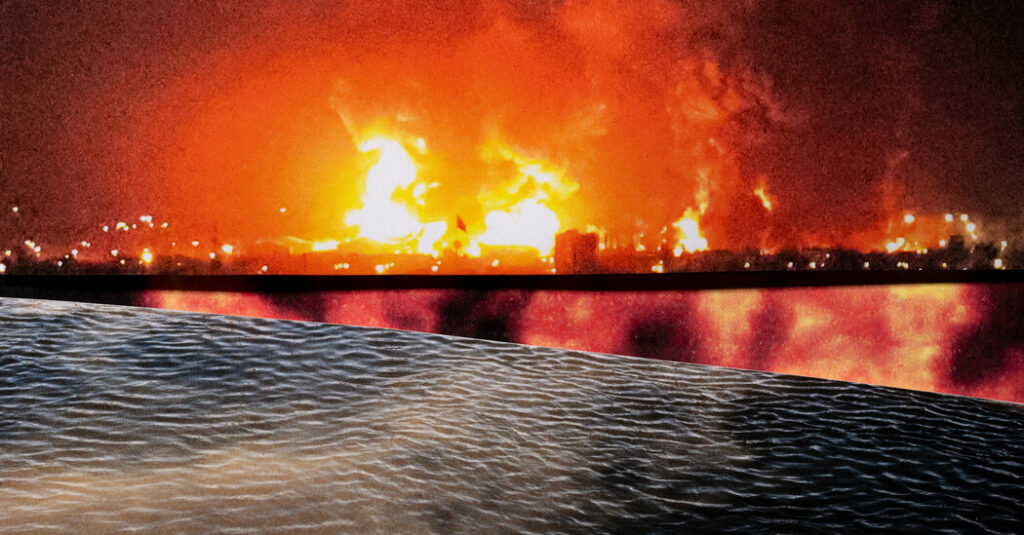
Source photographs by Atta Kenare/Agence France-Presse — Getty Images and Agence France-Presse — Getty Images.
Ali Vaez directs the Iran Project at the International Crisis Group.
The Times is committed to publishing a diversity of letters to the editor. We’d like to hear what you think about this or any of our articles. Here are some tips. And here’s our email: [email protected].
Follow the New York Times Opinion section on Facebook, Instagram, TikTok, Bluesky, WhatsApp and Threads.