

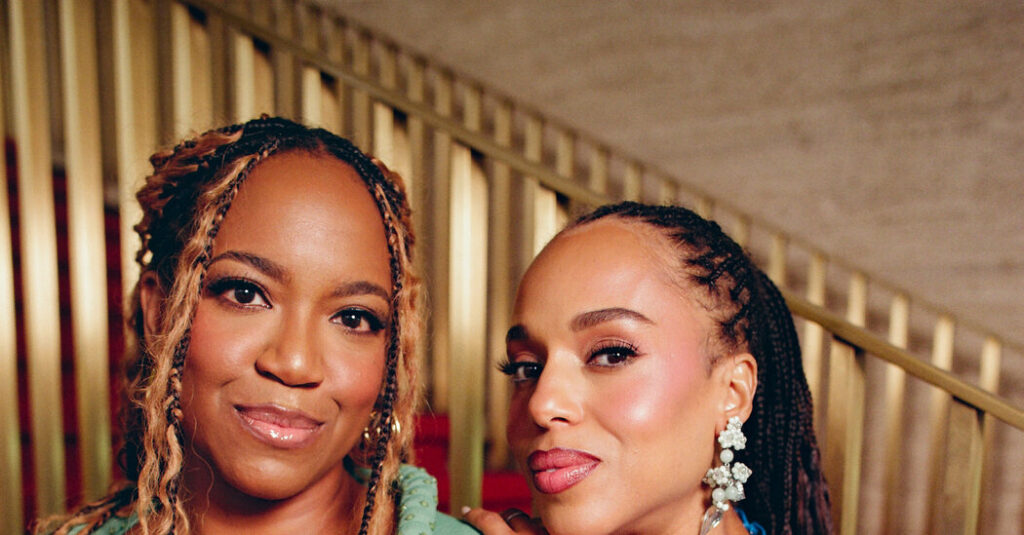
Whoopi Goldberg has been part of the cultural zeitgeist for so long that it can be hard to pinpoint when we first encountered her. That is not the case for Kerry Washington, who was an 8-year-old living in the Bronx when she became captivated by Goldberg and her early monologues. After watching the 1985 HBO special “Whoopi Goldberg: Direct From Broadway” with her mother, Valerie, she recently recalled, she would walk around her home reciting the lines — even the expletives.
“It really changed my idea of what acting was,” Washington said in interview earlier this month at Lincoln Center Theater, where she is starring in a revival of Goldberg’s 1984 Broadway show. “As a young child, I understood that she was doing a magic trick, and not just in what she was able to embody and express, but in how she moved her audiences.”
And if you ask Goldberg, she can recount the moment when she felt her talent was recognized: It was in October 1984, when her self-titled, one-woman show debuted on Broadway.
The show, in which Goldberg played six different characters, was directed by Mike Nichols, who had attended an Off Broadway version of it one year earlier — when it was called “The Spook Show” — at the Dance Theater Workshop. “I’ve never seen anyone like her,” he told The New York Times in 1984.
He was so moved by her performance that he was determined to take it to Broadway. She was “one part Elaine May, one part Groucho, one part Ruth Draper, one part Richard Pryor and five parts never before seen,” he also told The Times reporter for an article about the production. He later had it filmed for HBO as “Whoopi Goldberg: Direct From Broadway.”
More than 40 years later, audiences are being reintroduced to Goldberg’s boisterous characters via the director Whitney White (“Liberation”), who has revived the original show as “The Whoopi Monologues,” now starring Washington (who is also a producer), Kara Young, Dominique Fishback, Kecia Lewis and Danielle Pinnock. White adapted the new script from several versions, including the original Broadway production, which ran at the Lyceum Theater, and the 2005 HBO special “Whoopi: Back to Broadway — the 20th Anniversary.”
The theatrical return not only highlights Goldberg’s enduring comedic chops but also showcases her versatility as a playwright with a deep empathy for everyday people often lost to stereotype. Some of the characters include Fontaine, a drug addict with a Ph.D. in literature from Columbia who roams museums in Amsterdam; Surfer Girl, a young woman whose constant upbeat “valley girl” persona masks her trauma from a botched abortion; and Lurleen, a woman from the Deep South who is struggling with menopause.
“Originally, I wrote those people so I could get jobs,” Goldberg said in a phone interview while in Sicily, Italy. “People would pat me on my head and go, ‘Well, that’s very nice, but thank you.’” So she decided to shift gears. “I thought, well, I know what to do. I’m going to show what my brain can do.”
She continued: “And then people began to like the monologues.”
Goldberg also attributes the show’s success to Mel Gussow, the longtime Times theater critic whose glowing review of the early version of her solo show prompted Nichols’s curiosity about her in the first place. “Quickly we realize that Miss Goldberg is not simply a stand-up comedian,” Gussow wrote, “but a satirist with a cutting edge and an actress with a wry attitude toward life and public performance.”
Of Gussow, she said, “If I had been married to him, I could not have gotten a better review.” Once Nichols gave her his support, he became her lifelong mentor and friend. “Mike made it very clear that I was capable of all things,” she said. “One of the great joys of life is that whatever doubts come in from time to time about what one is able to do, you remember the people that told you first, ‘I see you, and I’m walking you in here.’
“All of that is wrapped up in that show,” she said.
Goldberg’s blend of poignancy, familiarity and political comedy resonated with Washington, who was then inspired by the link between art and activism that has guided her in her career. “She’s a trailblazer because nobody was talking about menopause 20 years ago in this way,” Washington said. “Especially not Black women.”
Even as a young girl, Washington said, “I could feel that she was taking on characters that were invisible in culture and society, but also characters that I knew. I knew Fontaines. I had Fontaines in my family. And I knew Jamaican Lady. My grandmother immigrated to this country through Ellis Island from Jamaica.”
Still, it was only after meeting Goldberg while filming “For Colored Girls,” Tyler Perry’s 2010 adaptation of Ntozake Shange’s 1975 choreopoem “For Colored Girls Who Have Considered Suicide / When the Rainbow Is Enuf,” that she began to realize she wasn’t alone. A generation of fellow Black actresses had also been inspired by Goldberg’s show.
“Anika Noni Rose and I had never had this conversation, but we were both like, ‘Whoopi, we just need to tell you the impact that this show had,’” Washington said, recalling a conversation she had on set with her co-stars. “And then Anika and I both started reciting monologues from the show to her.”
Washington soon found others, like Tracee Ellis Ross (“Black-ish”) and Robin Thede (“A Black Lady Sketch Show”), who felt similarly indebted to Goldberg. “It wasn’t just me in my living room reciting these monologues, it was all these girls,” Washington said. “So hearing these stories, I was like, There’s a community of women who feel this way about this woman, and we should resurrect this work in her honor. She deserves it.”
From there, Washington (with her production company, Simpson Street) recruited a creative team led by White, who would adapt the piece for a contemporary audience.
“My first pitch was to really honor what’s been written,” White said. “When you look at the material on the page, it’s an excellent play and I don’t think the world has gotten to know Whoopi Goldberg as a playwright.”
Seeking to update the show, while adhering to Goldberg’s perspective, White expanded it for an ensemble. “In casting five women, it means that the magic trick of the show is no longer about watching one woman change props and change hats and be fluid in that way,” White said. “Now the magic trick of the show is how deep can the portrait of humanity get? I want to go as deep as I can on each character to understand who they are, where they’re coming from and what they have to say.”
The result is twofold. Goldberg’s characters mainly reveal the diversity of Black women’s identities. At the same time, having five different actresses perform these roles heightens the sense of multiplicity and helps convey an intergenerational dialogue between Black women, which remains far too uncommon in American theater. Through this showcase, Washington and White hope that Goldberg’s script will formally become part of a pantheon.
“Every time you do a revival, you’re solidifying a story in our collective conscience for the next 10 years,” White said. “What Whoopi accomplished here in a literary, dramaturgical and playwriting way deserves to be canonized, republished, and people need to start doing it all over.”
Goldberg has revisited many of these characters over the years, including in “Whoopi Goldberg: Fontaine … Why Am I Straight?” (1988) and in her 2005 HBO special. “It was just about having them continue to live,” she said. “They pop up and tell me stuff from time to time and they say, ‘Well, let’s talk about some new stuff.’”
She has been pretty hands-off with this production, hoping the cast will fully immerse themselves in the material.
“I’m excited to see what people do and how they relate to them,” she said. “I mean, they’re these kind of great weird people.”