

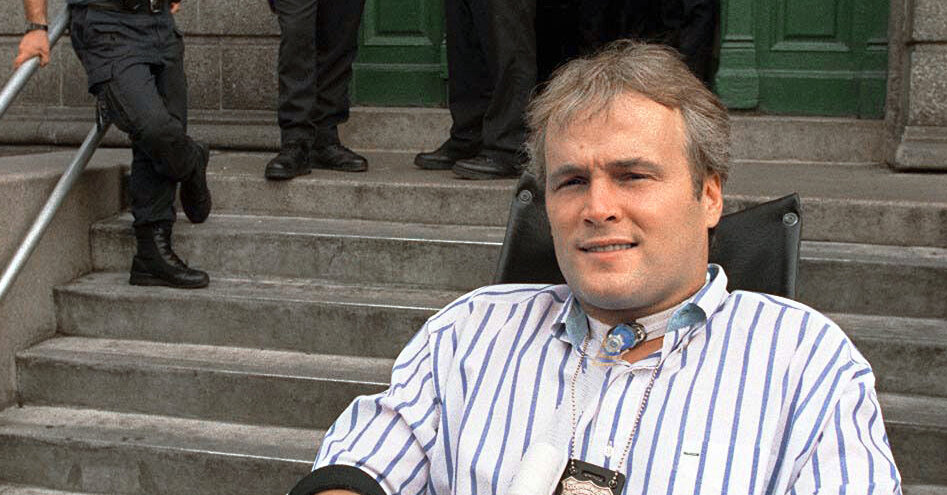
Officer Steven McDonald could not move or speak.
He had been lying in a bed at Bellevue Hospital in Manhattan for nearly nine months, recovering from gunshots that had severed his spinal cord and left him paralyzed from the neck down. Shavod Jones, the 15-year-old boy who had shot him on July 12, 1986, was behind bars.
Officer McDonald’s one-month old son, Conor, was about to be baptized in the hospital chapel in front of reporters and news photographers.
Officer McDonald was eager to send a message to the teenager who shot him. But all he could do was mouth his words, which his wife, Patti Ann McDonald, wrote down.
“I’m sometimes angry at the teenage boy who shot me, but more often I feel sorry for him,” Ms. McDonald said, reading his words to reporters, as his respirator wheezed in the background. “I forgive him.”
That message, delivered in March 1987, moved New York in an era when violent crime was rampant and racial tension and anti-police sentiment were prevalent. For the next 30 years, Officer McDonald traveled throughout the city and around the world, telling police officers, school children and politicians his story and asking them to believe in the power of compassion. He died in 2017 of complications from his injuries. He was 59.
Earlier this month, the New York Police Department named its academy in Queens after him. Replicas of his shields and his uniform, along with his wheelchair and respirator, are now encased behind glass in the lobby. “Detective Steven D. McDonald” — he was promoted in 1995 — is affixed in white letters in the front of the steel gray building.
Commissioner Jessica S. Tisch said she came up with the idea in January, while sitting in St. Patrick’s Cathedral, where, during a memorial for him, “God spoke to me.”
“This department needed to find a permanent way to honor Steven McDonald and ensure that his example would remain part of the N.Y.P.D. for generations to come,” she said during a ceremony at the academy, where Ms. McDonald and Conor McDonald, now a captain in the Police Department, sat close by.
Ms. McDonald was three months pregnant with Conor when her husband, then 29, went into the northeast section of Central Park on a July afternoon to investigate reports of bicycle thefts.
He approached Shavod who was walking with two friends near the Harlem Meer, an artificial lake in Central Park where muggings and thefts were commonplace at the time.
As Officer McDonald began patting down one of the boys, Shavod pulled out a gun and fired three shots.
Officer McDonald’s injuries were so severe that doctors said he would not survive the night. Then, they told him he should not expect to live more than five years.
Soon, they stopped making predictions, Captain McDonald, 39, said in an interview.
Ms. McDonald said some people questioned her husband’s decision to forgive Shavod, but she believes it might have saved his life.
“If he hadn’t, it would have destroyed him from the inside out,” Ms. McDonald said.
He recovered enough to speak again and he remained employed at the department, becoming a sort of ambassador, talking to officers at roll calls, attending memorials and vigils for fallen officers, and traveling to Israel, Northern Ireland and Bosnia. He met with Pope John Paul II and Nelson Mandela, and was interviewed by Barbara Walters.
In 1988, he sent a package to Shavod, who was in prison. Inside was a box of stationery, stamps and a note: “Let’s carry on a dialogue.”
In 1990, Mr. Jones called Officer McDonald at his home in Malverne, N.Y., on Long Island, and apologized.
But forgiveness took the relationship only so far.
When he was up for parole, Mr. Jones’ family asked Officer McDonald if he would be willing to ask for his early release.
Officer McDonald told them he could not.
His father, Captain McDonald said, felt that Shavod had to do his time.
His father hoped that when Mr. Jones got out, the two would team up and preach a message of peace.
“I don’t think we’ve ever seen anything like what I envision — the two of us, together,” he told the Los Angeles Times in a March 1995 interview. “Maybe Shavod and I will go to schools together and speak to kids. It’d be an amazing sight.”
He never got that chance.
Shortly after the interview, Mr. Jones was released. Three days later, he was killed in a motorcycle accident in East Harlem.
Conor McDonald, then 8, stood up in front of his third grade class and asked the other students to pray for Mr. Jones.
“My dad would always tell me that compared to Shavod, my life was very good and that we had to feel sorry for him,” Captain McDonald said. “I felt compelled as a young kid to forgive him and ask my classmates to forgive him.”
After Captain McDonald graduated from Boston College, he volunteered with homeless teenagers in Denver before joining the Police Academy. His father beamed with pride.
“I, on the other hand, was like ‘Are you kidding me?’” Ms. McDonald said. “My plan was for him to work at a friend’s law firm and then go to law school.”
But the job felt like a calling and a legacy. His great-aunt, uncle and grandfather had also been New York police officers. His great-grandfather, James Conway, was an officer in the Bronx when he was shot in 1936 in the chest trying to stop two men who had just held up a tavern. Officer Conway survived.
Steven McDonald prayed constantly that he might walk again. He went to Catholic Mass daily and visited Lourdes, France, and Medjugorje in Bosnia, pilgrimage sites where children claimed the Virgin Mary had appeared to them. At both places, he asked for a miracle.
But he did not become embittered, his son said. “He never once regretted becoming a police officer.”
Georgia Gee and Sheelagh McNeill contributed research.